One Community
World-Changing Ideas – One Community Weekly Progress Update #668
At One Community, we are championing world-changing ideas through the hands-on demonstration of open source DIY Highest Good living. Built entirely by an all-volunteer team, we design and freely share sustainable solutions for food, energy, housing, education, economics, and social architecture as part of an evolving, self-replicating model. This work is intended to grow into a global network of teacher/demonstration hubs that support fulfilled living, global stewardship practices, planetary regeneration, and the creation of a world that works for everyone, always for The Highest Good of All.
- Here’s our project overview
- Here’s our world-change methodology
- Here’s how this becomes self-replicating
- Here’s how we are open source and free-sharing all the do-it-yourself designs
OUR MAIN OPEN SOURCE HUBS
Click on each icon to be taken to the corresponding Highest Good hub page.
One Community’s physical location will forward this movement as the first of many self-replicating teacher/demonstration communities, villages, and cities to be built around the world. This is the January 5, 2026 edition (#668) of our weekly progress update detailing our team’s development and accomplishments:
World-Changing Ideas
One Community Progress Update #668

DONATE | COLLABORATE | HELP WITH LARGE-SCALE FUNDING
CLICK HERE IF YOU’D LIKE TO RECEIVE AN EMAIL EACH WEEK WHEN WE RELEASE A NEW UPDATE
YOU CAN ALSO JOIN US THROUGH SOCIAL MEDIA


ONE COMMUNITY WEEKLY UPDATE DETAILS
HIGHEST GOOD HOUSING PROGRESS
One Community is championing world-changing ideas through Highest Good housing that is artistic and beautiful, more affordable, more space efficient, lasts longer, DIY buildable, and constructed with healthy and sustainable materials:
- Learn about: Our Upcoming Crowdfunding Campaign
- Learn about the different village models and world-changing ideas: 7 Sustainable Village Models
- Visit the open source portals for the first two: Earthbag Village OS Hub | Straw Bale Village OS Hub
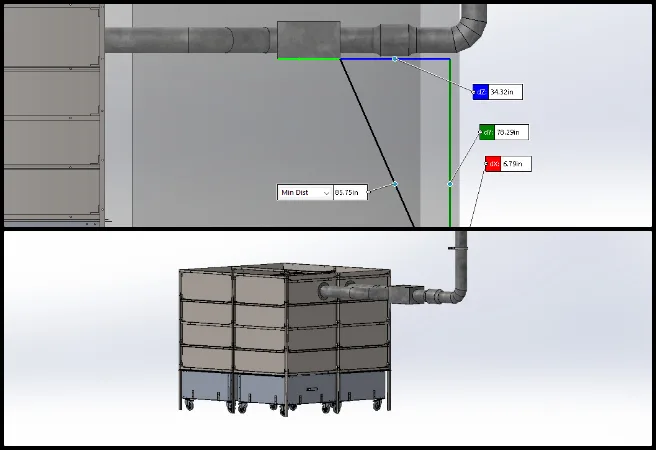
This week, Ajay Adithiya Kumar Elancheliyan Tamilalagi (Mechanical Engineer) continued working on the ventilation system design for the Vermiculture Toilet component of the Earthbag Village. He worked on several components of the Earthbag Village project, beginning with evaluating HVAC duct suspension options and identifying a cost-effective solution using galvanized threaded rods with angle-iron trapeze hangers. He then completed a report summarizing the modeling approach, loading assumptions, and results from recent calculations and simulations, preparing it for submission. Ajay updated the full CAD model based on feedback from Malhar and Jae, incorporating all required adjustments. He also improved clarity, structure, and technical accuracy across the Unistrut Assembly documentation by refining explanations, formatting, and supporting details. In addition, Ajay resolved issues related to missing CAD files, reorganized the file structure to support easier access for future contributors, cleared multiple SolidWorks warnings and errors, and continued refining project reports. His detailed engineering work contributes to world-changing ideas through practical, open-source system development. Below, you’ll find some images of this work.
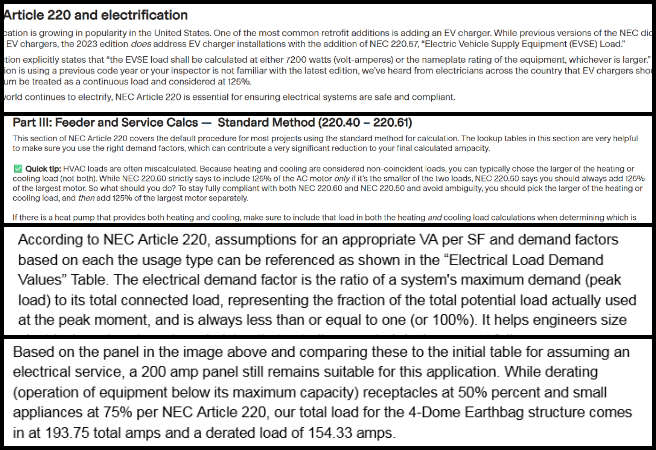
Derrell Brown (Plumbing Designer) continued working on the Earthbag Village 4-dome home final MEP report by addressing feedback from the initial draft and applying revisions across the electrical sections to improve clarity and consistency. He revisited electrical content previously incorporated into the report and reorganized portions to better align definitions, assumptions, and terminology with the intended level of technical detail. Updates included refining explanations of electrical concepts, adjusting language to reduce ambiguity, and clarifying technical jargon through reference to applicable provisions of the National Electrical Code. His refinements support world-changing ideas by improving accessibility and accuracy in technical documentation. See below for some of the pictures related to this work.
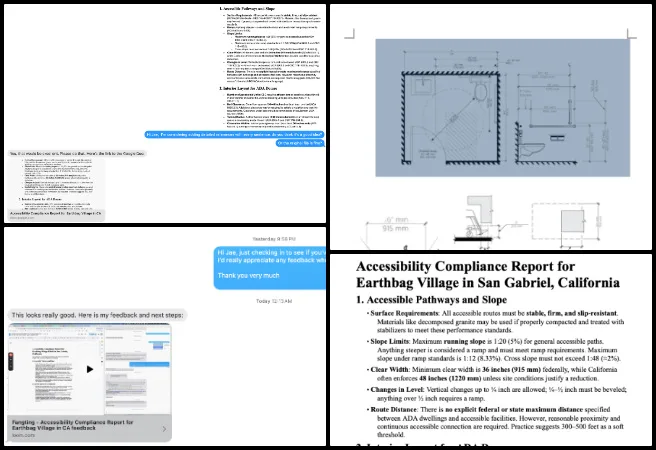
Fangting Xu (Interior Design Intern) continued working with ADA codes related to building connections for the ADA 3-dome cluster of the Earthbag Village. She refined the ADA compliance summary for the Earthbag Village by clarifying the scope, organizing requirements, and adding cited references with linked source documents. The update is based on federal ADA guidelines, CBC chapters, and applicable local standards, and was organized for review and incorporation into the construction documents. Her structured approach supports world-changing ideas through inclusive and compliant design practices. See below for some of the pictures related to this work.
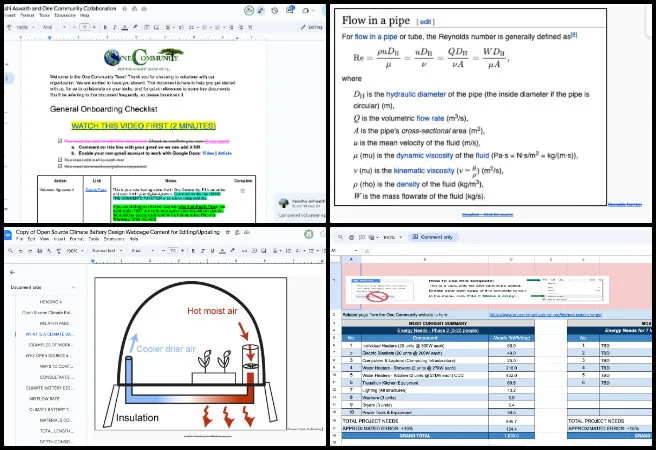
Iteesha Vishalakshi Aswath (Technical Program Manager) completed initial onboarding and training activities related to becoming a One Community administrator and spent the remainder of the time reviewing technical source material required to begin cost and needs analysis. The primary focus was a detailed review of the Open Source Climate Battery and Highest Good Energy report content to understand system scope, design assumptions, engineering calculations, and cost drivers. This included reviewing climate battery concepts, design elements, airflow and ventilation requirements, tubing materials and dimensions, burial depth considerations, soil thermal properties, insulation strategies, fan selection criteria, controls and automation approaches, and heating and cooling methodologies. This foundational review supports world-changing ideas by enabling informed planning and analysis of regenerative energy systems. Based on this work, Iteesha developed the background knowledge needed to identify inputs, dependencies, and assumptions that form the basis of cost and needs analysis for the Climate Battery and energy components. See below for some of the pictures related to this work.
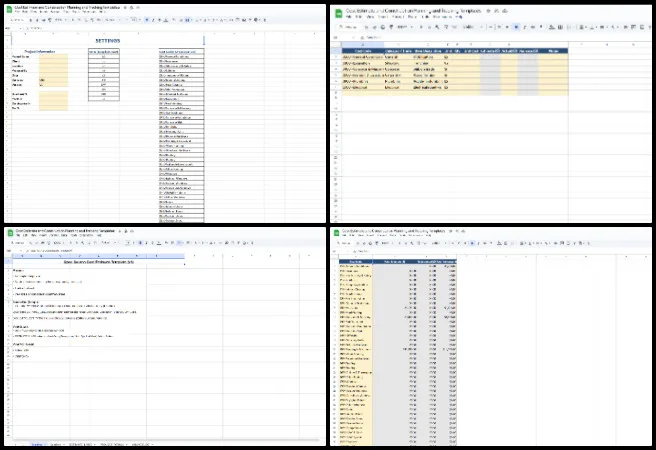
Kaustubh Kadam (Construction Engineering and Management Professional) worked on cleaning and improving the formulas in the Highest Good housing cost estimation template and started building the planning and tracking template. He created and organized several planning sheets, including a task sheet, lookahead schedule, and daily log, and identified additional sheets that could support tracking and reporting. He also researched and began adding practical formulas to make the templates easier to use and reduce manual entry. Kaustubh continued refining both templates by improving layout, adjusting sheet structure, and adding information where needed to enhance usability and consistency. His work contributes to world-changing ideas by strengthening scalable project planning and execution tools. See below for some of the pictures related to this work.
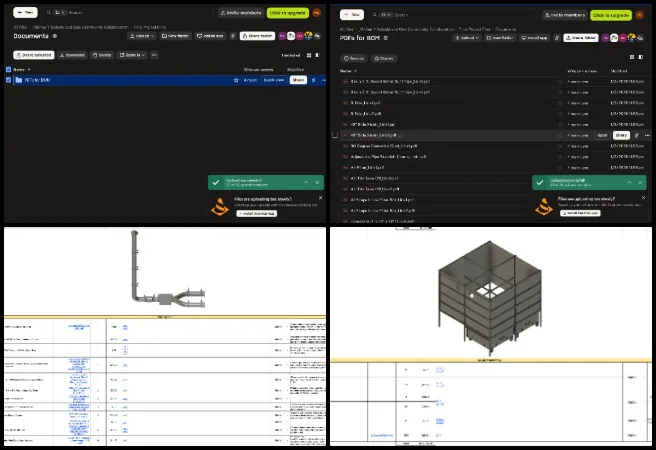
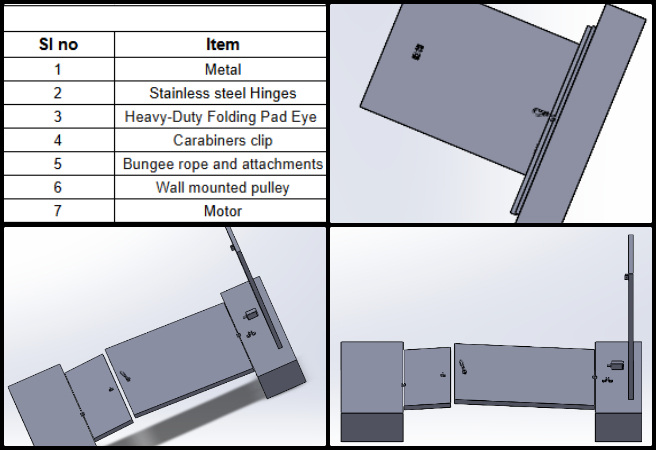
Malhar Solanki (Mechanical Engineer) continued working on the Vermiculture Toilet component of the Earthbag Village. He completed and refined the Bill of Materials and related documentation. This work included completing the PDF collection for the BOM, updating images to align with the latest model, and creating STEP files to support easier viewing during structure construction and assembly. The BOM was submitted to Jae for review, updated based on team feedback, and adjusted to reflect requested changes. Additional content was added to the report, and preparation continued for further report development. His documentation efforts reinforce world-changing ideas by enabling clear, replicable, and open-source engineering workflows. After incorporating Jae’s feedback, the BOM was updated, and PDFs were created for the associated references. The revised BOM was then shared with other team members for a second review to confirm accuracy and consistency. A weekly mechanical team meeting was held to discuss next steps and share the completed BOM with the group. Review the latest updates in the images below.
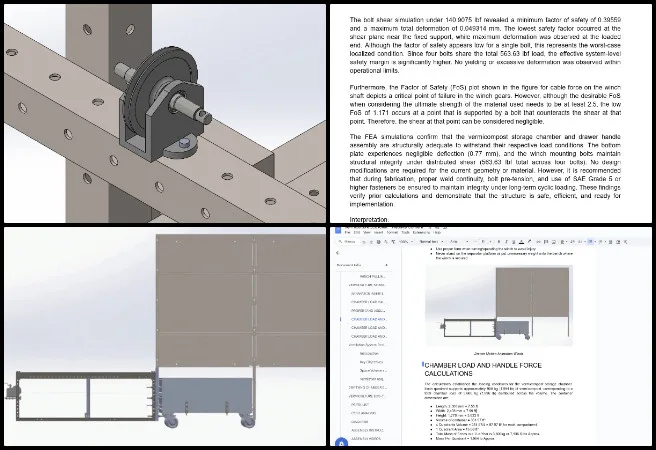
Rishi Chakrapani (Mechanical Engineer) continued working on the Vermiculture Toilet. His work focused on completing reports that received feedback from Jae, with revisions made to address the noted comments and requirements. This week, the animation showing the drawer being pulled out was added to the report, and progress continued on the animation depicting the slider being actuated by the same winch. The CAD files referenced during the weekly meeting were also reviewed, and updates were made to address interference constraints identified during that discussion. His detailed refinements support world-changing ideas through improved clarity and shared technical understanding. See below for some of the pictures related to this work.
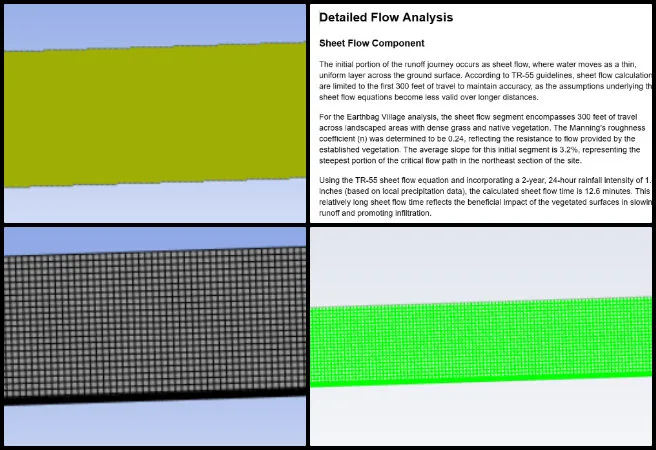
Sai Bhuvanesh Nandipati (Mechanical Engineer) focused on understanding the scope of the assigned work and clarifying the technical expectations associated with the project. He reviewed and interpreted the LEED strategies applied to the Earthbag Village model to understand their intent and relevance to the analysis. In parallel, he initiated the setup of a flow analysis model in ANSYS Fluent, establishing the required geometry, boundary conditions, and solver framework. The simulation work progressed to the physics setup stage, where governing models, material properties, and relevant flow assumptions were defined. His early technical groundwork supports world-changing ideas through data-driven sustainability analysis. See below for some of the pictures related to this work.
DUPLICABLE CITY CENTER PROGRESS
One Community is championing world-changing ideas through a Duplicable and Sustainable City Center that is LEED Platinum certified/Sustainable, can feed 200 people at a time, provide laundry for over 300 people, is beautiful, spacious, and saves resources, money, and space:
- Learn about this building and it’s function and world-changing ideas: Duplicable City Center Open Source Hub
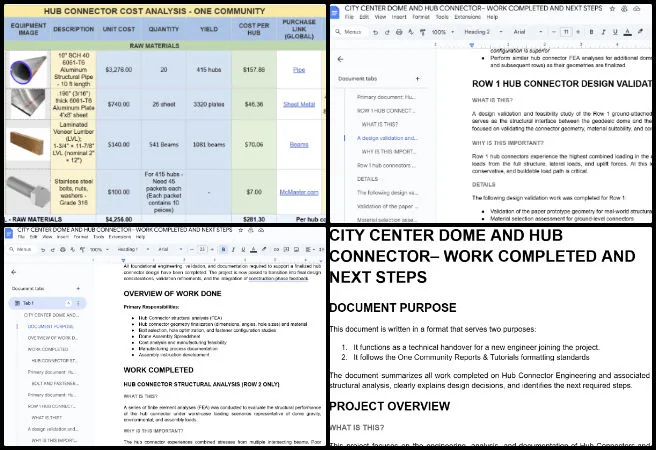
This week, Ayushman Dutta (Mechanical Engineer) continued working on the City Center Dome Hub Connector Engineering and DIY manufacturing. He reviewed feedback for the report and made corrections to the overall structure of the hub connector documentation. His focus included resolving issues in the manufacturing and assembly process documents by attaching source images and links and reformatting the material for improved clarity. Ayushman addressed feedback received for the work structure document and also contributed to the overall dome structure cost analysis. He completed the work structure report and corrected formatting errors in the manufacturing and assembly documents to ensure that all documentation met project standards and requirements. This open source Duplicable City Center project demonstrates how to develop and champion world-changing ideas. Review the connector analysis visuals below for more details.
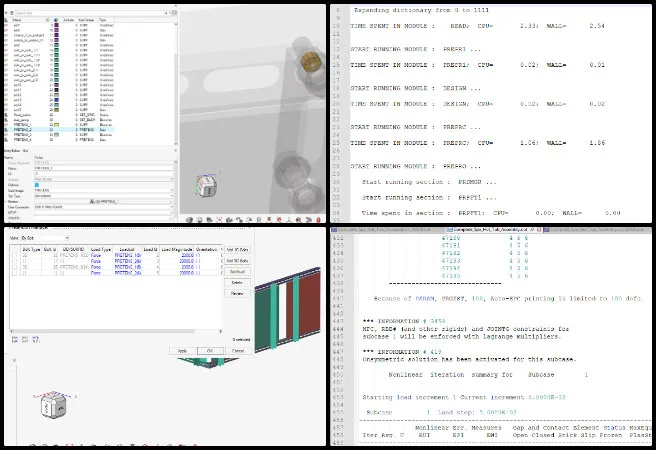
Sandesh Kumawat (Mechanical Engineer) continued developing the City Center Eco-spa Designs. He focused on troubleshooting convergence issues in the structural simulations while documenting progress for Jae through a structured status report. His investigation addressed solver instability related to contact gaps, incorrect or inconsistent element type assignments, and incomplete bulk data entries, along with a review of solver warnings to isolate root causes. To resolve these issues, Sandesh refined contact definitions, corrected element formulations where required, and verified material cards, boundary conditions, and load definitions against solver requirements. He also referenced solver manuals and best practice guidelines to validate modeling assumptions and convergence controls, documenting corrective actions and open items for traceability. The updated report captures current findings, decisions taken, and remaining risks to guide the next iteration toward a stable, converged solution. Discover One Community’s open source Duplicable City Center, which demonstrates the process of championing world-changing ideas. See the visuals below for a closer look.
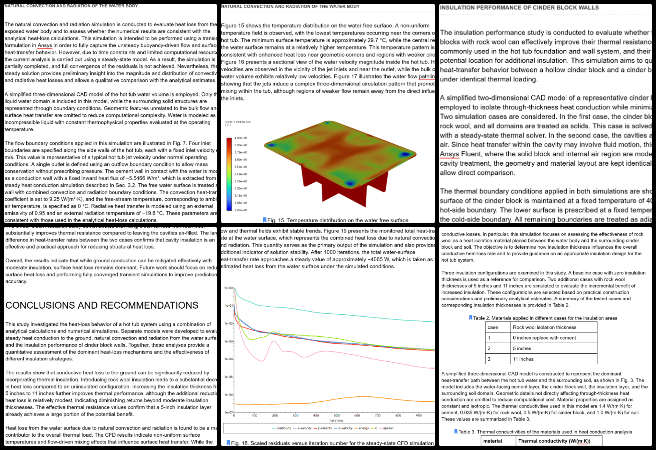
Shivarama Krishna Revanuru (Mechanical Engineer) continued working on the Duplicable City Center design. He focused on understanding assigned responsibilities related to finite element analysis and cost analysis, including the scope of work, expected deliverables, and how these tasks align with broader project objectives. Time was spent conducting cost analysis activities, identifying relevant cost components, organizing data inputs, and reviewing assumptions to ensure alignment with project requirements. In parallel, discussions were held with a teammate to clarify roles, coordinate efforts, and exchange information related to both the finite element analysis and cost analysis tasks. This open source Duplicable City Center project demonstrates the process of championing world-changing ideas. The images below illustrate aspects of this work.
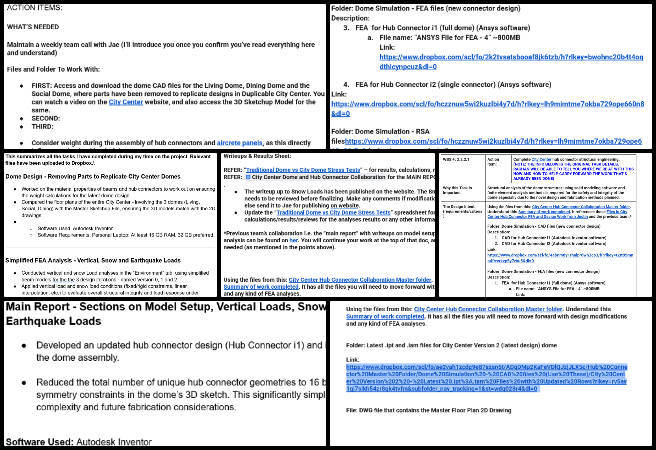
Srujan Pandya (Mechanical Engineer) continued his work on developing the dynamic simulation setup for earthquake analysis updates for the City Center Dome Hub Connector Engineering. He focused on consolidating documentation and improving accessibility of the FEA-related work for the updated City Center dome. Srujan reviewed and refined the main report, adding summaries and linking relevant supporting documents to enhance clarity and traceability. He completed and standardized the spreadsheets used for part counting and verification, ensuring that references, comments, and results were consistent throughout. He also organized and uploaded dome files to the correct folders and prepared a clear background summary explaining the project context and progress to support onboarding of new team members and future updates to the project webpage. The Duplicable City Center champions world-changing ideas through accessible open source solutions designed to guide people. The images below illustrate aspects of this work.
Tianxiang Huang (Mechanical Engineer) continued working on the Duplicable City Center design. He completed all remaining documentation and organized project materials in preparation for handover. Tianxiang placed the finalized files into the shared Dropbox folder, including a Word document and an Excel file converted from the original Google Docs and Google Sheets formats. He also created a text file to record file-sharing information for reference. In addition, he organized the ANSYS simulation archive files and uploaded them to the same folder to ensure that simulation data, models, and results are clearly structured and accessible. This open source Duplicable City Center project contributes to championing world-changing ideas. For more details, refer to the image below.
HIGHEST GOOD FOOD PROGRESS
One Community is championing world-changing ideas through Highest Good food that is more diverse, more nutritious, locally grown and sustainable, and part of our open source botanical garden model to support and share bio-diversity:
- Learn about the structures and world-changing ideas: Hoop House Hub | Aquapini & Walipini Open Source Hub
- See what we’ll be growing: Gardens & Hoop Houses | Large-scale Structures | Food Forest | TA
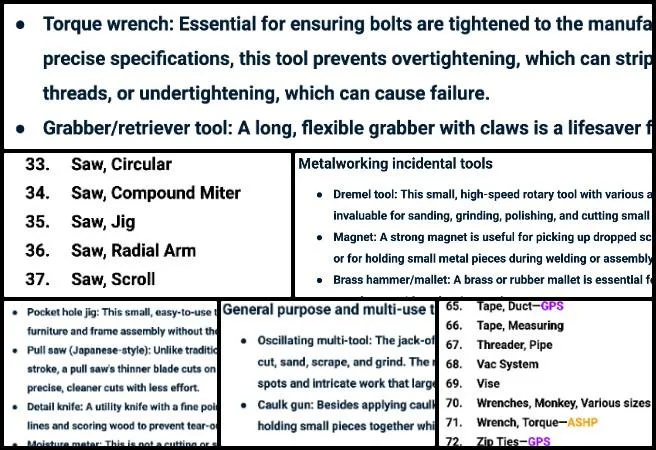
This week, the core team continued working on the Master Tools, Equipment, and Materials and Supplies List for the Large-scale Garden, Botanical Garden, and other Highest Good Food components. The team integrated items across numerous project documents. This work involved adding sandpaper to all projects utilizing orbital sanders, incorporating additional spirit levels, and placing metal and wood lathes and monkey wrenches into the appropriate woodshop and metal shop documents. In addition, a general storage inventory was included within the shop documentation, and a process was initiated to color-code all shop entries to distinguish between the automotive shop (ASHP), general storage inventory (GSI), metal shop (MSHP), and wood shop (WSHP). The Highest Good Food initiative is a key component of One Community’s open source plans, focused on world-changing ideas and exemplifying the organization’s commitment through innovative design and implementation. Below are some images showcasing this work.
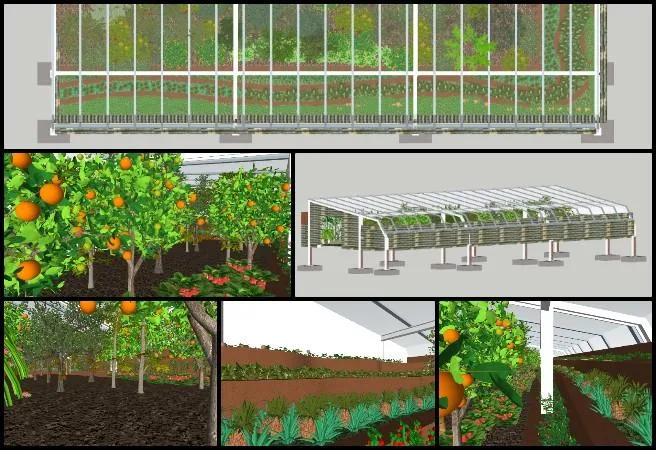
Japneet Kour (Volunteer Architect) continued contributing to the Highest Good Food initiative. She worked on completing the 3D model of Walipini 3, the tropical house, and added all plants, trees, and shrubs based on the tropical environment described in the report. Vegetation was arranged to represent plant types suitable for a tropical climate, with consideration given to spacing, size, and placement relative to the house and surrounding areas. All elements were positioned to align with realistic growth patterns and the environmental conditions described in the report. The Highest Good Food initiative is a key part of One Community’s open source platform, focused on sustainable and participatory development while supporting world-changing ideas. Visual examples from her work are presented below.
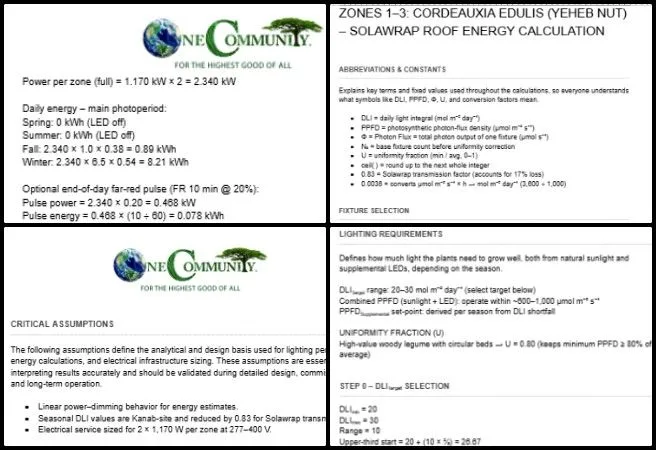
Jay Nair (BIM Designer) continued developing the Aquapini and Walipini Planting and Harvesting documents. Jay worked on standardizing the document containing lighting energy calculations for Walipini 1, ensuring that the data structure, formatting, and terminology were consistent with project documentation requirements. The updated calculations and organized datasets were prepared to support future development efforts, with the intent that this information informs the design of calculator software aimed at simplifying and streamlining lighting energy calculations for similar greenhouse projects. The Highest Good Food initiative is a key part of One Community’s open source platform, focused on sustainable and participatory development while supporting world-changing ideas. See below for pictures related to this work.
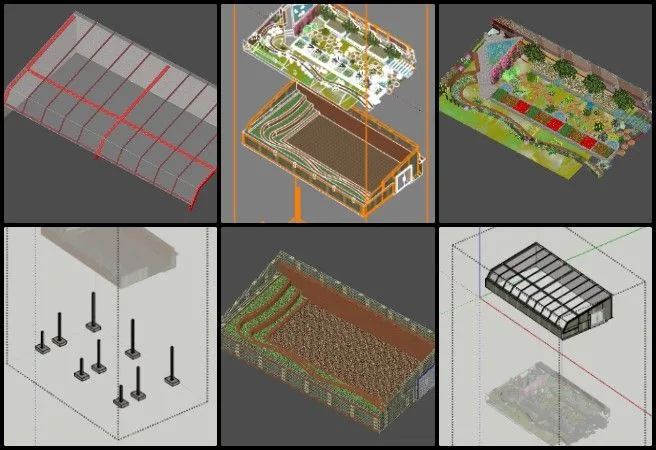
Nitin Parate (Architect) continued contributing to the Aquapini and Walipini renders and layout graphics. His work focused on developing the axonometric graphical representation of the Zen Aquapini. Updates were made to improve visual clarity, alignment, and overall composition while maintaining consistency with the design intent. Adjustments helped better communicate spatial relationships and system components within the axonometric view. Ongoing efforts involved refining visual elements to enhance readability and accuracy. The next stage includes post-production tasks, adding explanatory text within the axonometric drawing, and preparing supporting sectional details to clearly convey design and system information. The Highest Good Food initiative is a key part of One Community’s open source platform, promoting regenerative and participatory development while supporting open source world-changing ideas. Images below showcase his contributions.
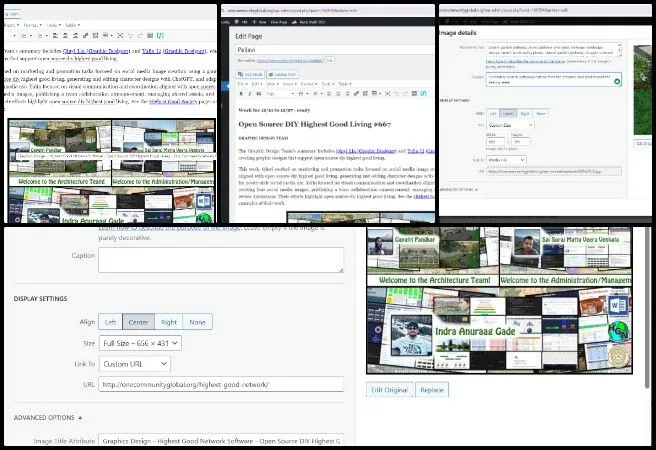
Pallavi Deshmukh (Software Engineer) continued working on the Aquapini and Walipini Planting and Harvesting web details. She developed new content for blog 667 and collaborated with teammates by considering their suggestions and applying feedback to maintain clarity and consistency in the final version. Pallavi continued integrating Walipini 1 and Zen Aquapini 1 material from Gayatri’s work into the Aquapini and Walipini Planting and Harvesting page, edited images to meet stated inclusion requirements, checked the full page using Jae’s feedback, and submitted the page for review. open source objectives, the Highest Good Food project integrates world-changing ideas into a larger vision of regenerative living. Her contributions are highlighted in the collage below.
HIGHEST GOOD ENERGY PROGRESS
One Community is championing world-changing ideas through Highest Good energy that is more sustainable, resilient, supports self-sufficiency and includes solar, wind, hydro and more:
- Learn about the open source sustainable-energy foundations: Solar, Hydro, and Wind
- Explore our research into the most sustainable products and companies for saving water and energy and world-changing ideas: Insulation, Eco-laundry, Lightbulbs and Light Bulb Companies, Doors and Door Companies, Windows and Window Companies, Toilets, Faucets and Faucet Accessories, Urinals, and more.
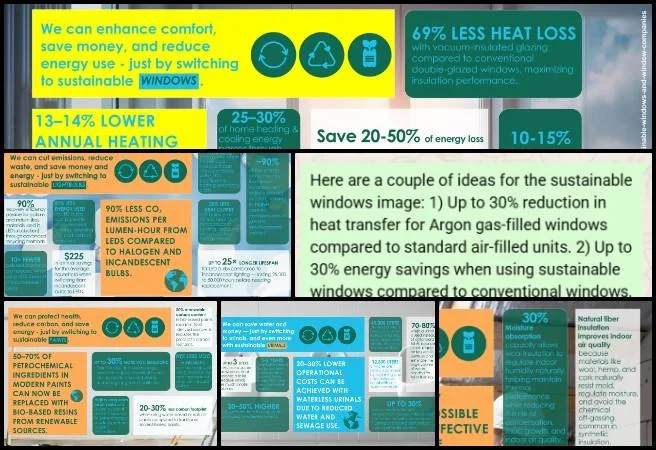
This week, the core team continued contributing to the Highest Good Energy initiative. They examined the Hub Connector Manufacturing and Assembly document, providing comments on areas where changes could improve clarity and usability, and making formatting edits where consistency or layout issues were identified. In addition to the document review, the team reviewed a set of images related to sustainable building elements and provided feedback on selection and presentation for windows, lighting, insulation, paints, and urinals, with a focus on relevance and alignment with sustainability criteria. The Highest Good Energy initiative plays a leading role in One Community’s open source platform by promoting sustainable and participatory development, focused on world-changing ideas. Below are images related to this project.
HIGHEST GOOD EDUCATION PROGRESS
One Community is championing world-changing ideas through Highest Good education that is for all ages, applicable in any environment, adaptable to individual needs, far exceeds traditional education standards, and more fun for both the teachers and the students. This component of One Community is about 95% complete with only the Open Source School Licensing and Ultimate Classroom construction and assembly details remaining to be finished.
With over 8 years of work invested in the process, the sections below are all complete until we move onto the property and continue the development and open sourcing process with teachers and students – a development process that is built directly into the structure of the education program and everything else we’re creating too:
- Program Overview: Education Open Source Hub
- How the components work together in designing human orchestrated eco-abundance: How to use the Education for Life Program
- Lesson Plans for Life – Lesson Plans How-to
- Foundations of Outstanding Leaders, Teachers, and Communicators
- Curriculum for Life
- Teaching Strategies for Life
- Learning Tools and Toys for Life
- Evaluation and Evolution
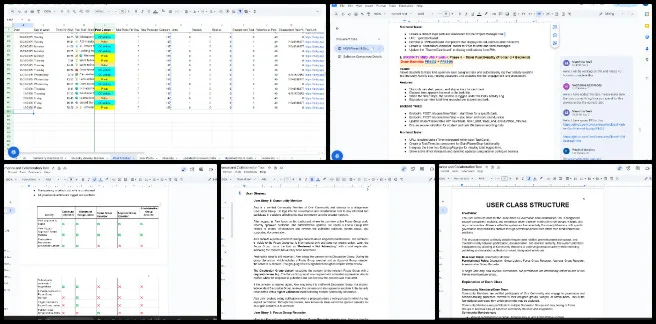
This week, Prudhvi Marpina (Data Analyst) continued developing the Highest Good Education software platform, concentrating on Phase 4 marketing, promotion, and administrative activities. He supported Highest Good Network software development, marketing, and administrative efforts across multiple phases. Prudhvi worked on Phase 5 governance by updating the HGN document based on feedback from Jae, including revisions to user structures and user class naming. He also coordinated with development administrator Rajeshwari through calls and discussions to review updates to user class structures and user stories, making required adjustments to align with review requirements. In addition, Prudhvi supported Phase 4 software management by updating the status of required action items, tracking pull requests, and communicating review and Git-related updates to relevant developers. For marketing and promotion, he updated scheduled BlueSky content using Buffer and maintained weekly tracking data across the BlueSky data sheet and the Social Media Master Dashboard. He also contributed to One Community administration by updating the weekly blog and reviewing administration team tasks, providing feedback for the current reporting period. Through these activities, he supported One Community’s commitment to demonstrating world-changing ideas. The images below highlight his contributions.
HIGHEST GOOD SOCIETY PROGRESS
One Community is championing world-changing ideas through a Highest Good society approach to living that is founded on fulfilled living, the study of meeting human needs, Community, and making a difference in the world:
- Read the Highest Good society overview and world-changing ideas: Highest Good Society
- Learn about the model for fulfilled living and sharing: A Day in the Life
- Learn about the 4 economic models: RBE | For-profit | Non-profit | Entrepreneurship
- Learn about our open source community collaboration and management software: The Highest Good Network
This week, the core team completed over 33 hours managing volunteer work reviews, handling emails, overseeing social media accounts, supporting web development, and identifying and integrating bug fixes for the Highest Good Network. The team also interviewed and onboarded new volunteer team members. Additionally, they produced and integrated the video above, highlighting how demonstrating world-changing ideas serves as a foundation of One Community’s broader mission. The following images showcase highlights of this work.
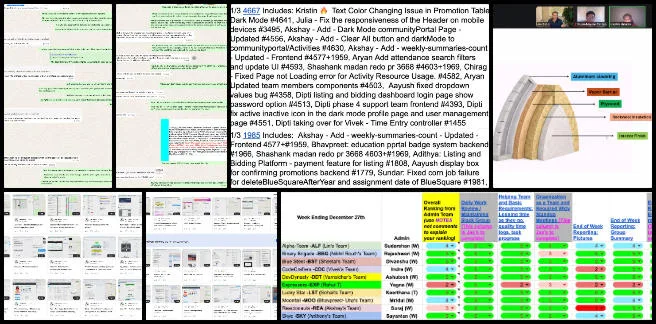
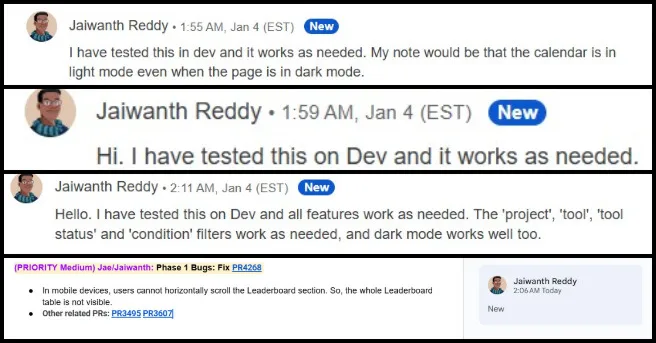
Jaiwanth Reddy Adavalli (Project Manager) continued developing the Job Applicants page and key components of the Highest Good Network. He tested multiple pull requests of components in various parts of the HGN Software and created new action items to develop components in Phase 1. He familiarized himself with the Food Inventory Management Dashboard and created wireframes for about a dozen graphs. Jaiwanth tracked updates in software team management documents to support task management. As a member of the pull request review team, he reviewed submissions from the volunteer team assigned to him. This work supports One Community’s commitment to demonstrating world-changing ideas. The images below highlight his contributions.
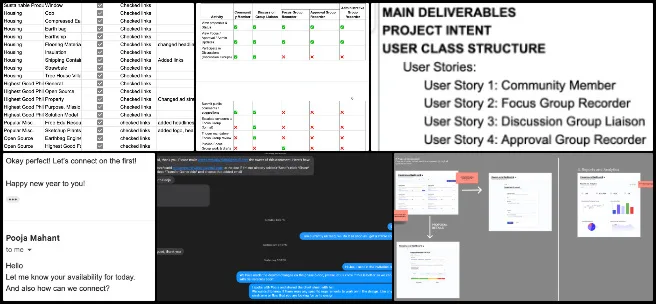
Rajrajeshwari Gangadhar Sangolli (Data Analyst) continued working on Google Ads management and strategy evolution of the Highest Good Network. She completed administrative work for eight volunteers, including creating collages, preparing SEO keywords, organizing folders, adding comments, and checking for errors. Submission checks were completed for eight admins, with issues identified and documented. Feedback materials were reviewed through Jae’s video, and coordination took place with Prudhvi, along with email communication with Pooja to begin Phase 5 work. Chart designs were updated for clarity, simplified, and shared for review. Multiple ad campaigns were checked for links, ad strength, logos, business names, and accuracy, with updates made across more than twenty ads. Document settings and formatting were revised, ownership access was shared, user stories were completed for five profiles, and Phase 5 documentation was updated with new roles and a permissions table based on feedback. This project supports One Community’s commitment to demonstrating world-changing ideas. The images below highlight key aspects of her work.
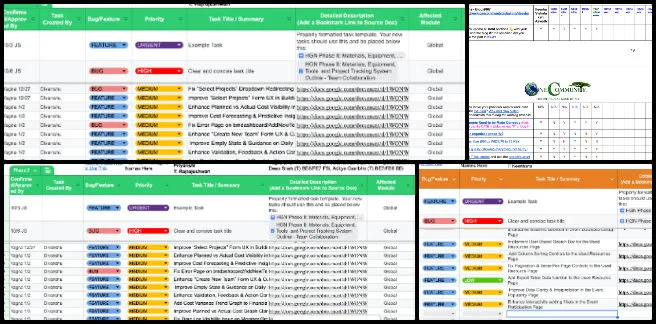
Yagna Reddy Badvel (Data Analyst and Team Administrator) continued working on the Summary Dashboards and Weekly Report page on the Highest Good Network. He audited the Phase 2 “Materials, Equipment, Tools, and Project Tracking System” tab by correcting task categorization, dropdown selections, priorities, formatting issues, links, and filters to maintain accuracy and consistency. He reviewed weekly team submissions to confirm that summaries met writing standards, media requirements were completed, and tracking logs were added where needed. This work helps advance One Community’s mission of championing world-changing ideas.
Yagna also optimized and uploaded images to WordPress with appropriate SEO settings, formatting, and titles, ensured all eligible contributors were included, and organized folders and documents for the next review cycle. In parallel, he reviewed components of the Volunteer Status dashboard by watching the walkthrough video and taking detailed validation notes up to the 8-minute mark, documenting logic gaps related to totals, mentor and volunteer counts, hours, and team activity, and cross-referencing his findings with the Bugs & Validation tracker to prepare follow-up items. Additionally, he reviewed Iteesha Vishalakshi’s Admin-in-Training document across all four steps, checking progress, completeness, and alignment with current guidelines, and provided targeted feedback to improve formatting, clarity, and process adherence. This work supports One Community’s commitment to demonstrating world-changing ideas. The images below highlight his contributions.
ADMINISTRATION TEAM
The Administration Team’s summary, which covers their work on the Highest Good Network, was managed by Prudhvi Marpina (Data Analyst) and includes Anusha Gali (Software Engineer), Ashutosh Mishra (Software Engineer), Divanshu Bakshi (Team Admin), Indra Anuraag Gade (Software Engineer and Team Administrator), Keerthana Chitturi (System Administrator), Leo Lishin Shiu (Software Engineer), Neeharika Kamireddy (Data Analyst), Olawunmi “Ola” Ijisesan (Administrative and Management Support), Olimpia Borgohain (Data Analyst and Team Administrator), Priyanshi Sharma (Data Analyst and Team Administrator), Rachna Malav (Data Analyst), Rajeshwari Bhirud (Administrator), Rishitha Adepu (Administrator), Sayantan Paul (Volunteer Frontend Tester and Software Team Administrator), and Sudarshan Raju Chintalapati Venkata (Data Analyst). The Administration Team supports the Highest Good Network, a tool designed to track and measure progress while developing systems that contribute to championing world-changing ideas. Through administrative support, documentation, testing, training, recruiting, analytics, and content management, the team helps advance this mission, aligning with One Community’s commitment to demonstrating world-changing ideas
This week, Anusha focused on Level 2 frontend and backend software testing and quality assurance by reviewing and tracking a high volume of pull requests, approving those that met functional and UI requirements, and requesting changes where issues such as dark mode inconsistencies, configuration problems, inaccessible URLs, broken filters, and unmet requirements were identified. She documented testing outcomes, blockers, and dependency-related delays, confirmed merge statuses, and communicated detailed status updates to leadership while also supporting administrative tasks across multiple teams. This work aligns with our purpose of championing world-changing ideas through transparent and replicable solutions.
Ashutosh contributed to Dev Dynasty development by debugging the video slice ingestion workflow, preparing quick fixes for delayed responses, refining document refactoring strategies through optimized chunking, defining prompt templates, and building automated LCEL pipelines to streamline deployment and demos. Divanshu managed Mastodon operations by publishing and monitoring daily posts, documenting feature issues and enhancements with full reproduction details, processing analytics data using Python, transforming raw exports into structured datasets, and validating dashboard accuracy through schema and metric checks. These efforts strengthen collaborative systems that support championing world-changing ideas.
Indra supported analytics and content operations by maintaining X/Twitter dashboards, posting and logging content, labeling datasets for ML models, rerunning pipelines to evaluate engagement improvements, and validating updated data. He also tested job posting analytics components, created reusable action item templates based on completed Figma designs, supported admin training, and contributed to the Code Crafters weekly blog update. Keerthana handled administrative coordination by reviewing team summaries for accuracy and formatting, updating Step 2 and Step 4 tracking documents, compiling and validating the weekly blog, and assigning Phase 3 action items to developers. Leo managed social media coordination by reviewing team summaries, creating blog collages, preparing to take over Facebook and Instagram workflows, managing weekly posts, and uploading Meta performance data to the Social Media Master Dashboard. Together, this work strengthens systems that support world-changing ideas.
Neeharika supported task management and administrative oversight by reviewing software team documents and PR dashboard action items, following up on task progress, testing pull requests, verifying updated PDFs, reviewing admin work, and conducting an interview with details forwarded to leadership. Ola organized the admin workspace, managed scheduling and verification tasks, and conducted a detailed review of Pinterest analytics, documenting key performance indicators related to performance, engagement, and pin clicks. Olimpia updated LinkedIn analytics KPIs, completed senior admin reviews of volunteer documentation, resolved prior admin comments, identified individuals requiring warnings or blue squares, and scheduled LinkedIn posts with relevant images, hashtags, and links. These combined efforts improve coordination, accountability, and clarity in support of world-changing ideas.
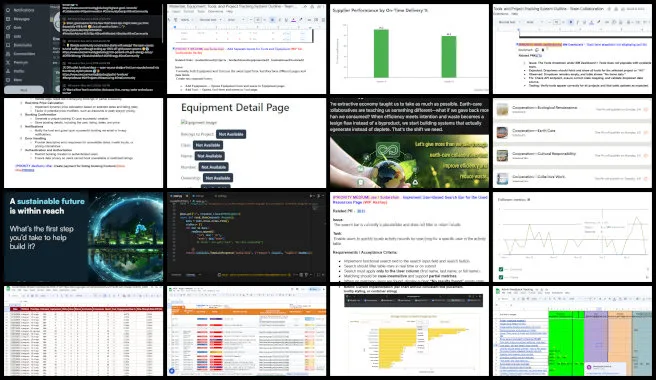
Priyanshi continued Phase 2 project management testing by validating dashboard graphs, filter behavior, and visual clarity across multiple pull requests, documenting page load failures and visualization issues for follow-up. Rachna focused on routine administrative tasks by reviewing emails, comments, and SEO pages while monitoring website updates during a holiday-reduced interview period. Rajeshwari completed blog administration by reviewing software submissions, editing WordPress content with SEO alignment, incorporating team updates and collages, conducting CSS and functionality testing across dashboards, and updating admin feedback tracking. Rishitha managed content administration by consolidating blogs, optimizing SEO, maintaining bios, supporting Threads engagement, updating dashboard data, and maintaining volunteer trackers. Sayantan validated dashboard updates, reviewed admin training materials, provided structured feedback, and finalized Team Skye’s weekly summary, while Sudarshan managed the Alpha Software Team blog, reviewed Phase 3 pull requests, created and documented bug-related tasks, and supported multi-page system improvements. This work supports championing world-changing ideas. To learn more about how this work supports championing world-changing ideas, visit the Highest Good Society and Highest Good Network pages. Highlights of the team’s contributions are shown in the collage below.
GRAPHIC DESIGN TEAM
The Graphic Design Team’s summary includes Qinyi Liu (Graphic Designer) and Yulin Li (Graphic Designer), who focused this week on creating graphic designs that support world-changing ideas.
This week, Qinyi worked on marketing and promotion tasks, creating social media images and announcements with a game character visual style. She generated and edited designs with ChatGPT and ensured all visuals aligned with world-changing ideas. Qinyi also reused existing characters to produce posters, bio images, and assets for social media and website use. Yulin focused on visual communication and coordination, creating social media images and volunteer announcements based on feedback to improve clarity and consistency while ensuring alignment with world-changing ideas. She published a team collaboration announcement, managed assets through Dropbox, and participated in weekly reviews. Their efforts highlight world-changing ideas. See the Highest Good Society pages and the collage below for examples of their work.
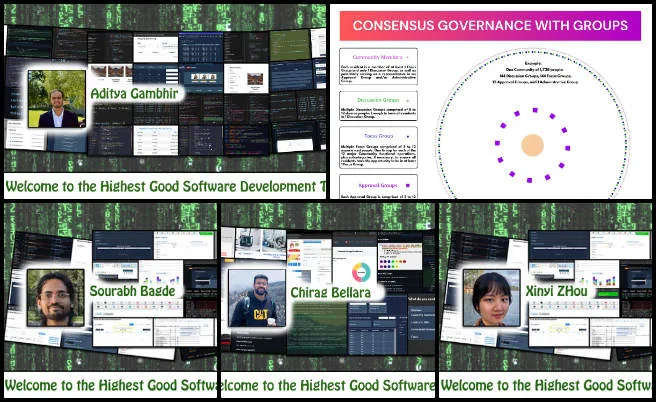
HIGHEST GOOD NETWORK PROGRESS
 One Community is championing world-changing ideas through open source Highest Good Network® software that is a web-based application for collaboration, time tracking, and objective data collection. The purpose of the Highest Good Network is to provide software for internal operations and external cooperation. It is being designed for global use in support of the different countries and communities replicating the One Community sustainable village models and related components.
- Learn about our open source community collaboration and management software and world-changing ideas: The Highest Good Network
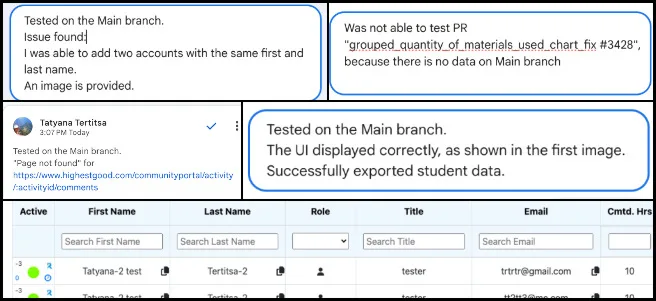
This week, the core team tested Highest Good Network pull requests and confirmed 16 as fixed. This effort highlights One Community’s commitment to demonstrating world-changing ideas.
The following PRs were not fixed: the community portal activity comment section and the ability to add a user with the same first and last name. Several PRs could not be tested because no data was available on the Main branch, including the grouped quantity of materials used chart fix and the skills dashboard user card updates. This work strengthens One Community’s mission of championing world-changing ideas. See the Highest Good Society and The Highest Good Network pages, and the collage below, for an overview of the team’s contributions.
BINARY BRIGADE SOFTWARE DEVELOPMENT TEAM
The Binary Brigade Team, presenting their work on the Highest Good Network software, was managed by Nikhil Routh (Software Engineer) and included Apoorva Jain Ramapura Prashanth (Software Engineer), Taariq Mansurie (Full-Stack Developer), Ramsundar Konety Govindarajan (Software Engineer), Sumedh Kumar (Full-Stack Developer), Harsha Rudhraraju (Software Engineer), and Amalesh Arivanan (Software Engineer). The Highest Good Network software is our tool for managing and objectively measuring progress, ensuring that all contributions are tracked and aligned with our mission while modeling and championing world-changing ideas. It supports social architecture, construction, production, and maintenance processes that contribute to open-source projects and resilient, sustainable ecosystems.
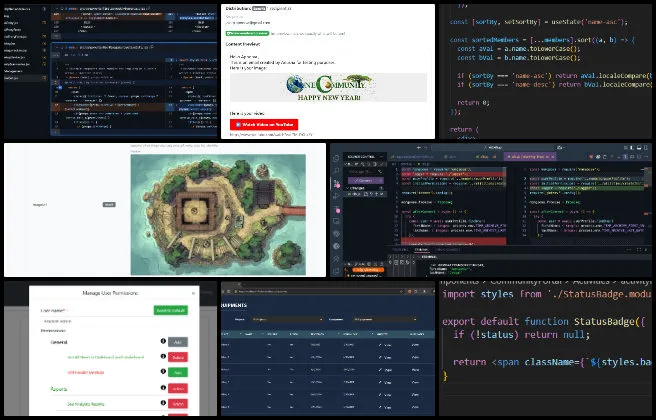
This week, Amalesh continued work on pull requests 704 and 1831 by addressing existing issues and reviewing changes for alignment with the current codebase, contributed to the Phase 2 Summary Dashboard by implementing a responsive line chart showing weekly task progress with filtering, improved mismatched team code detection and filtering on the Weekly Team Summaries page, completed the disconnected timer refresh button in pull request 4459, resolved merge conflicts, merged the Replicate Task function, fixed integration test conflicts for the reasonSchedulingController, and documented and tracked work per project requirements. Apoorva focused on resolving four critical issues in the MailChimp replacement email system by adding support for a video variable type across frontend and backend, fixing the Clear Draft state reset issue, resolving persistent offline notification banners after reconnection, correcting preview layout issues caused by large images, and validating fixes locally across frontend and backend pull requests.
Harshavarma added routes, reducers, and actions for the tool replacement graph, implemented an engagement members list table using mock data, added status badges and dark mode support, refined layout and responsiveness, and continued UI polishing while preparing the frontend for future backend integration. Nikhil worked on the Weekly Report Summary and Weekly Summaries modules by updating imports and correcting class mappings for the CSS Modules migration, updated pull requests 3770 and 3662 based on review feedback, collaborated with teammates on Phase III database and backend workflow discussions, and completed handoff activities related to managerial responsibilities and task transition. This work aligns with our purpose of championing world-changing ideas through transparent and replicable solutions.
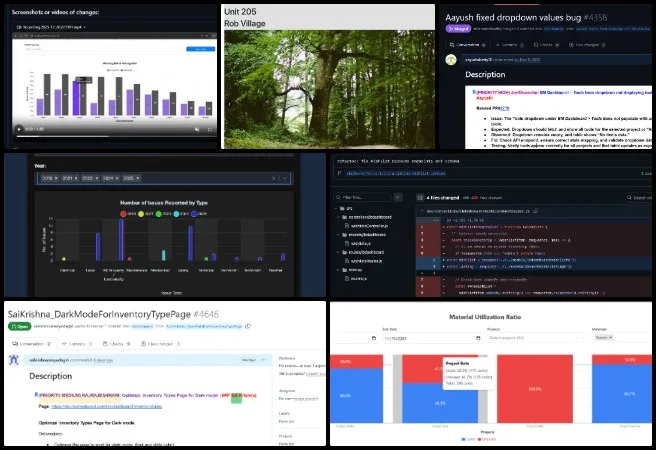
Ram cleared merge conflicts for older pull requests 3925 and 1672 related to task interaction permissions, identified incorrect behaviors around volunteer access and task deletion, clarified expected functionality with stakeholders, noted missing logic related to People Report visibility after unassignment, and requested time to address the gaps. Sumedh fixed a high-priority submit button issue in the BM Dashboard affecting equipment status updates, investigated dark mode problems and identified the need for broader styling changes, raised frontend and backend pull requests 4656 and 1984, addressed dark mode issues in the equipment list by resolving style conflicts and adding a new hook, raised pull request 4663, and documented limitations around image upload due to missing API access.
Taariq worked across the HGN Software Development effort focused on stabilizing the filters-on-refresh feature by fixing frontend and backend bugs, validating behavior across tabs, resolving merge conflicts, performing code cleanup, resuming Phase 4 Assign Lesson Plan UI work, reporting a browser-specific issue, reviewing assigned tasks and recent repository changes, and documenting the incomplete state of the auto-scroll, auto-refresh, and BioStatusToggle work for reassignment. See the Highest Good Society and Highest Good Network pages for more information on how this works in championing world-changing ideas. The collage below shows images of their work.
BLUE STEEL SOFTWARE DEVELOPMENT TEAM
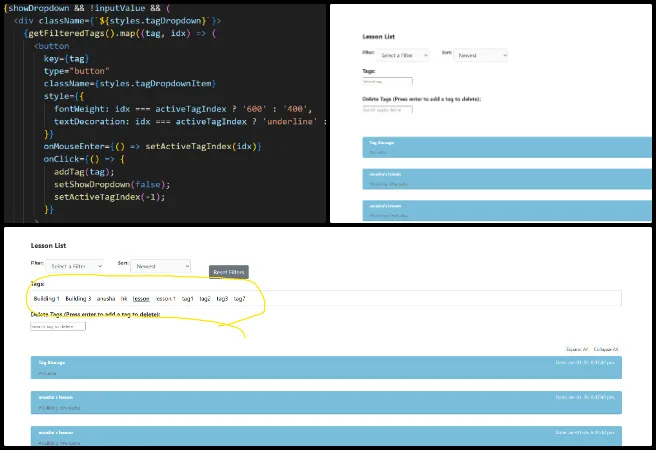
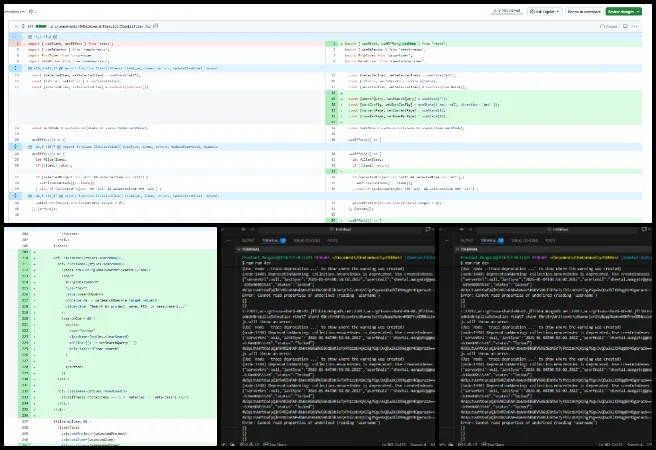
The Blue Steel Software Team, working on the Highest Good Network software, was managed by Divanshu Bakshi (Product Manager), and includes Linh Huynh (Software Engineer), and Sheetal Mangate (Software Engineer). This week, Linh worked on improving the usability of the Materials table in the Building Management Dashboard, focusing on frontend functionality and user experience. He added global search to filter materials by project, name, PID, and measurement, expanded column sorting to include project, name, and inventory-related numeric fields, and introduced pagination with configurable page sizes and navigation to better support large datasets. These updates provide clearer visibility into operational data that underpins world-changing ideas. Linh also updated the table layout to include a sticky header so column labels remain visible during scrolling and adjusted the layout of the Time, Project, and Material filters to improve alignment, responsiveness, and visual consistency across screen sizes and light and dark modes.
Linh synchronized his work with the latest development branch, resolved unintended local dependency file changes, and pushed the updated implementation to a dedicated feature branch for lead review and traceability. He also monitored team feedback, investigated potential bugs, and addressed UX and UI issues such as layout inconsistencies and interaction edge cases identified from previous tasks. This work aligns with our purpose of championing world-changing ideas through transparent and replicable solutions.
Sheetal worked on integrating Bitwarden login retrieval based on specified search criteria and addressed issues with the Bitwarden search command not returning expected results by analyzing Bitwarden CLI behavior to determine the correct approach for fetching specific login details. She discovered that the command used to list vault items was returning an empty array and debugged the issue by focusing on Bitwarden session handling, resolving problems related to how the application was retrieving, managing, and passing the session key. After correcting these session-related issues, she validated that the login retrieval logic returned the expected vault items and completed code cleanup by removing temporary or unnecessary logic added during development, improving code clarity and maintainability, and preparing the finalized changes for commit in support of world-changing ideas. The collage below shows images of their work.
CODE CRAFTERS SOFTWARE DEVELOPMENT TEAM
The Code Crafters Team, covering their work on the Highest Good Network software, was managed by Vivek Chandra (Software Engineer) and includes Ajay Naidu (Software Engineer), Akshith Kumar Reddy Balappagari Gnaneswara (Software Engineer – Full Stack), Bhanu Anish Akkineni (Software Engineer), Chaitanya Swaroop Kumar Allu (Software Engineer), Juhitha Reddy Penumalli (Software Engineer), and Sphurthy Satish (Software Engineer). The Highest Good Network software manages and objectively measures our progress in championing world-changing ideas by coordinating social architecture, construction, production, and maintenance efforts while supporting scalable and lasting access to regenerative lifestyles worldwide.
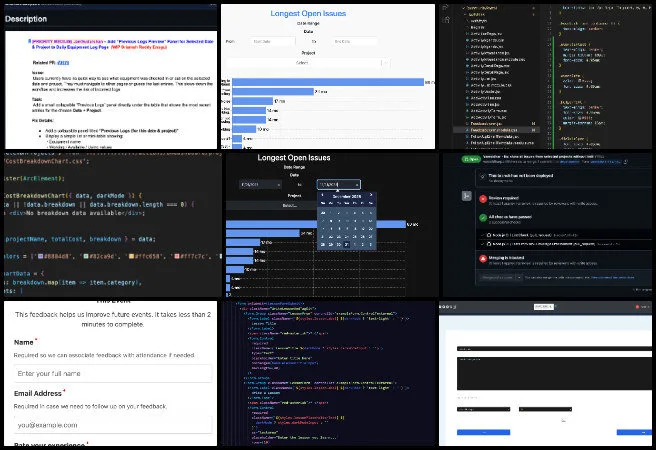
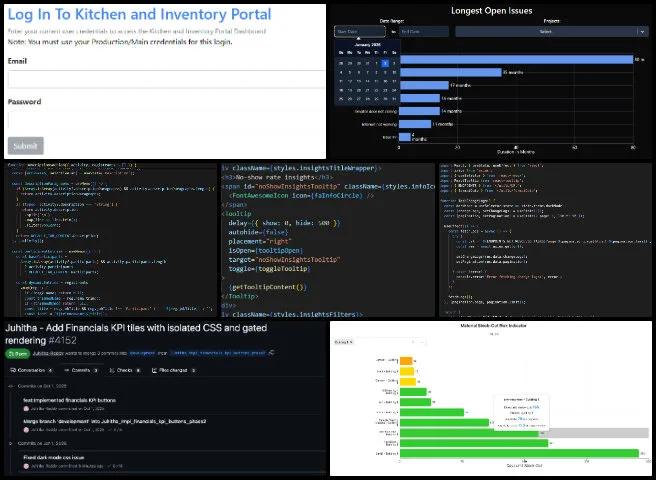
This week, Ajay resolved merge conflicts across multiple branches, addressed reviewer feedback, updated code on active pull requests, refined component behavior, and stabilized the openIssueCharts file for merge readiness. He also contributed to dark mode improvements for dashboard summary cards and tracked progress across PRs 4594, 4604, 4499, and 4619. Akshith worked on Phase 3 tasks for the Registration Status page by aligning the Event Details UI with the standard layout, adding missing avatar icons, improving alignment, and implementing the Share Availability option with a modal for copying event links, currently under testing before raising pull requests. These efforts reflect One Community’s long-term commitment to championing world-changing ideas that create meaningful global impact.
Anish implemented deliverable-0 for the Kitchen and Inventory portal, creating an access page with the KitchenandInventoryLogin component, adding KIProtectedRoute for access control, developing a navigation bar for consistent portal navigation, configuring routing, and adding unit tests to validate page and navigation behavior. Chaitanya implemented and refined the Material Stock-Out Risk Indicator for the BM Dashboard, developing a backend API to predict stock-out days, integrating it into the frontend with real-time data fetching, adding project filters, improving error handling with UI feedback and graceful degradation, refactoring shared data-fetching logic, streamlining MongoDB queries, resolving linter issues, supporting dark mode and responsive layouts, and validating behavior across edge cases. These contributions help maintain focus on championing world-changing ideas.
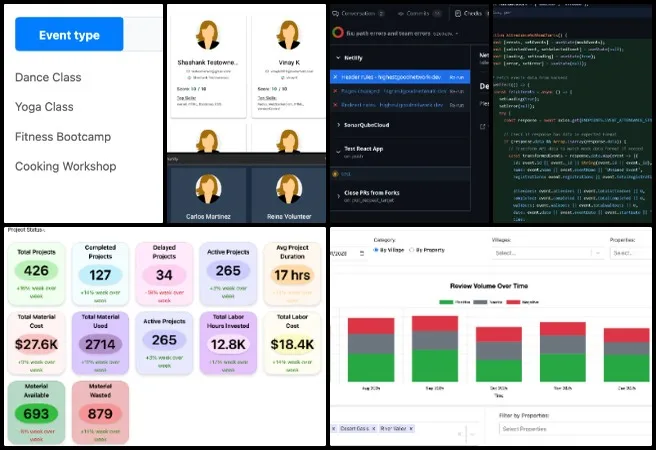
Juhitha focused on closing and stabilizing tasks across Phase 2 and Phase 4 dashboard items, resolving review feedback, addressing SonarQube reliability and duplication issues, updating the Summary Dashboard stacked bar graph and action item buttons, fixing dark mode inconsistencies and delete button behavior, debugging pull request blockers for the financials dashboard, and implementing an injury tracking line chart with ongoing backend integration. Sphurthy added an information icon with a tooltip to the Community Portal participation reports section, explaining average no-show rates and updating dynamically based on Event type, Time, and Location tabs, using reactstrap’s Tooltip component with hover functionality, CSS styling, hover effects, and dark mode support. Vivek focused on investigating a persistent frontend-to-backend integration issue, reviewing backend APIs, analyzing frontend consumption, and attempting multiple approaches to isolate the problem, while also providing knowledge-sharing support on merge conflict resolution and assisting a teammate with their assigned tasks. These efforts collectively strengthen One Community’s mission and commitment to championing world-changing ideas. The collage below shows an overview of this team’s work.
DEV DYNASTY SOFTWARE DEVELOPMENT TEAM
The Dev Dynasty Team’s summary, covering their work on the Highest Good Network software, was managed by Vamsidhar Panithi (Software Engineer) and includes Adithya Cherukuri (Volunteer Software Engineer), Neeraj Kondaveeti (Software Engineer), and Sriamsh Reddy (Software Engineer). The Highest Good Network software is how we’ll manage and objectively measure our processes for open sourcing a better world for us all through our social architecture, construction, production, and maintenance processes. This progress supports One Community in championing world-changing ideas.