A Prototype Solution Engine for Global Challenges – One Community Weekly Progress Update #669
Posted on January 12, 2026 by One Community Hs
Leave a Comment
At One Community, we are pioneering a prototype solution engine for global challenges by designing and demonstrating open source approaches to food, energy, housing, education, economics, social architecture, and fulfilled living. Created entirely by an all-volunteer team, everything we develop is free-shared to support a self-replicating model intended to grow into a global collaboration of teacher/demonstration hubs. Through evolving sustainability and global stewardship practices, we work to regenerate our planet and help create a world that works for everyone, always for The Highest Good of All.
OUR MAIN OPEN SOURCE HUBS
Click on each icon to be taken to the corresponding Highest Good hub page.
One Community’s physical location will forward this movement as the first of many self-replicating teacher/demonstration communities, villages, and cities to be built around the world. This is the January 12, 2026 edition (#669) of our weekly progress update detailing our team’s development and accomplishments:
A Prototype Solution Engine
for Global Challenges
One Community Progress Update #669
DONATE | COLLABORATE | HELP WITH LARGE-SCALE FUNDING
CLICK HERE IF YOU’D LIKE TO RECEIVE AN EMAIL EACH WEEK WHEN WE RELEASE A NEW UPDATE
YOU CAN ALSO JOIN US THROUGH SOCIAL MEDIA


ONE COMMUNITY WEEKLY UPDATE DETAILS
HIGHEST GOOD HOUSING PROGRESS
One Community is pioneering a prototype solution engine for global challenges through Highest Good housing that is artistic and beautiful, more affordable, more space efficient, lasts longer, DIY buildable, and constructed with healthy and sustainable materials:
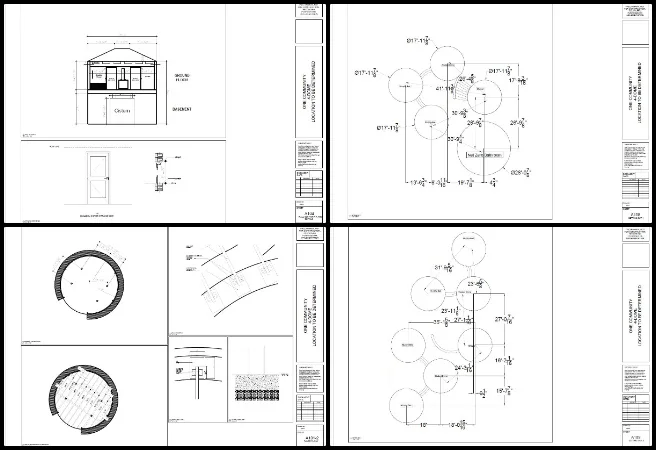
This week, Baraka Minja (Civil and Environmental Engineer Pr. Eng.) continued working on the Communal Eco-shower and Vermiculture Toilet drawings. He worked on the communal shower CAD drawings, updating them to align with the standard connection details used across other earthbag drawings. He modified the door details within the building sections to reflect the updated drawings, ensuring consistency across the design. In addition, he updated the setting out drawings and placed them on layouts to show the relative positioning of the communal shower in relation to other structures, supporting a prototype solution engine for global challenges through replicable and coordinated site design. See below for some of the pictures.
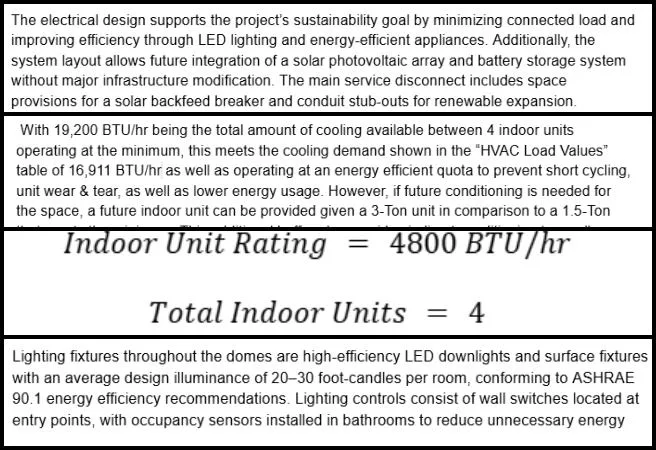
Derrell Brown (Plumbing Designer) continued working on the Earthbag Village 4-dome home final MEP report by addressing feedback from the initial draft and applying revisions across the mechanical and electrical sections to improve calculation logic, clarity, and alignment with overall project intent. He revisited previously developed mechanical and electrical content to better define terminology and update introductory text that precedes the calculations included in the report. Revisions focused on refining explanations of core mechanical and electrical concepts, adjusting language to reduce ambiguity, and clarifying technical terms through reference to applicable code provisions. In parallel, he began updating the MEP cost analysis spreadsheet to capture all equipment, materials, and systems referenced throughout the construction drawings and written report, ensuring consistency between the documented scope and associated cost items. His work supports a prototype solution engine for global challenges by strengthening transparency and cost alignment in system documentation. See below for some of the pictures related to this work.
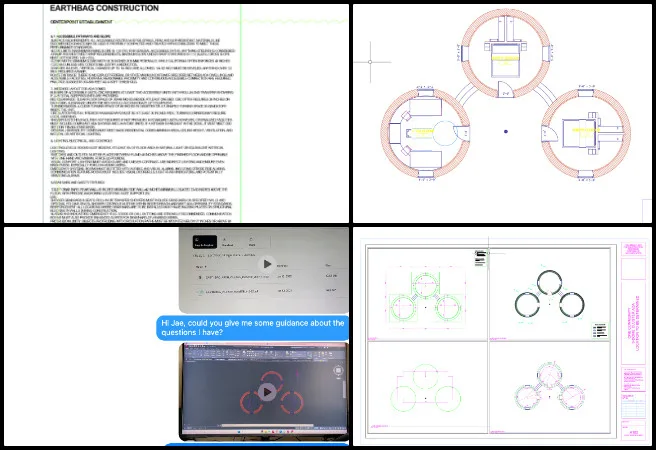
Fangting Xu (Interior Design Intern) continued working with ADA codes related to building connections for the ADA 3-dome cluster of the Earthbag Village. She prepared the construction documents for the 3-dome cluster using the AutoCAD file of the 3-dome cluster as the reference. During this process, Fangting Xu identified several inconsistencies and requested clarification and guidance from Jae. She also held a weekly meeting with Baraka to follow up on progress and coordination. Her attention to accessibility and documentation consistency supports a prototype solution engine for global challenges. See below for some of the pictures related to this work.
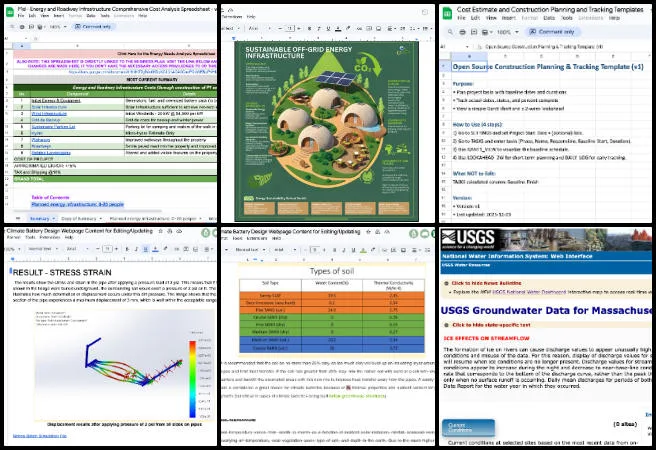
Iteesha Vishalakshi Aswath (Technical Program Manager) completed initial onboarding and training activities related to becoming a One Community administrator and spent the remainder of the time reviewing technical source material required to begin cost and needs analysis. The primary focus was a detailed review of the Open Source Climate Battery and Highest Good Energy report content to understand system scope, design assumptions, engineering calculations, and cost drivers. Building on this foundational review, the work this week focused on deeper evaluation and structured feedback across the energy documentation. This work supports One Community’s commitment to pioneering a prototype solution engine for global challenges through open-source collaboration and measurable progress.
She reviewed the Open Source Climate Battery Design webpage content for clarity and accuracy, completing approximately 70 percent of the material, and added comments with questions, clarification requests, and suggestions for improvement across sections covering system purpose, use cases, and technical topics including airflow, tubing, soil, insulation, fan selection, validation methods, and results related to stress, strain, and thermal behavior. In parallel, she read the Highest Good Energy Report to better understand One Community’s approach to open source energy systems, net-zero infrastructure goals, energy self-sufficiency targets, and the role of climate battery systems within broader strategies for scalable community hubs. Based on this context, she provided feedback and helped redefine the scope of work needed to create reusable templates for cost estimation and construction planning, contributing to a prototype solution engine for global challenges. See below for some of the pictures related to this work.
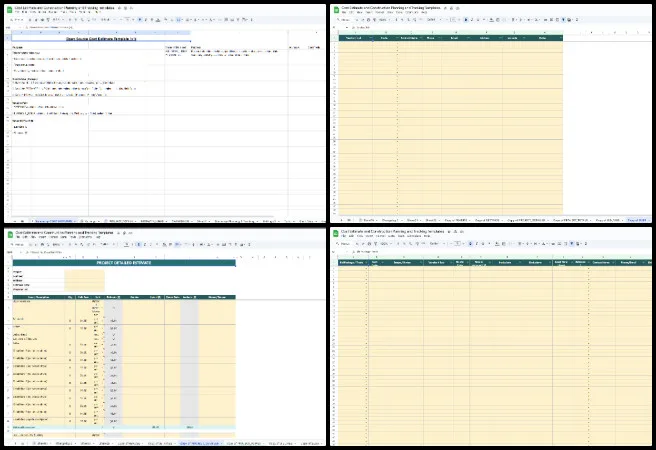
Kaustubh Kadam (Construction Engineering and Management Professional) worked on cleaning and improving the formulas in the cost estimation template and started building the planning and tracking template to support Highest Good Housing projects by adding additional tabs to the planning sheet and making updates based on items discussed with Iteesha. He improved the sheet structure and organization to better support planning and tracking needs. He also added a new version of the estimation template to provide an additional option that enables comparison of formats and evaluation of usability. Within the templates, formulas were added and adjusted to reduce manual entry and improve consistency, supporting a prototype solution engine for global challenges through scalable planning tools. See below for some of the pictures related to this work.
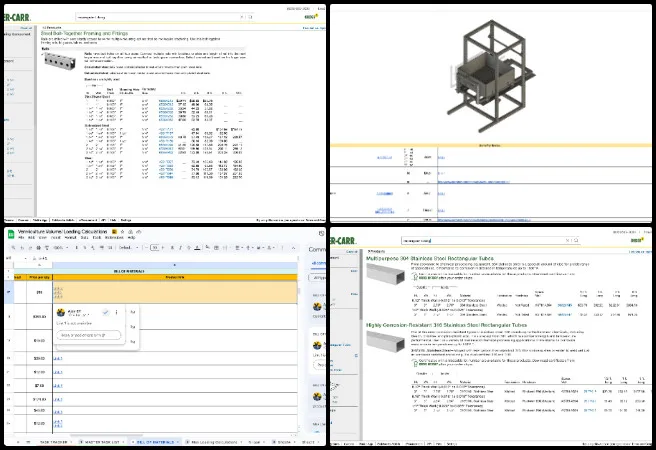
Malhar Solanki (Mechanical Engineer) continued working on the Vermiculture Toilet component of the Earthbag Village. He participated in the mechanical team’s weekly meeting to discuss blockers and define objectives for the documentation. He prepared and organized relevant mathematical formulas for inclusion in the waste dumping finite element analysis section of the report. He worked on report writing related to material selection, including a comparison between two different sets of materials based on FEA results. He added content to the unistrut assembly section, along with appropriate reference images to support the written material. He completed an additional section of the waste dumping mechanism to align with the overall system documentation. He also checked and verified the report sections prepared by Ajay and Rishi to ensure consistency and accuracy. Updates to the project BOM were verified and incorporated, and the dumping mechanism documentation was completed, strengthening a prototype solution engine for global challenges. Review the latest updates in the images below.
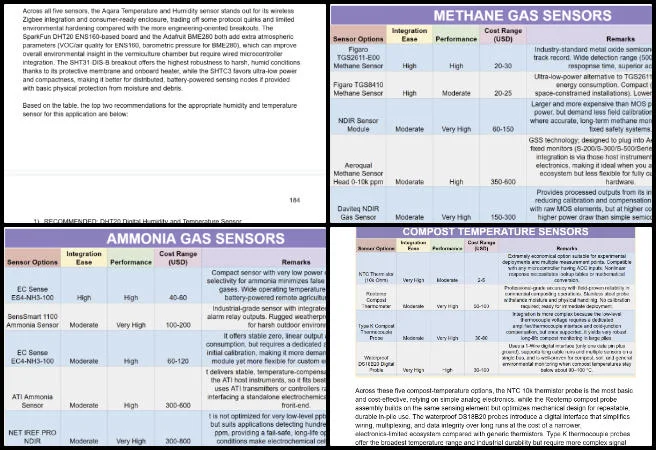
Rishi Chakrapani (Mechanical Engineer) continued working on the Vermiculture Toilet. His work focused on completing the reports that received feedback from Jae, with revisions made to address the noted comments and requirements. He completed additional research to expand the points of comparison included in the sensor selection report, with an emphasis on improving clarity and technical justification for the selected options. An exploded view of the dumping mechanism was developed in SolidWorks to better illustrate component relationships and assembly order. An additional GIF animation was also created and added to the report to support the visual explanation of the mechanism’s operation. His work enhances a prototype solution engine for global challenges through clear visual and analytical documentation. See below for some of the pictures related to this work.
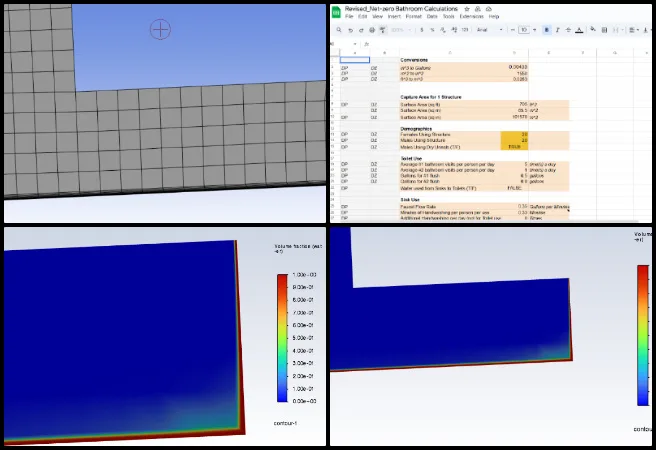
Sai Bhuvanesh Nandipati (Mechanical Engineer) focused on understanding the scope of the assigned work and clarifying the technical expectations associated with the project. He reviewed and interpreted the LEED strategies applied to the Earthbag Village model to understand their intent and relevance to the analysis. This context supported the detailed modeling and verification work completed during the week. He clarified the scope of the assigned work and reviewed the calculations used to support LEED points based on the methods documented in the Excel file. He set up and ran a flow analysis simulation for the sheet flow model and confirmed that the run was producing results. He also identified the need to optimize the model and verify the computed travel time for water flow over a 300 ft path length. His analytical work supports a prototype solution engine for global challenges through data-driven sustainability validation. See below for some of the pictures related to this work.
DUPLICABLE CITY CENTER PROGRESS
One Community is pioneering a prototype solution engine for global challenges through a Duplicable and Sustainable City Center that is LEED Platinum certified/Sustainable, can feed 200 people at a time, provide laundry for over 300 people, is beautiful, spacious, and saves resources, money, and space:
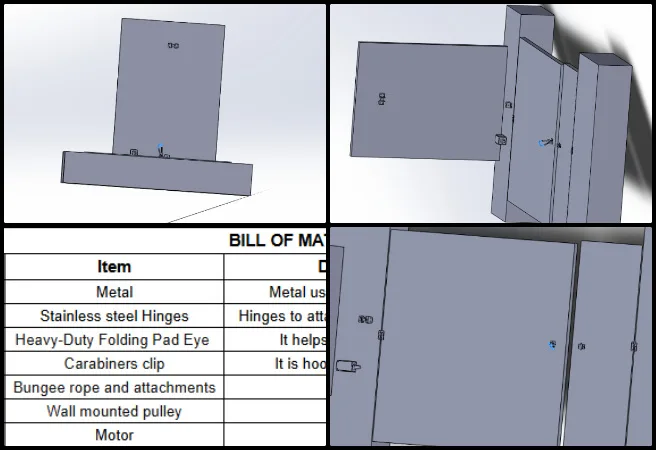
This week, Bevan Chiu (Mechanical Engineer Volunteer) continued his work finishing the City Center Eco-spa Designs. He worked on updating the CAD model and the DIY assembly instructions. The CAD work focused on developing plumbing access panels, including defining the panel structure with an HDPE sheet on the top surface and pressure-treated wood on the bottom for support. A hinge mechanism was added to the design and positioned to attach directly to the HDPE sheet, allowing the panel to open as intended, and a pull handle was integrated for opening the hinged panel. In parallel, he prepared draft DIY assembly instructions that outline the sequence of steps for preparing the ground foundation and assembling the cinder blocks, with attention to clarity and order so the steps can be followed by an end user. This open source Duplicable City Center project is pioneering a prototype solution engine for global challenges. For more details, refer to the image below.

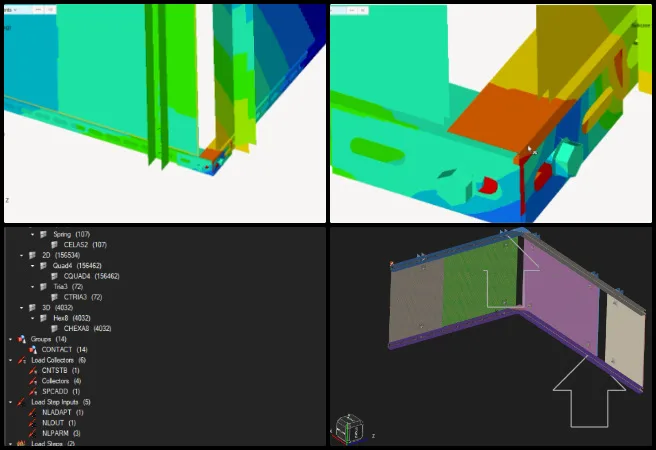
Sandesh Kumawat (Mechanical Engineer) continued developing the City Center Eco-spa Designs. He focused on high-fidelity structural validation of the Eco-Spa assembly using HyperMesh and Abaqus. He completed the bolt pretension analysis and verified that the primary frame can withstand the hydrostatic pressure load case using a quarter-symmetry model to improve computational efficiency. During solution runs, he identified contact shattering and convergence challenges arising from complex interactions between the hybrid materials and interfaces, which increased solution time. Sandesh is actively stabilizing these contacts and refining solver settings to achieve consistent convergence. Once these issues are resolved and the full simulation is finalized, the results provide a high level of confidence in the safety and structural integrity of the design. Discover One Community’s open source Duplicable City Center, which is pioneering a prototype solution engine for global challenges. See the visuals below for a closer look.
Shivarama Krishna Revanuru (Mechanical Engineer) continued working on the Duplicable City Center design. He focused on understanding assigned responsibilities related to finite element analysis and cost analysis, including clarification of expected scope and deliverables. Time was spent working on cost analysis tasks to estimate and organize relevant expenses, while also discussing approaches, assumptions, and division of work with a teammate to align on both FEA and cost analysis activities. Initial work began on finite element analysis and structural load analysis for the pulley system, with attention given to identifying load conditions, boundary assumptions, and analysis objectives to support further modeling and evaluation. This open source Duplicable City Center project is pioneering a prototype solution engine for global challenges. The images below illustrate aspects of this work.
HIGHEST GOOD FOOD PROGRESS
One Community is pioneering a prototype solution engine for global challenges through Highest Good food that is more diverse, more nutritious, locally grown and sustainable, and part of our open source botanical garden model to support and share bio-diversity:
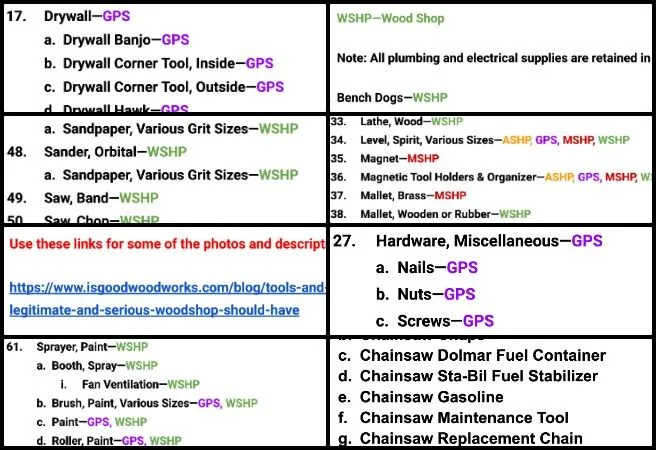
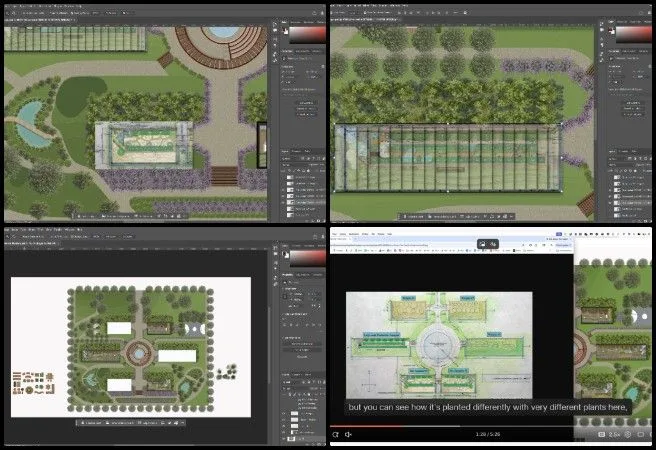
This week, the core team continued working on the Master Tools, Equipment, and Materials and Supplies List for the Large-scale Garden, Botanical Garden, and other Highest Good Food components. They worked on completing the color coordination of the acronyms related to the Tools, Equipment, Materials/Supplies for the Automotive Shop (ASHP), General Storage Inventory (GSI), Metal Shop (MSHP), and Wood Shop (WSHP). Subsequently, toolboxes and all chainsaw-related items were added to the required projects. This included the primary chainsaw and 13 separate accessories and associated entities integrated into those projects that require chainsaw utilization. The Highest Good Food initiative is a key component of One Community’s open source plans, focused on a prototype solution engine for global challenges and exemplifying the organization’s commitment through innovative design and implementation. Below are some images showcasing this work.
Anuneet Kaur (Administrator) continued her focus on the design of the Transition Food Self-sufficiency Plan components of the Highest Good food initiative. She continued working on the Food Procurement and Storage, Food Self-Sufficiency Transition Plan, Sustainable Food Nutrition Calculations, Vegan Rice, Omnivore Rice, Vegan Potato, and Omnivore Potato webpages. Anuneet ensured each webpage followed updated formatting guidelines, corrected inconsistencies, and optimized all links for SEO across the recipe sections. She also reviewed titles, spacing, and layout alignment to maintain consistency throughout the Food Web Project. These efforts strengthen One Community’s mission of pioneering a prototype solution engine for global challenges through replicable systems and free-shared resources.
Additionally, she ensured all team members were included in the live blog task and identified any missing participants. She reviewed Yulin’s infographic on sustainable research and provided detailed, constructive feedback. Anuneet also fulfilled administrative responsibilities by editing summaries and collages for the Highest Good Society, Highest Good Education, and Core Teams, and reviewed fellow admin submissions to ensure completeness and accuracy. Her work contributes to a prototype solution engine for global challenges. Below are some images showcasing her work.

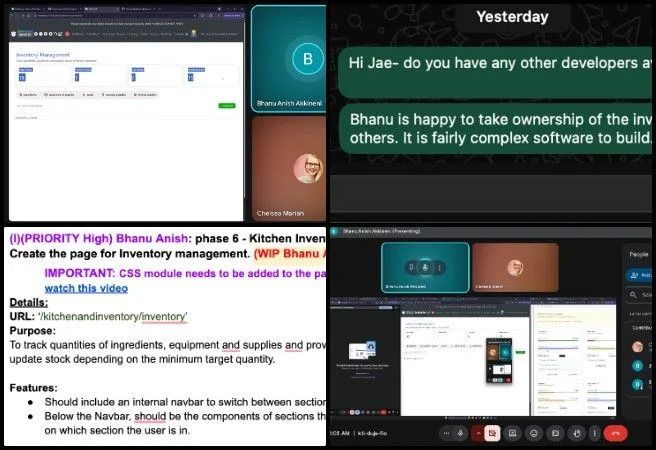
Chelsea Mariah Stellmach (Project Manager) continued working on the Transition Food Self-sufficiency food and inventory tracking software plans. Chelsea coordinated with Bhanu to assign him a new task within the HGN software focused on developing a dark and light mode inventory management page, with an estimated effort of 30 hours. She discussed current blockers, confirmed the expected timeline, and identified the need for additional resources to support progress. Chelsea also contacted Jae to request the assignment of additional software developers to work on other components of the software to support a faster pace of delivery. As an essential aspect of One Community’s open source goals, the Highest Good Food initiative supports a prototype solution engine for global challenges. The following images provide a view of her contributions.
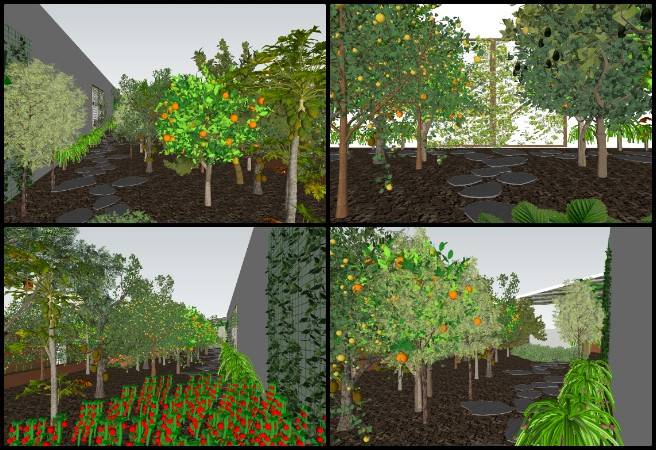
Japneet Kour (Volunteer Architect) continued contributing to the Highest Good Food initiative. Japneet added Walipini 1 renders to the report and updated the SketchUp file for the Walipini 3 Tropical House by adjusting the placement of ground plants and trees, adding pathways to improve circulation, and testing Lumion to review visualization options and ensure the project files reflect the most current design information. The Highest Good Food initiative is a key part of One Community’s open source platform, focused on sustainable and participatory development while supporting a prototype solution engine for global challenges. Visual examples from her work are presented below.
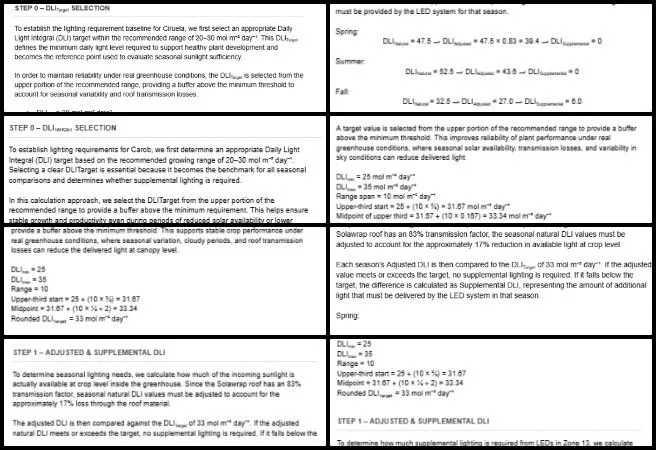
Jay Nair (BIM Designer) continued developing the Aquapini and Walipini Planting and Harvesting documents. He worked on standardizing the calculations related to the lighting fixtures used in Greenhouse Walipini 1, with a focus on aligning inputs, assumptions, and outputs across the dataset. In parallel, Jay prepared instructions outlining the logic, data requirements, and calculation steps needed to support the development of a calculator intended to automate lighting energy calculations for other greenhouse projects. The Highest Good Food initiative is a key part of One Community’s open source platform, focused on sustainable and participatory development while supporting a prototype solution engine for global challenges. See below for pictures related to this work.
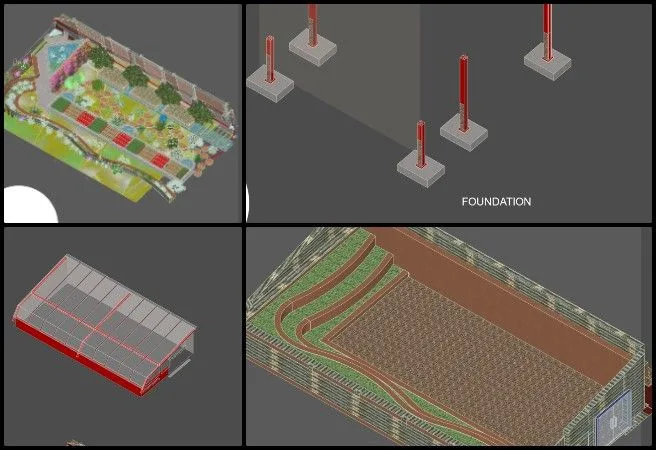
Nitin Parate (Architect) continued contributing to the Aquapini and Walipini renders and layout graphics. His work focused on developing the axonometric drawing of the Zen Aquapini. Changes were made to improve clarity, alignment, and overall layout while keeping the design intent intact. Adjustments helped show spatial relationships and system elements more clearly. Ongoing work includes refining visuals, followed by post-production, adding explanatory text, and preparing supporting sectional drawings. The Highest Good Food initiative is a key part of One Community’s open source platform, promoting regenerative and participatory development while supporting a prototype solution engine for global challenges. Images below showcase his contributions.
Pallavi Deshmukh (Software Engineer) continued working on the Aquapini and Walipini Planting and Harvesting web details. Pallavi developed new content for blog 668 and collaborated with teammates by incorporating their suggestions and feedback to maintain clarity and consistency in the final version. She continued adding Walipini 1 content based on Gayatri Pandkar’s work, making updates in response to feedback from Jae, including editing and incorporating revised images. Pallavi also added a table of contents for the Zenapini section to improve structure and navigation. In addition, Jae assigned her a new web page focused on integrating all related content for the Aquahaven Southwest Area web design, and she began organizing and preparing the materials needed for this integration work. The Highest Good Food project integrates a prototype solution engine for global challenges into a larger vision of regenerative living. Her contributions are highlighted in the collage below.

Shivangi Varma (Architectural Designer and Planner) continued the redesign of the Highest Good Food overall presentation, currently focused on the Aquapini and Walipini masterplan render. She updated the Highest Good Food Infrastructure masterplan render based on the latest feedback received, continued edits to the west section of the masterplan render, revised the layout for the Zenipini structure in response to Loom video feedback, and added detail to the Walipini and Aquapini renders. The Highest Good Food initiative plays a leading role in One Community’s open source platform by promoting sustainable and participatory development, focused on a prototype solution engine for global challenges. Below are visuals highlighting this work.
HIGHEST GOOD ENERGY PROGRESS
One Community is pioneering a prototype solution engine for global challenges through Highest Good energy that is more sustainable, resilient, supports self-sufficiency and includes solar, wind, hydro and more:
- Learn about the open source sustainable-energy foundations and a prototype solution engine for global challenges: Solar, Hydro, and Wind
- Explore our research into the most sustainable products and companies for saving water and energy: Insulation, Eco-laundry, Lightbulbs and Light Bulb Companies, Doors and Door Companies, Windows and Window Companies, Toilets, Faucets and Faucet Accessories, Urinals, and more.
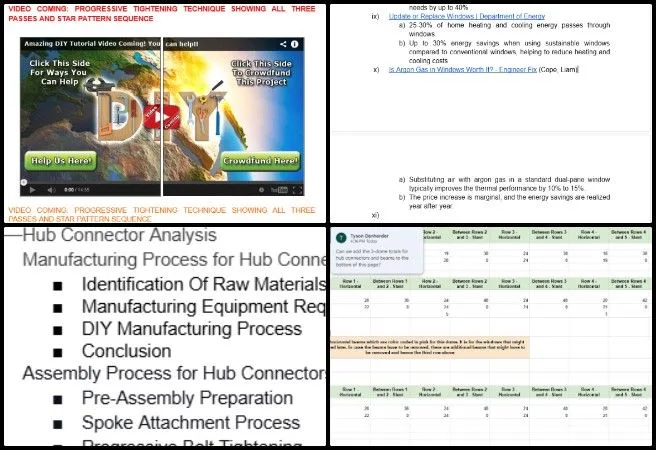
This week, the core team continued contributing to the Highest Good Energy initiative. They reviewed and edited the formatting of the Hub Connector Manufacturing and Assembly document so the material could be read and referenced more easily. The team then read some of the Earthbag Village construction documents again to improve familiarity with the expectations, scope of work, and guidance provided to volunteers in that area, paying attention to how tasks and responsibilities are described. In addition, they began reading the One Community Business Plan to gain a clearer understanding of the information presented, including how the material is organized and how it relates to ongoing and future project activities. The Highest Good Energy initiative plays a leading role in One Community’s open source platform by promoting sustainable and participatory development, focused on a prototype solution engine for global challenges. Below are images related to this project.
HIGHEST GOOD EDUCATION PROGRESS
One Community is pioneering a prototype solution engine for global challenges through Highest Good education that is for all ages, applicable in any environment, adaptable to individual needs, far exceeds traditional education standards, and more fun for both the teachers and the students. This component of One Community is about 95% complete with only the Open Source School Licensing and Ultimate Classroom construction and assembly details remaining to be finished.
With over 8 years of work invested in the process, the sections below are all complete until we move onto the property and continue the development and open sourcing process with teachers and students – a development process that is built directly into the structure of the education program and everything else we’re creating too:
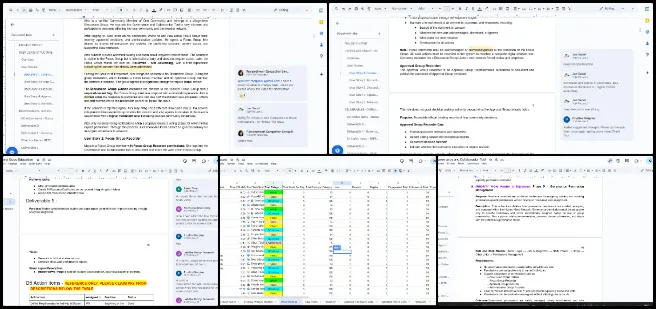
This week, Prudhvi Marpina (Data Analyst) continued developing the Highest Good Education software platform, concentrating on Phase 4 marketing, promotion, and administrative activities. He focused on Highest Good Network software development, marketing, and administration. He worked extensively on Phase 5 governance by updating Deliverable 0 content, defining and refining the Deliverable 1 action items table, and adding an overview section to the Phase 5 document, then shared the updates with Jae for review and feedback. Prudhvi coordinated with development administrator Rajeshwari through discussions to align on deliverable structure, incorporate review suggestions, and explore initial ideas for the governance portal design. He also supported Phase 4 software management by reviewing Deliverable 3 items, updating review statuses, and communicating next steps to developers. In marketing and promotion, he updated current and upcoming BlueSky posts through Buffer and refreshed analytics in the BlueSky visual tracking sheet. In addition, he supported OC administration by updating the weekly blog and providing feedback on the administration team’s work for the week. Through these activities, he supported One Community’s commitment to demonstrating a prototype solution engine for global challenges. The images below highlight his contributions.
HIGHEST GOOD SOCIETY PROGRESS
One Community is pioneering a prototype solution engine for global challenges through a Highest Good society approach to living that is founded on fulfilled living, the study of meeting human needs, Community, and making a difference in the world:
This week, the core team completed over 34 hours managing volunteer work reviews, handling emails, overseeing social media accounts, supporting web development, and identifying and integrating bug fixes for the Highest Good Network. The team also interviewed and onboarded new volunteer team members. Additionally, they produced and integrated the video above, highlighting how demonstrating a prototype solution engine for global challenges serves as a foundation of One Community’s broader mission. The following images showcase highlights of this work.
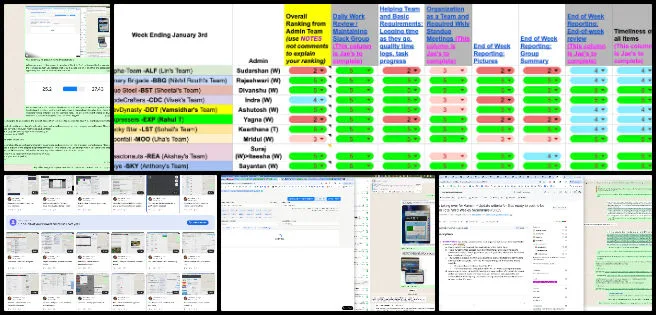
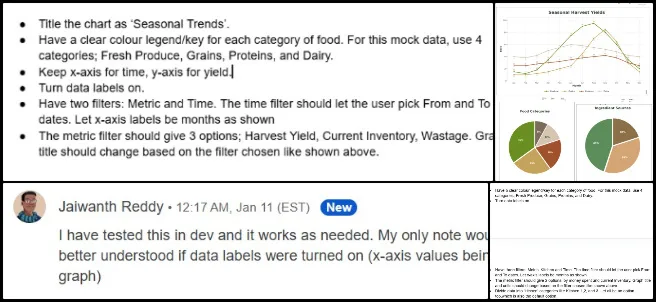
Jaiwanth Reddy Adavalli (Project Manager) continued developing the Job Applicants page and key components of the Highest Good Network. He tested multiple pull requests of components in various parts of the HGN Software. He created new action items to develop new components in the Food Inventory Management Dashboard and created wireframes for some graphs. Jaiwanth tracked updates in software team management documents to support task management. As a member of the pull request review team, he reviewed submissions from the volunteer team assigned to him. This work supports One Community’s commitment to demonstrating a prototype solution engine for global challenges. The images below highlight his contributions.
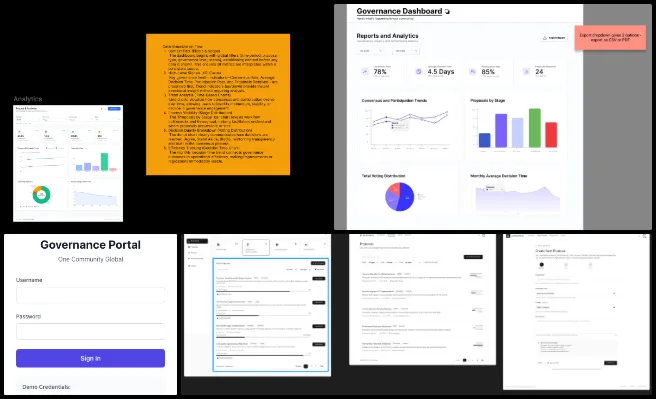
Pooja Kulkarni began working on UX and UI design of the Highest Good Network. She worked on UX and UI design for a consensus-based governance and collaboration tool aligned with One Community’s “Consensus with Large Groups” model. She designed and refined multiple governance screens, including the main dashboard, proposal management views, proposal creation flow, and reports and analytics screens, with a focus on clarity, neutrality, scalability, and human-centered design. She defined end-to-end user flows for creating proposals, managing discussions, vetting, and readiness for voting, and documented how users move between overview dashboards and detailed views. She also created detailed wireframe prompts for Figma and UX Pilot, specifying layout structure, filters, dropdown options, interaction states, and accessibility considerations. Pooja also outlined access requirements for governance portals, including authenticated login, active user checks, and redirect behavior for unauthorized users, ensuring governance participation remains secure and accountable. Her work emphasized reducing cognitive load, improving data visualization clarity, and maintaining transparency and trust across governance workflows. This project supports One Community’s commitment to demonstrating a prototype solution engine for global challenges. The images below highlight key aspects of her work.
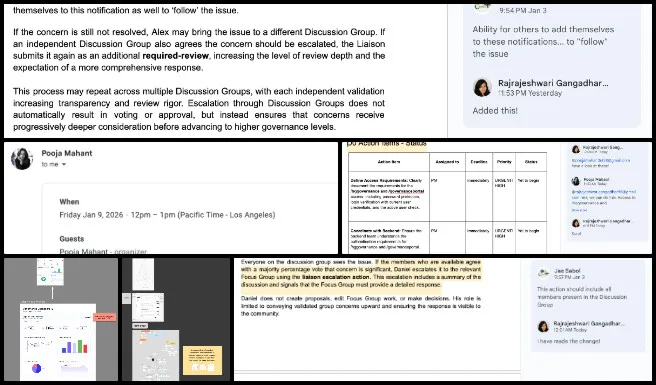
Rajrajeshwari Gangadhar Sangolli (Data Analyst) continued working on Google Ads management and strategy evolution of the Highest Good Network. She completed the weekly administrative work for the Highest Good Food and Highest Good Energy volunteers, including all required steps from one through four. She watched Jae’s video and documented the changes and edits that needed to be applied. She communicated with Prudhvi to discuss the division of responsibilities and collaboration workflow, and messaged Pooja to coordinate timelines for collaboration on Phase 5. This progress highlights One Community’s commitment to pioneering a prototype solution engine for global challenges through practical, buildable solutions.
Rajrajeshwari also had a meeting with Pooja to discuss the overall design plan, during which the concepts, purpose, and creation process of low-fidelity designs were explained. Following this, she researched low-fidelity design principles to better understand their structure and application before beginning work on them. She implemented the requested changes, verified deliverables against user stories, and worked on creating the low-fidelity designs. She read through and cross-verified Deliverable 0 and Deliverable 1, focusing on the overview sections and the action items table to ensure accuracy and alignment with project requirements. Rajrajeshwari responded to comments related to task creation and progress updates and provided instructions related to Phase 2. In addition, she completed the weekly analysis tasks, which included checking multiple Google Ads campaigns for broken links, evaluating campaign strength, and reviewing overall setup quality and consistency. This project supports One Community’s commitment to demonstrating a prototype solution engine for global challenges. The images below highlight key aspects of her work.
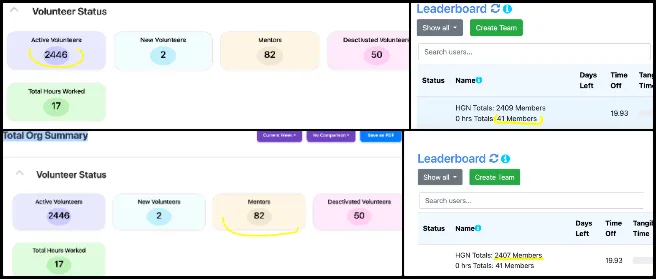
Yagna Reddy Badvel (Data Analyst and Team Administrator) continued working on the Summary Dashboards and Weekly Report page on the Highest Good Network. He reviewed and validated multiple dashboard metrics by comparing the Total Org Summary and Leaderboard views, identifying inconsistencies across HGN totals, active volunteer counts, mentor counts, deactivated volunteer logic, and total hours worked. He examined how zero-hour volunteers, mentor-tagged users, inactive accounts, and historical data were being included in different calculations, documented the logic gaps, and created corresponding tasks in the HGN Phase 1 Bugs document. In parallel, he reviewed Jae’s walkthrough videos, captured structured validation notes, raised several related issues, and flagged additional items for follow-up as the review progresses. This work supports One Community’s commitment to demonstrating a prototype solution engine for global challenges. The images below highlight his contributions.
ADMINISTRATION TEAM
The Administration Team’s summary, which covers their work on the Highest Good Network, was managed by Prudhvi Marpina (Data Analyst) and includes Anusha Gali (Software Engineer), Ashutosh Mishra (Software Engineer), Divanshu Bakshi (Team Admin), Keerthana Chitturi (System Administrator), Leo Lishin Shiu (Software Engineer), Mridul Bhushan (Volunteer Project Strategy Analyst and Team Administrator), Neeharika Kamireddy (Data Analyst), Olawunmi “Ola” Ijisesan (Administrative and Management Support), Olimpia Borgohain (Data Analyst and Team Administrator), Priyanshi Sharma (Data Analyst and Team Administrator), Rachna Malav (Data Analyst), Rajeshwari Bhirud (Administrator), Rishitha Adepu (Administrator), Sayantan Paul (Volunteer Frontend Tester and Software Team Administrator), and Sudarshan Raju Chintalapati Venkata (Data Analyst). The Administration Team supports the Highest Good Network, a tool designed to track and measure progress while developing systems that contribute to a prototype solution engine for global challenges. Through administrative support, documentation, testing, training, recruiting, analytics, and content management, the team helps advance this mission, aligning with One Community’s vision of building a replicable and sustainable future model.
This week, Anusha completed Level 2 frontend and backend software testing and quality assurance by reviewing and validating a high volume of pull requests, approving those that met functional and UI requirements, and requesting changes where issues such as dark mode visibility, pagination logic, validation failures, and integration constraints were identified. She documented blockers related to external service configurations, environment discrepancies, and missing commits, while also completing OC Administration work by reviewing fellow administrators’ blog posts and providing feedback aligned with guidelines. This work contributes to building a prototype solution engine for global challenges.
Ashutosh focused on advancing AI chatbot development by aligning the chatbot wireframe with backend updates, separating chatbot access into lightweight and high-load applications, and performing load testing on generation patterns. He debugged LCEL chains for text generation, evaluated confidence issues from Hugging Face models, and tested multiple prompt variations to compare output confidence across scenarios. Divanshu managed end-to-end Mastodon operations by publishing and monitoring daily posts, documenting feature issues and enhancements, processing analytics data through Python-based transformations, and validating dashboard accuracy through schema and metric reconciliation. Together, these efforts support a pioneering approach to building a prototype solution engine for global challenges.
Keerthana handled administrative coordination by reviewing team summaries for accuracy and formatting, updating Step 2 and Step 4 tracking documents, compiling and validating the weekly blog, and assigning Phase 3 action items to developers. Leo reviewed team summaries and collages, compiled blog content, scheduled Facebook and Instagram posts, and verified platform analytics consistency as Master Manager. Mridul supported Team Moonfall by consolidating blog content, adjusting images to meet publishing requirements, generating alt text, and resuming Phase 2 software testing by identifying and logging defects. This coordinated work supports a prototype solution engine for global challenges.
Neeharika supported task management and testing by reviewing software team documents, following up on assigned tasks, testing pull requests, and verifying updated PDFs. Ola monitored Pinterest KPIs, organized admin folders, and scheduled weekly content, while Olimpia updated LinkedIn analytics KPIs, completed senior admin reviews, resolved prior comments, identified cases requiring warnings or blue squares, and scheduled upcoming posts. These contributions reflect ongoing momentum toward pioneering a prototype solution engine for global challenges through consistent iteration and team collaboration.
Priyanshi continued Phase 2 project management testing by validating dashboard visualizations and documenting loading issues, while Rachna focused on routine administrative tasks during a reduced interview period. Rajeshwari conducted endpoint testing, documented bugs, and managed blog administration, while Rishitha consolidated blogs, optimized SEO, maintained bios, supported Threads engagement, and updated dashboards and trackers. Sayantan completed software testing across dashboards and logged UI visibility issues, and Sudarshan managed the Alpha Software Team blog, reviewed Phase 3 pull requests, and created tasks to address bugs and system improvements. To learn more about how this work supports pioneering a prototype solution engine for global challenges, visit the Highest Good Society and Highest Good Network pages. Highlights of the team’s contributions are shown in the collage below.
GRAPHIC DESIGN TEAM
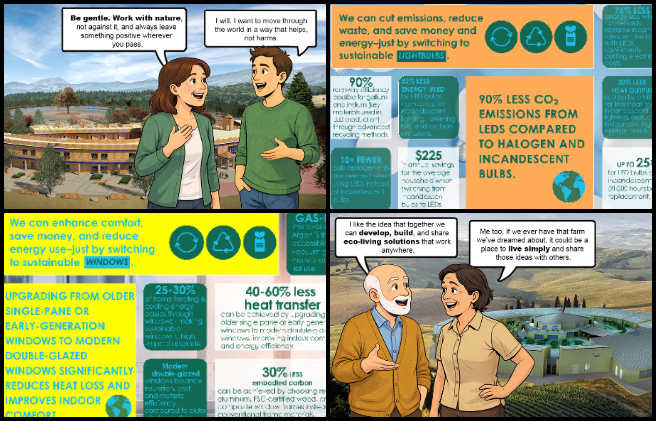
The Graphic Design Team’s summary includes Qinyi Liu (Graphic Designer) and Yulin Li (Graphic Designer), who focused this week on creating graphic designs that support a prototype solution engine for global challenges.
This week, Qinyi worked on social media marketing visuals using a game character style, including a prototype solution engine for global challenges, by generating and reusing character designs in poster-style formats and adapting them for consistent promotional layouts. Yulin focused on visual communication and coordination, including a prototype solution engine for global challenges, by updating infographics based on feedback, publishing a team collaboration announcement for the Highest Good Network software team, managing shared assets in Dropbox, and participating in weekly review discussions. Their efforts highlight a prototype solution engine for global challenges. See the Highest Good Society pages and the collage below for examples of their work.
HIGHEST GOOD NETWORK PROGRESS
 One Community is pioneering a prototype solution engine for global challenges through open source Highest Good Network® software that is a web-based application for collaboration, time tracking, and objective data collection. The purpose of the Highest Good Network is to provide software for internal operations and external cooperation. It is being designed for global use in support of the different countries and communities replicating the One Community sustainable village models and related components.
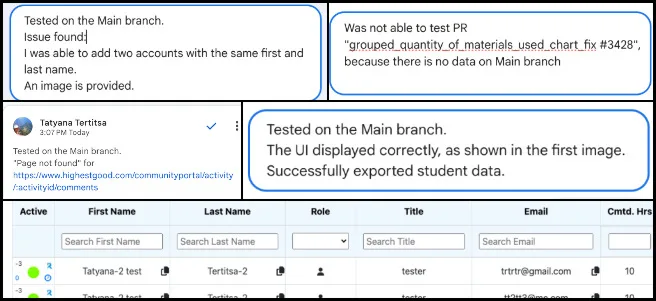
This week, the core team tested Highest Good Network pull requests and confirmed 16 as fixed. This effort highlights One Community’s commitment to pioneering a prototype solution engine for global challenges.
The following PRs were not fixed: the community portal activity comment section and the ability to add a user with the same first and last name. They were also not able to test several PRs because there was no data available on the Main branch, including the grouped quantity of materials used chart fix and the skills dashboard user card updates. This work strengthens One Community’s mission of pioneering a prototype solution engine for global challenges. See the Highest Good Society and The Highest Good Network pages, and the collage below, for an overview of the team’s contributions.
ALPHA SOFTWARE DEVELOPMENT TEAM
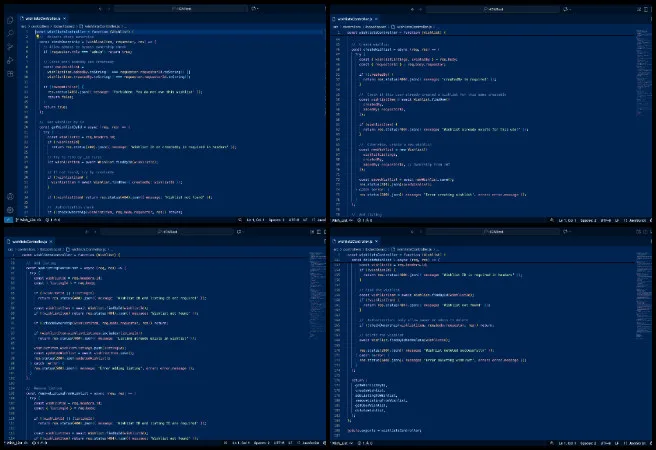
The Alpha Software Team, working on the Highest Good Network software, was managed by Lin Khant Htel (Frontend Software Developer), who currently serves as the team’s sole member. The Highest Good Network software is a key part of sustainable and free-shared eco-solutions, helping track and measure progress toward pioneering a prototype solution engine for global challenges. The software supports social architecture, construction, production, and maintenance processes that contribute to the open source project and resilient ecosystems. Designed to be portable and scalable, the Highest Good Network software is well suited for off-grid and sustainable living communities. This project reflects One Community’s open source commitment to pioneering a prototype solution engine for global challenges.
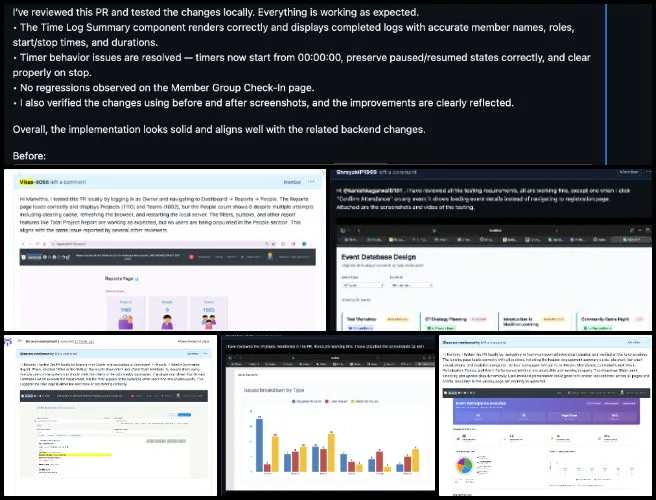
This week, Lin reviewed PR #1804, examined the code, ran it on a local machine, and confirmed the results matched expectations, reviewed and checked the weekly summaries, photos, and videos submitted by Alpha team members, carried out management duties for the Alpha Team. See the Highest Good Society and Highest Good Network pages for more on how this contributed to pioneering a prototype solution engine for global challenges. See the collage below to view the team’s work.
BINARY BRIGADE SOFTWARE DEVELOPMENT TEAM
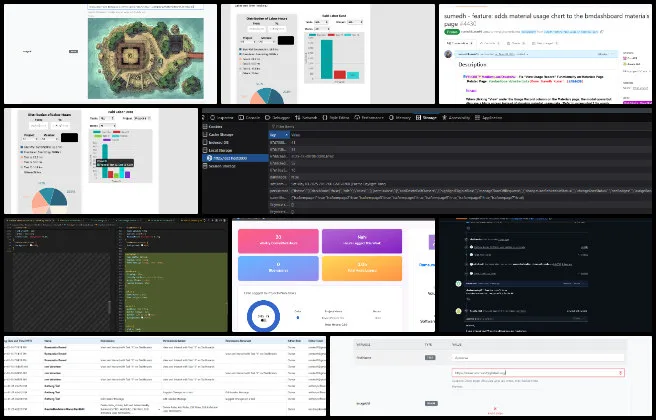
The Binary Brigade Team, presenting their work on the Highest Good Network software, was managed by Nikhil Routh (Software Engineer) and included Apoorva Jain Ramapura Prashanth (Software Engineer), Sourabh Bagde(Software Developer), Taariq Mansurie (Full-Stack Developer), Aswin “Tony” Kanikairaj (Software Engineer), Ramsundar Konety Govindarajan (Software Engineer), Sumedh Kumar (Full-Stack Developer), Harsha Rudhraraju (Software Engineer), and Amalesh Arivanan (Software Engineer). The Highest Good Network software is our tool for managing and objectively measuring progress, ensuring that all contributions are tracked and aligned with our mission while modeling and pioneering a prototype solution engine for global challenges. It supports social architecture, construction, production, and maintenance processes that contribute to open-source projects and resilient, sustainable ecosystems.
This week, Aswin improved the user experience of the Paid Labor Cost section in the BM Dashboard’s Total Construction Summary by fixing a Dark Mode contrast issue in the Tasks, Project, and Dates filters through CSS Module updates to input backgrounds, borders, and text/hover/focus states, aligning the styling with existing BM Dashboard filters and checking common viewport sizes for regressions. Sourabh completed end-to-end work on the Myspace autoposter by building a responsive card-based scheduling UI with subtabs, inputs, validation, and matched light/dark mode styling, and by adding Express routes for GET, POST, PUT, and DELETE to deliver a full CRUD API while addressing SonarCloud security findings by replacing Math.random() with a cryptographically secure ID generator and rewriting slugify as a linear sanitizer to reduce ReDoS risk. Nikhil resolved conflicts in older open pull requests, submitted them for review, raised PR 4690 for modularizing src/Common components, and completed managerial handover by training the current manager and transferring processes. The outcomes of this work align with the ongoing goal of pioneering a prototype solution engine for global challenges.
Sumedh resolved merge conflicts in PR4298, PR4336, PR4330, and PR4302 with verification to avoid functional impact, updated PR4473 to refine date filtering, enhanced the map view to show project end dates and render locations via Leaflet country lookup from coordinates, implemented authenticated-only access control in PR4302, and improved modularity while addressing SonarQube issues in PR4463. Ram updated the dashboard task “X” button so users without permission cannot use it, changed it to unassign a person instead of deleting a task, verified People Report behavior after unassigning, and investigated a 500 error tied to userProfile validation before sharing details with Diya. This section highlights how focused execution contributes to pioneering a prototype solution engine for global challenges.
Taariq worked on frontend and backend tasks, including implementing weekly summary email user inclusion logic for active users, debugging and stabilizing archived projects’ undo/unarchive behavior after merge-conflict impacts, completing remaining issues in a filter color refresh feature, and testing auto-scroll and BioStatusToggle behavior while reviewing active pull requests. The results achieved this week reinforce the direction of pioneering a prototype solution engine for global challenges.
Apoorva resolved Mailchimp merge conflicts, fixed bugs, and addressed remaining technical requirements for the final code push and applied UI improvements to Mastodon based on reviewer feedback. She implemented requested enhancements to the Truth Social Autoposter for testing to avoid regressions. Harshavarma implemented dark mode for the Members List tab, added reducers/actions/constants to support mock data, fixed import and reference issues affecting app runtime, validated action-to-reducer data flow and table rendering across member statuses in both themes, and raised PR 4699 for review. This work plays a role in pioneering a prototype solution engine for global challenges through coordinated, real-world implementation.
Amalesh finished work on PRs 704 and 1831 and created updated PRs (frontend 4679, backend 1990), delivered the Phase 2 Summary Dashboard weekly progress line chart with PRs (frontend 4320, backend 1878), started “Phase 1 Bugs: Fix PR4548” with frontend PR 4694, and tracked time and onboarding tasks while documenting testing artifacts in the shared folder. See the Highest Good Society and Highest Good Network pages for more information on how this works in pioneering a prototype solution engine for global challenges. The collage below shows images of their work.
BLUE STEEL SOFTWARE DEVELOPMENT TEAM
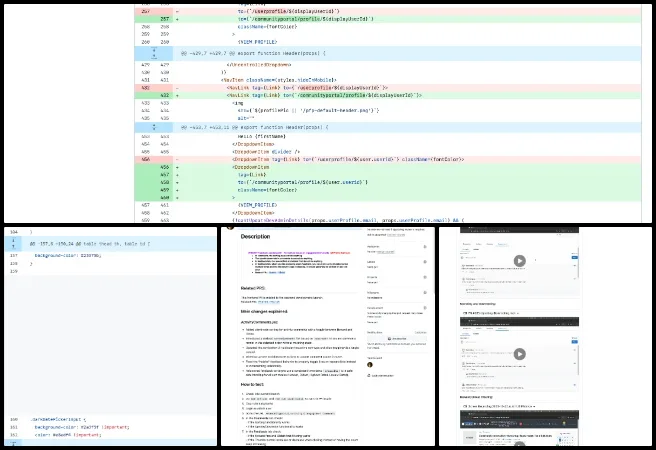
The Blue Steel Software Team, working on the Highest Good Network software, was managed by Divanshu Bakshi (Product Manager) and includes Linh Huynh (Software Engineer), and Som Ramnani (Software Engineer). This week, Linh worked on the front-end implementation of bulk actions and multi-select functionality for the Materials table, adding a checkbox column for row-level selection, a Select All option limited to visible items, and selection state handling to support multiple rows. A bulk actions dropdown was added to appear only when items are selected and to support actions such as marking items on hold, marking items as reviewed, adding or updating notes through a modal interface, and exporting selected items as CSV or PDF. His work supported ongoing development priorities aligned with a prototype solution engine for global challenges and included adding visual indicators for selected rows with styling verified in both light and dark modes, checking layout behavior across screen sizes to maintain responsiveness, adjusting the ItemsTable component to remain reusable across Materials and Reusables, and wiring the front-end export functionality while noting that remaining bulk update actions depend on backend endpoints and supporting data fields.
Som worked on PR #4585 to stabilize and improve the Activity Comments feature by fixing sorting behavior between Newest and Oldest, resolving upvote and downvote issues so vote counts update correctly, and addressing feedback-related bugs affecting helpful counts. Som updated the PR description, added demo videos to show expected behavior, and submitted the PR for review. He also addressed a Phase-3 task to redirect profile routes to the Hours Logging Dashboard instead of the Application Portal by resolving merge conflicts in CPDashboard.jsx, integrating development branch changes while preserving the new dashboard behavior, updating CPDashboard.jsx to ensure the dashboard loads correctly from profile routes, creating a new pull request for these changes, and updating demo videos to reflect the current dashboard behavior in support of a prototype solution engine for global challenges. See below images of their work.
CODE CRAFTERS SOFTWARE DEVELOPMENT TEAM
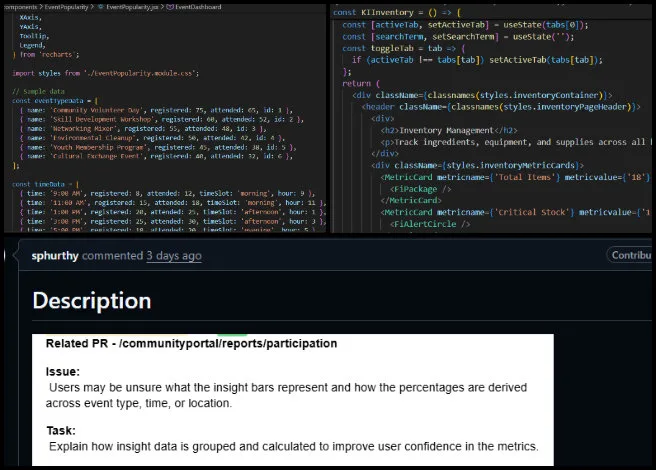
The Code Crafters Team, covering their work on the Highest Good Network software, was managed by Akshith Kumar Reddy Balappagari Gnaneswara (Software Engineer – Full Stack), Bhanu Anish Akkineni (Software Engineer), and Sphurthy Satish (Software Engineer). The Highest Good Network software manages and objectively measures our progress in pioneering a prototype solution engine for global challenges by coordinating social architecture, construction, production, and maintenance efforts while supporting scalable and lasting access to regenerative lifestyles worldwide.
This week, Akshith worked on Phase 3 enhancements by improving interactivity on the Event Participation page through the addition of filters, updating the data structure with new fields to support filtering, and implementing date range, time-of-day, and event-type filters to improve user experience. He also enhanced the Event Popularity page by adding more detailed data displays and hover-based interactions that allow users to view contextual information tied to chart visuals, followed by testing and raising a pull request for review. Anish focused on the Kitchen and Inventory Management portal by implementing the header and tab-based navigation bar for the inventory page, with an emphasis on layout structure and usability. He improved responsiveness through an interactive search bar and adaptive action buttons, and advanced dark mode support and media queries to ensure consistent behavior, visibility, and interaction across desktop, tablet, and mobile devices. The progress shown here continues the path of pioneering a prototype solution engine for global challenges through documented action.
Meanwhile, Sphurthy completed the Community Portal participation reports feature by addressing user questions around insight bar meanings and percentage calculations, adding an information icon with hover tooltips to the no-show rate insights section, defining clear explanatory tooltip content for average no-show percentage calculations grouped by event type, time, or location, implementing dynamic tooltip updates based on the active insight tab, and managing tooltip state, positioning, and visibility using React to ensure consistent interpretation of no-show rate data across reports. These efforts collectively strengthen One Community’s mission and commitment to pioneering a prototype solution engine for global challenges. The collage below shows an overview of this team’s work.
DEV DYNASTY SOFTWARE DEVELOPMENT TEAM
The Dev Dynasty Team’s summary, covering their work on the Highest Good Network software, was managed by Vamsidhar Panithi (Software Engineer) and includes Adithya Cherukuri (Volunteer Software Engineer), Deekshith Kumar Singirikonda (Developer), Neeraj Kondaveeti (Software Engineer), and Sriamsh Reddy (Software Engineer). The Highest Good Network software is how we’ll manage and objectively measure our processes of pioneering a prototype solution engine for global challenges through our social architecture, construction, production, and maintenance processes. This progress supports One Community in pioneering a prototype solution engine for global challenges.
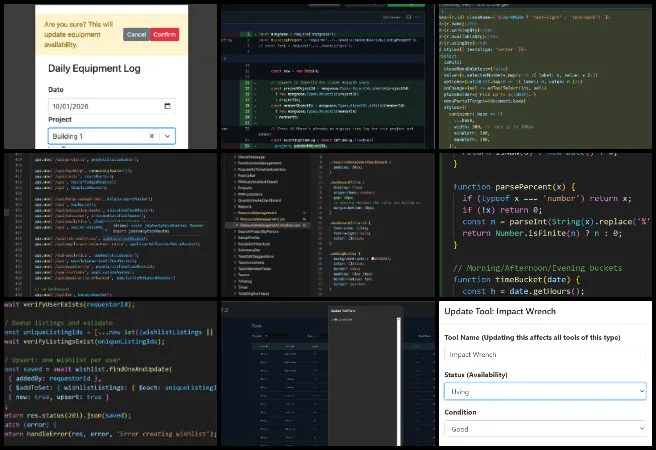
This week Adithya completed the Lessons page Back button fix by resolving linting issues, verifying backward routing, pushing updated code with documentation and images, then began the Edit Tool feature by creating a new branch, identifying the root error, adding an async Redux update action for backend PUT requests, and building an UpdateToolModal with Reactstrap that pre-fills tool data and validates required fields. Deekshith delivered a full-stack flow for wishlist management with Node.js and Express endpoints that enforce ownership, prevent duplicate listing IDs, apply an upsert strategy for one wishlist per user, and return consistent error responses, alongside React utilities for safe date parsing, percentage handling, time-bucket categorization, and hook-based state management that drives a dashboard with theme-aware styling, filters, and role-based props. The work completed this week adds clarity and depth to pioneering a prototype solution engine for global challenges.
Neeraj added client-side export to the Used Resources page with CSV and XLSX support reflecting current or selected rows, introduced row-selection state without altering layout, preserved column order in exports, generated date-based filenames, applied small spacing changes between action buttons, tested locally, and documented considerations for large datasets pending paginated APIs. Sriamsh reworked the Daily Equipment Log flow by adding an inline confirmation banner with Cancel and Confirm actions, separating confirmation from execution logic, adding post-submission feedback, checking project selection behavior when no data is expected, reviewing small-screen layout issues such as overlaps, and validating user flows around project selection, log type changes, and confirmation. These efforts collectively move the project forward in pioneering a prototype solution engine for global challenges.
Vamsidhar fixed Time Log Visibility on the Member Group Check-In page by creating a Time Log Summary component that refreshes on stop actions, handling nested and flat member arrays, ensuring timers start from zero, keep paused and resumed states via React refs, and retain final values. On the backend, he added a project time log retrieval endpoint, corrected route ordering, updated aggregation pipelines to reference userProfiles with proper ObjectId conversion, removed extra console logs, and verified that time logs now appear immediately without page refresh. See the Highest Good Society and Highest Good Network pages for more on how this relates to our mission of pioneering a prototype solution engine for global challenges. Explore some of the team’s work in the collage below.
EXPRESSERS SOFTWARE DEVELOPMENT TEAM
The Expressers Team’s summary, which covers their work on the Highest Good Network, was managed by Rahul Trivedi (Software Engineer) and includes Casstiel Pi (Software Engineer). This effort supports One Community’s goal of a prototype solution engine for global challenges.
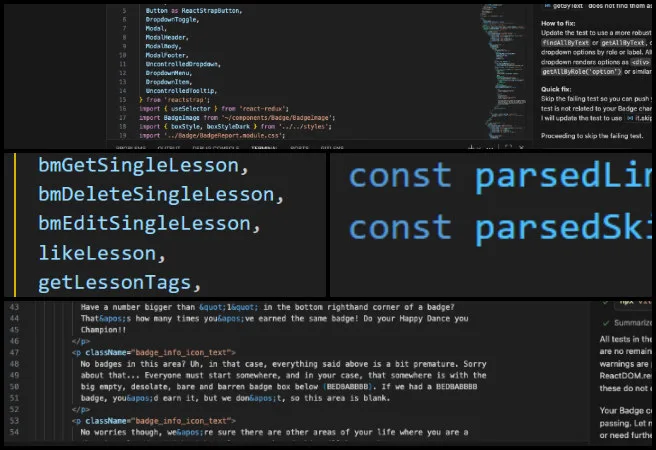
This week, Casstiel continued work on enhancing the multi-select filter solution. The frontend portion is complete, and efforts are now focused on developing the backend logic, including adding a new optimized controller and implementing new pagination options for better display. The clicking error still occurs when users interact with the box, as the related fix has not yet been merged into the dev branch. Backend logic is being tested in the local environment, where some logical errors have been identified due to incorrect data being returned. Rahul focused on improving the BMDashboard activity log by optimizing performance and resolving identified bugs, followed by additional fixes within the same component to improve stability. The dashboard was reviewed after each change to verify that updates functioned as expected. Further work was carried out to optimize the BMDashboard by identifying remaining issues and outlining areas requiring correction. In parallel, team management responsibilities were completed, including reviewing weekly summaries and assessing submitted videos and images to ensure alignment with ongoing work and standards. See the Highest Good Society and Highest Good Network pages for more on how this work contributes to a prototype solution engine for global challenges. See the collage below to view the team’s work.
LUCKY STAR SOFTWARE DEVELOPMENT TEAM
The Lucky Star Team’s summary, covering their work on the Highest Good Network, was managed by Keerthana Chitturi (System Administrator) and Sohail Uddin Syed (Software Engineer). The team includes contributions from Chirag Bellara (Software Engineer), Shashank Madan (Software Engineer), Shravya Kudlu (Software Development Engineer), Veda Bellam (Software Engineer), Venkataramanan Venkateswaran (Software Engineer) and Vinay Krishna (Software Engineer). Their work supports One Community’s goal of a prototype solution engine for global challenges through cross-functional software development and ongoing system improvements.
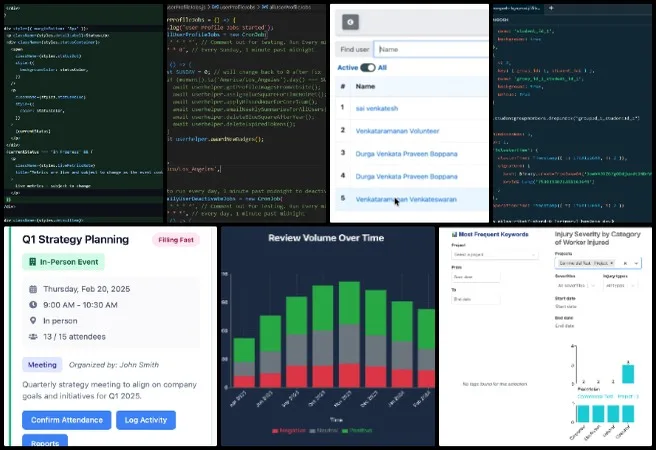
This week, Chirag worked on fixing merge errors in PR 4304 by reapplying changes after overlapping updates in related pull requests. He added a Capacity filter to events in the Database Design tab, updated the filtering logic to run on the client side, implemented dark mode support, improved filter alignment, and created pull request 4687 with the completed updates. This work contributes to a prototype solution engine for global challenges. Shashank focused on improving dark mode styling across relevant components, resolving merge conflicts from an older pull request, and enhancing code quality. He implemented logic to dynamically display attendance statistics based on event progress and completion timing, refactored inline styles into a module.css file for maintainability, updated no-show charts to support dark mode, tested the changes, resolved additional conflicts, and raised a pull request for review. This backend and frontend progress contributes to a prototype solution engine for global challenges.
Shravya completed the teacher-facing student group feature, enabling educators to create groups, manage student membership, and remove groups or individual members. She resolved blocking issues in data models and controllers related to missing validation, sanitization, and incorrect route mappings, and submitted the fixes under pull request 1997. She also addressed a previously reported registration page error by resolving extensive merge conflicts and aligning the code with current standards while ensuring compliance with SonarQube requirements. These backend updates contribute to a prototype solution engine for global challenges. Sohail resolved badge category count and assignment discrepancies related to pull requests 2877 and 1153 by correcting backend calculation logic, synchronizing badge distribution, and fixing historical data inconsistencies. He also resolved merge conflicts for pull request 1788 related to Blue Square email automation, which was tested and reviewed before being merged. This backend refinement contributes to a prototype solution engine for global challenges.
Veda worked on the Listing and Bidding Dashboard by creating a stacked column chart titled Review Volume Over Time within the Reviews section. Her work included resolving frontend issues, implementing sentiment-based stacked bars, date range filtering, category-based grouping, consistent sizing with existing dashboard visuals, fixing MongoDB connection issues affecting data availability, refining mobile responsiveness, and ensuring consistent behavior across light and dark modes. These updates contribute to a prototype solution engine for global challenges. Venkataramanan resolved multiple frontend and backend issues across the HighestGoodNetworkApp and HGNRest repositories, addressing UI alignment problems, duplicate and misordered blue squares, bio status filtering behavior, WBS resource dropdown logic, timelog submission validation, and related controller updates while coordinating testing and reviews. These fixes contribute to a prototype solution engine for global challenges.
Vinay addressed a hover-triggered chart visibility issue on the Injury Severity by Category of Worker Injured dashboard by refactoring render logic so charts display immediately after filters change, restricting hover behavior to tooltips, and validating behavior across datasets and filter combinations. This refinement contributes to a prototype solution engine for global challenges. See the Highest Good Society and Highest Good Network pages to learn more about how this work supports a prototype solution engine for global challenges. The collage below highlights the team’s work for the week.
MOONFALL SOFTWARE DEVELOPMENT TEAM
The Moonfall Team’s summary, which covers their work on the Highest Good Network, was managed by Uha Kruthi (Software Engineer) and includes Aayush Shetty (Software Engineer), Alisha Walunj (Software Engineer), Mani Shashank Marneni (Software Engineer), Sai Krishna (Software Engineer), and Sudheesh Thuralkalmakki Dharmappa Gowda (Full Stack Developer). Their efforts support One Community by advancing the mission of a prototype solution engine for global challenges through open-source collaboration, ecologically responsible innovation, and holistic global progress.
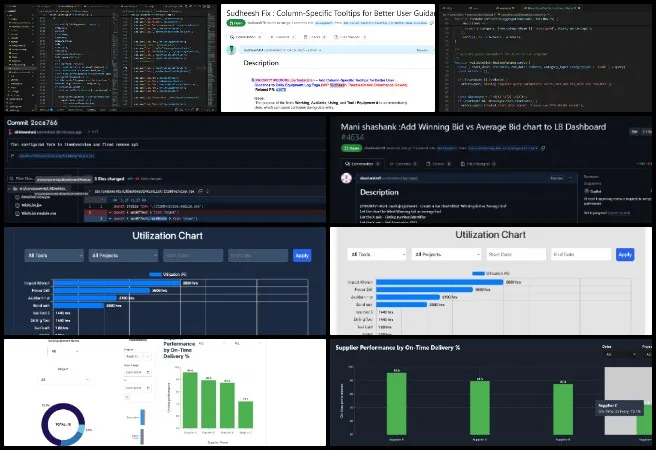
This week, Sai built the backend infrastructure for the Distribution of Labor Hours pie chart by creating a controller to aggregate labor hours from the timeentry collection using MongoDB pipelines grouped by team, project, and project category. He implemented router endpoints to fetch distribution data and supported category types, registered routes in the central configuration, validated date formats and category values, and calculated percentage values for accurate visualization. The outcomes of this work align with the ongoing goal of pioneering a prototype solution engine for global challenges. Sudheesh worked on Phase 2 Summary Dashboard tasks by fixing pending issues in the material utilization ratio chart, resubmitting the updated work for testing, and updating dark mode styling on the Supplier Performance Chart through CSS adjustments and frontend component updates to ensure consistent appearance.
Aayush resolved merge conflicts across multiple frontend and backend pull requests, addressed sonar code analysis feedback, fixed dark mode issues related to an existing pull request, prepared changes for branch integration, captured screenshots for documentation, uploaded supporting visuals, and submitted the weekly summary. The results achieved this week reinforce the direction of pioneering a prototype solution engine for global challenges. Mani developed a horizontal bar chart titled “Winning bid vs Average bid” by mapping listing identifiers against USD values with dual series for winning and average bids. He added a color-coded legend, integrated a calendar-based date range selector and a Top N filter, implemented conditional grouping by village or property with dynamic filter enablement, and ensured responsive design aligned with other dashboard components.
Uha fixed visibility and accessibility issues in the Utilization Chart across light and dark modes by improving contrast for chart values, axis labels, legends, and button text, correcting Apply button visibility in light mode, and ensuring hour labels remain readable in dark mode. Alisha completed work on the listing and bidding platform by implementing and refining wishlist functionality through CSS modularization, updating the Wishlist component to correctly display amenities and pricing, fixing routing between wishlist and item overview pages, resolving an issue caused by a null userId from localStorage by updating reducer logic and API URLs, rebasing her branch with the latest codebase, correcting the remove-from-wishlist endpoint, configuring a missing form, and adjusting styling to align with updated functionality. Visit the Highest Good Society and Highest Good Network pages for more on how this work supports creating a prototype solution engine for global through open-source development and globally accessible resources. The collage below paints the team’s efforts for the week.
REACTONAUTS SOFTWARE DEVELOPMENT TEAM
The Reactonauts team summary was managed by Akshay Jayaram (Software Engineer) and Iteesha Vishalakshi Aswath (Technical Program Manager), and it includes Aseem Deshmukh (Software Developer), Diya Wadhwani (Software Developer), Kristin Dingchuan Hu (Software Engineer), Namitha Vijaykumar Pawar (Software Engineer), Peterson Rodrigues dos Santos (Full Stack Developer), Sri Satya Venkatasai Siri Sudheeksha Vavila (Software Engineer), Siva Putti (Software Engineer), and Suparshwa Patil (Software Engineer). The Highest Good Network software helps manage and objectively measure progress by focusing on pioneering a prototype solution engine for global challenges. It supports social architecture, construction, production, and maintenance processes to build sustainable and thriving ecosystems in order to work towards pioneering a prototype solution engine for global challenges.
This week, Akshay enhanced the Community Portal database design page by adding a Sort by Date filter that allows events to be ordered from earliest to latest or latest to earliest. He implemented client-side sorting based on event date data from MongoDB, integrated the feature with existing type and location filters, ensured proper reset behavior with Clear Filters, and updated filter state handling, while also submitting the weekly team review, tracking contributor progress, and hosting the weekly team call towards pioneering a prototype solution engine for global challenges. Aseem addressed requested updates for PR 4310 by adjusting the layout so charts, buttons, and filters remain contained within the Financials card on smaller screens, making the card responsive, and pushing the updates to GitHub. Diya resolved final-day inconsistencies discovered during validation of PR 1986 by fixing failing tests related to Mongo session handling after Jest teardown, refactoring the user lifecycle model to introduce explicit lastActivityAt and deactivatedAt tracking, separating paused and separated states, moving end-date derivation and notifications to a cron-based process, refining edge cases around same-day activity, validating behavior across lifecycle flows, enforcing access restrictions after finalization, documenting lifecycle rules and test scenarios, and consolidating all changes into PR 1993. The progress made this week contributes to our long-term goal of pioneering a prototype solution engine for global challenges.
Kristin completed sorting functionality for the Resources Management page, resolved merge conflicts, applied reviewer feedback, and opened frontend PR 4675. She also began implementing a dropdown on the Community Portal calendar to support year, week, and day views with initial weekly grid structure updates. Namitha fixed issues from PR 4197 affecting Listing and Bidding Dashboard bar graphs by improving dark mode tooltip visibility, adding mobile responsiveness, updating chart theming for light and dark modes, enabling and configuring data labels, standardizing axis usage, setting final graph titles, and ensuring consistent layout across viewports. Peterson improved the PR Promotions modal styling by correcting dark and light theme color usage to improve readability, contrast, and overall accessibility, and submitted the changes in PR 4678. Each step forward supports One Community’s focus on pioneering a prototype solution engine for global challenges thereby paving way for a better future. Sudheeksha spent 20 hours across three days completing Phase 2 work to fix the Lesson List Filter not updating results, resolved the underlying errors, finalized corrections, and raised the pull request. Siva updated feedback sorting to use the createdAt field, added null safety for date handling, restructured feedback search logic, added unit tests, resolved SonarQube issues by modernizing NaN checks and improving error logging, removed unused state, simplified nested logic, and fixed text contrast issues for accessibility across PRs 4662, 4633, and 4553. This work plays a role in pioneering a prototype solution engine for global challenges through coordinated, real-world implementation.
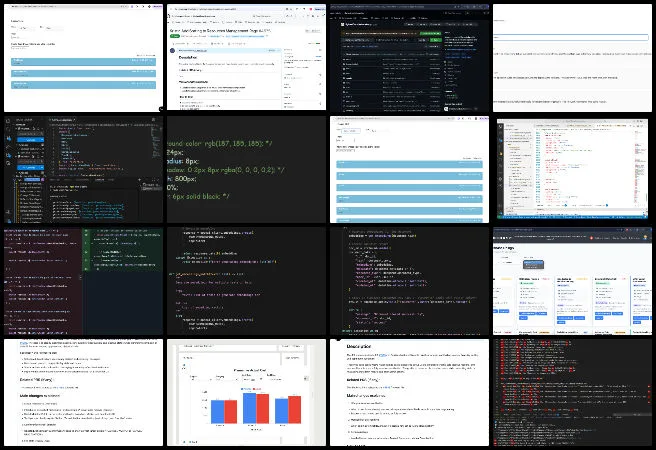
Suparshwa refined the chatbot prompt to restrict responses to provided documents and began developing an orchestration layer for persistent chat memory, defining logic for storing, retrieving, and using prior interactions to maintain conversational context. See the Highest Good Network and Highest Good Society pages to learn more about how this work supports the modeling and pioneering a prototype solution engine for global challenges. See below for the picture collage of the work done by the Reactonauts team towards building a prototype solution engine for global challenges.
SKYE SOFTWARE DEVELOPMENT TEAM
The Skye Team’s summary, covering their work on the Highest Good Network, was managed by Sayantan Paul (Frontend Tester and Software Team Administrator) and Anthony Weathers (Software Engineer). The team includes Lavanya Lahari Nandipati (Software Developer), Marcus Yi (Software Engineer), and Swathi Angadi (Software Engineer). The Highest Good Network software objectively tracks and manages progress, supporting social architecture, construction, production, and maintenance processes that foster sustainable and thriving ecosystems, while playing a major role in pioneering a prototype solution engine for global challenges.
This week, Lavanya investigated and resolved an issue affecting the 40-hour badge by testing badge behavior across multiple weekly scenarios, including partial weeks, mixed hour entries, and boundary conditions. She traced data flow through hour aggregation and badge eligibility logic to identify where incorrect evaluation occurred, implementing a targeted code change to correct the calculation while preserving related badge behavior, validating the fix across multiple scenarios, removing temporary diagnostic logs, and preparing the change for review with documented findings. This progress reflects continued momentum in pioneering a prototype solution engine for global challenges through open development.
Marcus worked on finishing the Facebook and Facebook Groups poster and scheduler by fixing image-only posting so standalone images can be published. He extended the same functionality to scheduled posts, implementing photo scheduling, verifying that scheduled image posts process correctly, pushing frontend changes to the main branch, preparing a pull request, coordinating with users to identify alternative testing approaches due to platform limitations, investigating remaining issues with scheduled posting validation, and outlining next steps to enable reliable end-to-end testing. These efforts reflect One Community’s ongoing dedication to pioneering a prototype solution engine for global challenges.
Swathi worked on adding functionality to the bm dashboard materials page by implementing required behaviors aligned with existing workflows, addressing dark mode issues across the consumable page, materials page, and add material dropdown to ensure consistent styling and visibility. She also updated the materials dropdown to display the latest available values to support accurate selection and interaction within the dashboard. This work contributes to pioneering a prototype solution engine for global challenges through practical, repeatable development.
Anthony worked on a fix to prevent the warning tracker list from failing to update when viewing a user’s warnings after any modifications were made. He enabled the list to be retrieved correctly, then continued investigating ways to improve the speed of the process before finalizing the changes. He investigated an issue where a user could not assign a warning despite having the required permissions and determined that removing and re-adding the permission resolved the problem. By addressing these challenges, their work supports long-term stability in stewardship tracking features and contributes to advancing and pioneering a prototype solution engine for global challenges within the broader Highest Good Network (HGN) infrastructure. See the Highest Good Network and Highest Good Society pages for more on how this contribution advances One Community’s goals by pioneering a prototype solution engine for global challenges within the Highest Good Network open source hub. See the collage below for the team’s work.
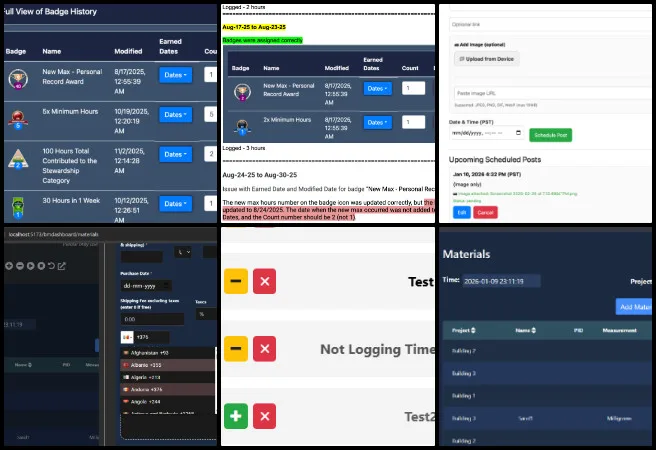
SOFTWARE PR REVIEW TEAM A-N
The PR Review Team’s summary for members with names starting A–N, managed by Neeharika Kamireddy (Data Analyst), highlights their contributions to the Highest Good Network software. This platform forms the foundation for measuring our results in pioneering a prototype solution engine for global challenges. Active team members included Abdelmounaim Lallouache (Software Developer), Abhinav Tharamel Baiju (Software Engineer), Carl Bebli (Software Developer), Julia Ha (Software Engineer), and Nathan Hoffman (Software Engineer). They supported the project by reviewing all pull requests shared this week. Learn more about how the Highest Good Network tracks progress toward pioneering a prototype solution engine for global challenges in the Highest Good Network open source hub. The collage below showcases a compilation of this team’s work.
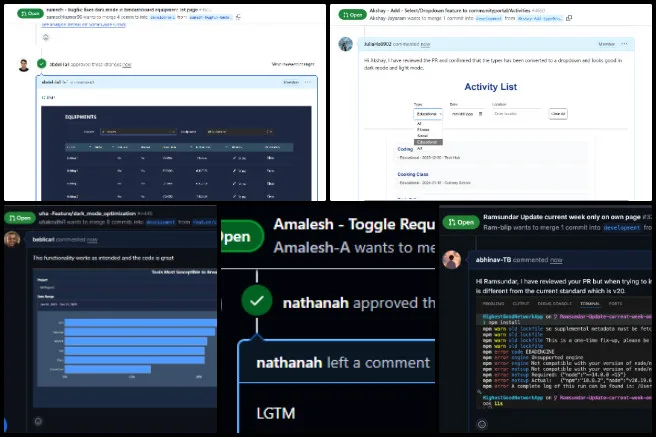
SOFTWARE PR REVIEW TEAM O-Z
The PR Review Team’s summary for team members with names starting from O–Z, covering their work on the Highest Good Network software, was managed by Jaiwanth Reddy Adavalli (Software Project Manager). The Highest Good Network software is a foundation for measuring our results in pioneering a prototype solution engine for global challenges. This week’s active members of the team were Rohan Rastogi (Software Engineer), Sai Shravan Neelamsetty (Software Engineer), Shreya Padaganur (Software Engineer), Sundar Machani (Software Engineer), Vikas Meneni (Software Engineer), and Yiyun Tan (Software Engineer). They reviewed all the Highest Good Network PRs (Pull Requests) shared in this week’s update. Learn more about how the Highest Good Network open source hub measures progress toward pioneering a prototype solution engine for global challenges. The collage below shows a compilation of the work from this team.
AND WE PRODUCED THIS WEEKLY UPDATES BLOG – CLICK HERE TO SUBSCRIBE
FOLLOW ONE COMMUNITY’S PROGRESS (click icons for our pages)
INVESTOR PAGES
OVERVIEW | LOCATION | FUNDING
GET INVOLVED
DONATE | WAYS ANYONE CAN HELP | MEMBERSHIP
CLICK HERE FOR ALL PAST UPDATES
Category: Basics of One Community, Community, One Community Tags: sustainable civilization building, permaculture, RBE, Highest Good society, creating global solutions, One Community Update, addressing climate change, Education for Life update, creating a new world paradigm, open source, grass roots sustainability, open source food, the betterment of society, non profit, self-sufficiency, ecological living, creating holistic transformational change, sustainable living, radical sustainability, solutions that create solutions, regenerative world building, open source sustainability, open source housing, One Community progress, Duplicable City Center Hub, global sustainability, open source design, Education For Life progress, better is possible, for the highest good of all, A Prototype Solution Engine for Global Challenges, transforming the global environment, solution based thinking, sustainable community building, Earthbag Village, Highest Good education, one community, Permaculture Communities, Highest Good housing, food forest, green living, resource based economy, Highest Good food
 One Community