One Community
Sustainable Human Support Webs – One Community Weekly Progress Update #688
Through our work at One Community, sustainable human support webs are designed to make a sustainable future practical and accessible for all. As an all-volunteer team committed to “The Highest Good of All,” we are open sourcing and free sharing a self-replicating model that brings together sustainable food, energy, housing, education, economics, and social architecture. By evolving sustainability and fostering global stewardship practices, we are creating collaborative teacher/demonstration hubs to help regenerate our planet and build a world that works for everyone.
- Here’s our project overview
- Here’s our world-change methodology
- Here’s how this becomes self-replicating
- Here’s how we are open source and free-sharing all the do-it-yourself designs
OUR MAIN OPEN SOURCE HUBS
Click on each icon to be taken to the corresponding Highest Good hub page.
One Community’s physical location will forward this movement as the first of many self-replicating teacher/demonstration communities, villages, and cities to be built around the world. This is the May 25, 2026 edition (#688) of our weekly progress update detailing our team’s development and accomplishments:
Sustainable Human Support Webs
One Community Progress Update #688

DONATE | COLLABORATE | HELP WITH LARGE-SCALE FUNDING
CLICK HERE IF YOU’D LIKE TO RECEIVE AN EMAIL EACH WEEK WHEN WE RELEASE A NEW UPDATE
YOU CAN ALSO JOIN US THROUGH SOCIAL MEDIA


ONE COMMUNITY WEEKLY UPDATE DETAILS
HIGHEST GOOD HOUSING PROGRESS
One Community is pioneering sustainable human support webs through Highest Good housing that is artistic and beautiful, more affordable, more space efficient, lasts longer, DIY buildable, and constructed with healthy and sustainable materials:
- Learn about: Our Upcoming Crowdfunding Campaign
- Learn about the different village models and sustainable human support webs: 7 Sustainable Village Models
- Visit the open source portals for the first two: Earthbag Village OS Hub | Straw Bale Village OS Hub
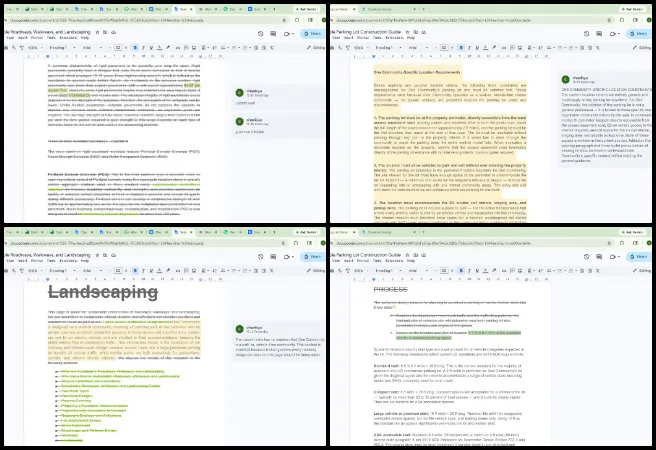
This week, Chanikya Sita (Civil/Transportation Engineer) completed Task #860 by reviewing the Sustainable Roadways, Walkways and Landscaping page and the Sustainable Parking Lot Construction guide line by line from a transportation engineering perspective. He identified grammar issues, updated cost figures to reflect 2025 market rates using verified industry sources, and added missing technical content related to traffic demand modeling, NFPA 1 fire access code requirements, wetland setback criteria, and light pollution mitigation. Chanikya added edits to both Google Docs as tracked suggestions and included comments citing relevant standards. His work contributes to sustainable human support webs by improving the accuracy and accessibility of open-source infrastructure planning resources. See below for some of the pictures related to this work.
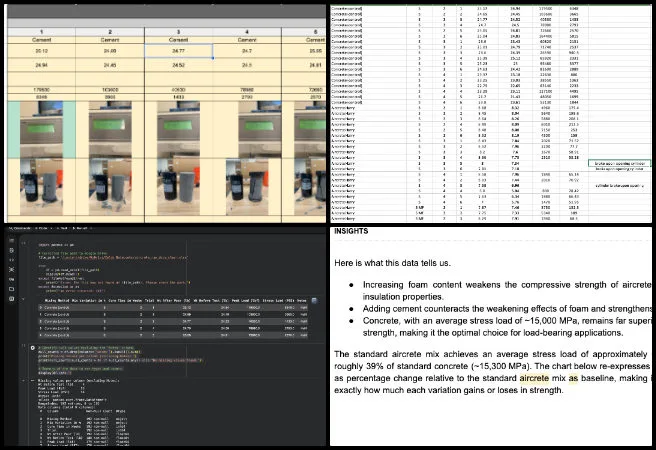
Devendranath Chowdary Maganti (Administrative Assistant) worked on Aircrete documentation and reviewed the full Aircrete process and related testing scenarios to strengthen understanding of the project. He also reviewed summary graphs and created a new Google Sheet using the provided data to improve visualization and make the information easier for the audience to interpret. In addition, Devendranath developed new visualizations, including items that had been missed in previous work, to improve data presentation. He also provided support to the Administration Team as needed. His efforts support sustainable human support webs by improving the organization and communication of technical sustainability information. Below, you’ll find some images of this work.
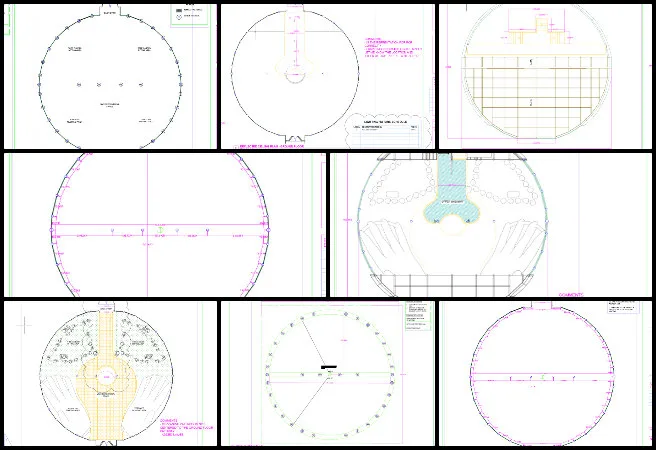
Gaurang Pawar (Architectural Designer) reviewed Michaela’s drawings and identified the required updates. He updated the AutoCAD file to reflect those changes and added plan placeholders where required. For areas where final plans were not yet available, he created box placeholders within the viewports for future plan placement. Gaurang also uploaded the updated AutoCAD file and the sheet PDFs to Dropbox. This work supports sustainable human support webs through improved coordination and accessibility of architectural documentation. Review the latest updates in the images below.
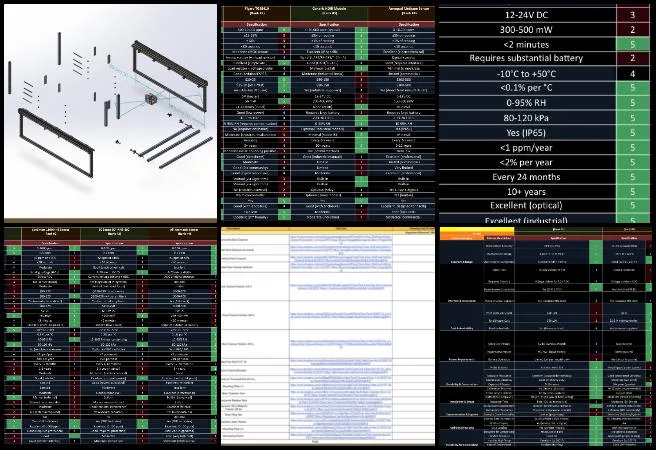
Rishi Chakrapani (Mechanical Engineer) continued working on the Vermiculture Toilet. He added additional images of individual components to the Bill of Materials to improve visual reference and documentation of the assembly. Explanations and analysis were included for each listed component to provide additional detail on part selection and function within the system. The sensor selection report tables were reformatted to improve organization, readability, and consistency across the report. These updates contribute to sustainable human support webs by strengthening the clarity and usability of sustainable engineering documentation. Below, you’ll find some images of this work.
DUPLICABLE CITY CENTER PROGRESS
One Community is pioneering sustainable human support webs through a Duplicable and Sustainable City Center that is LEED Platinum certified/Sustainable, can feed 200 people at a time, provide laundry for over 300 people, is beautiful, spacious, and saves resources, money, and space:
- Learn about this building and its function and sustainable human support webs: Duplicable City Center Open Source Hub
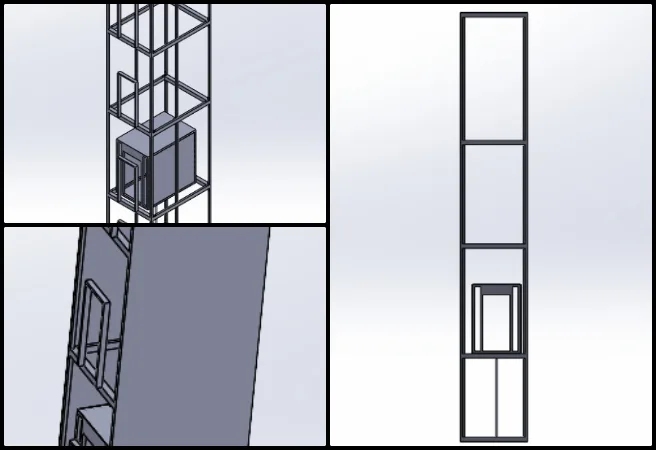
This week, Akhil Shesham (Mechanical Engineer) continued working on the open-source elevator assembly by modeling additional missing components and integrating them into the existing SolidWorks assembly. He also worked on refining and updating the WBS to reflect the current project scope and deliverables. In addition, Akhil focused on assembly closure by adjusting component placement, resolving fit / alignment issues, and moving the assembly toward the final stage. This open source Duplicable City Center project is pioneering sustainable human support webs. For more information, check the image below.
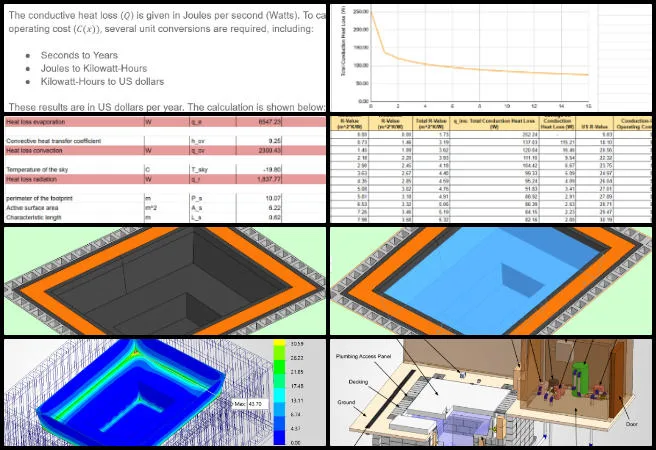
Bevan Chiu (Mechanical Engineer) continued refining his work finishing the City Center Eco-spa Designs. He worked on the heat loss calculations to align with the current design specifications, linked the conduction calculations to the insulation sweet spot analysis, and verified the results with close agreement. He updated the thermal sweet spot analysis by refining the marginal heat loss savings plots and improving the report formatting. He also integrated the insulation sweet spot analysis section into the final report, including results for insulation thicknesses ranging from 0 to 16 inches and the associated operating cost calculations. This progress supports sustainable human support webs through improved coordination and planning. He created a diagram listing the different components for the spa tub. For the thermal FEA supporting the insulation sweet spot analysis, Bevan refined the parametric setup and compiled the heat power results for different insulation thickness values. This open source Duplicable City Center project is pioneering sustainable human support webs. For more details, refer to the image below.
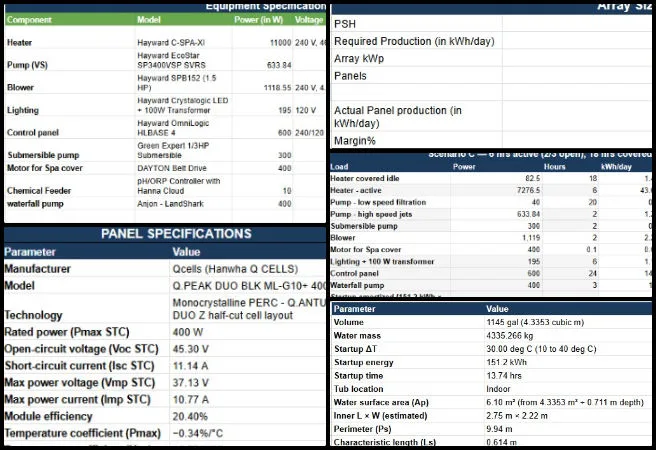
Kaartick Tamilarasan (Mechanical Engineer) continued working on the Duplicable City Center design. He focused on completing the off-grid solar system design calculations for the confirmed scenario, which established a design load of 71.736 kWh/day based on 6 hours of active spa use daily with the cover two-thirds open and 18 hours fully covered. After applying a 5% contingency and a 0.85 system efficiency factor, the required daily solar production was calculated as 84.4 kWh/day. Using a California winter peak sun hours value of 4.5 hours per day, the required array size was calculated as 18.756 kWp. Panel counts of 48, 54, 60, 66, and 72 were evaluated, and 60 panels met the required production threshold after system losses. This work contributes to sustainable human support webs through improved systems and documentation. A configuration of 72 panels was selected, producing 110.16 kWh/day with a 30.52% margin above the required value to maintain compliance through year 25 of the panel warranty period. The array string configuration was calculated as 3 panels per string, 24 total strings, and 8 MPPT charge controllers with 3 strings connected to each controller and a combined short-circuit current of 33.4 A per controller. A comparison of commercially available 400 W monocrystalline PERC panels was completed, and the Qcells Q.PEAK DUO BLK ML-G10+ panel was selected based on electrical specifications, California wind and snow load ratings, 25-year warranty coverage, and CEC listing. This open source Duplicable City Center project supports sustainable human support webs by enhancing clarity and accessibility. For more details, refer to the image below.
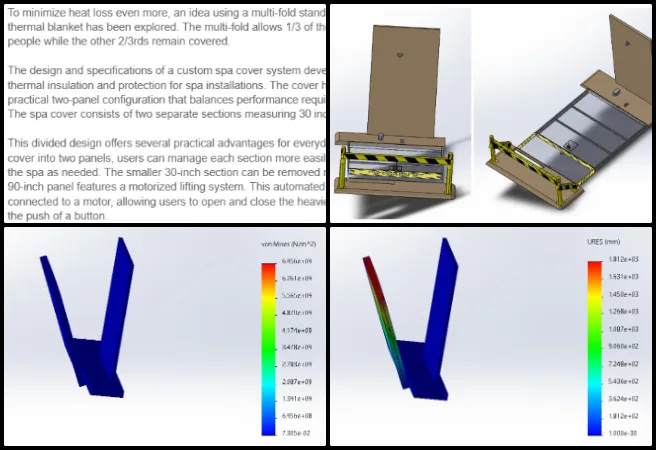
Shivarama Krishna Revanuru (Mechanical Engineer) continued working on the Duplicable City Center design. He focused on writing the project report by collecting relevant data and supporting documents. Changes were made to the SPA cover CAD model based on updated requirements and feedback from teammates, and FEA analysis was created using updated simulation conditions. Collaboration with teammates continued on the thermal analysis of the spa system to review design performance and evaluate analysis results. This open source Duplicable City Center project is pioneering sustainable human support webs. The images below illustrate aspects of this work.
HIGHEST GOOD FOOD PROGRESS
One Community is pioneering sustainable human support webs through Highest Good food that is more diverse, more nutritious, locally grown and sustainable, and part of our open source botanical garden model to support and share bio-diversity:
- Learn about the structures and sustainable human support webs: Hoop House Hub | Aquapini & Walipini Open Source Hub
- See what we’ll be growing: Gardens & Hoop Houses | Large-scale Structures | Food Forest | TA
This week, the core team continued working on the Master Tools, Equipment, and Materials/Supplies List for the Large-scale Garden, Botanical Garden, and other Highest Good Food components. They revised the shop drawing to increase natural light and relocated tool storage within the GSI to improve the efficiency of tool movement. They focused on reviewing the TEMS documentation by expanding descriptions for items including the moisture meter, Japanese pull saw, and magnets. They also completed the alphabetization of all individual tool listings. Their efforts contribute to One Community’s mission of sustainable human support webs through open-source collaboration, ecologically responsible innovation, and a focus on long-term global development. The collage below portrays the team’s efforts and achievements for the week.

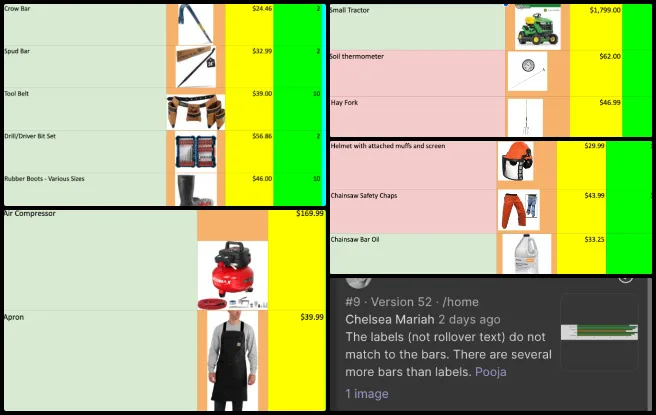
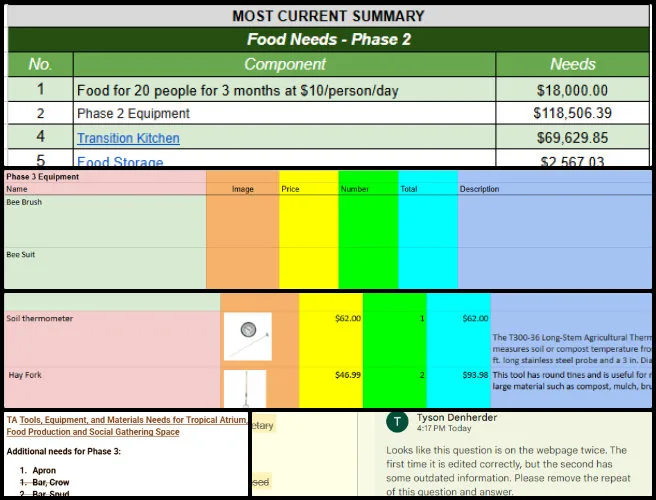
Chelsea Mariah Stellmach (Project Manager) continued her work on the Transition Food Self-sufficiency food and inventory tracking software plans. She followed up on ongoing projects with Pooja and Sayantan and met with Tyson to discuss ways she could support his project as a consultant. Based on Tyson’s recommendation, Chelsea began working on the pricing spreadsheet and added photos, links, and estimated costs for equipment and materials needed during the early phases of the build-out, including tractors and calipers. These contributions support sustainable human support webs by strengthening both technical execution and design alignment across the platform. See the collage below for this week’s progress.
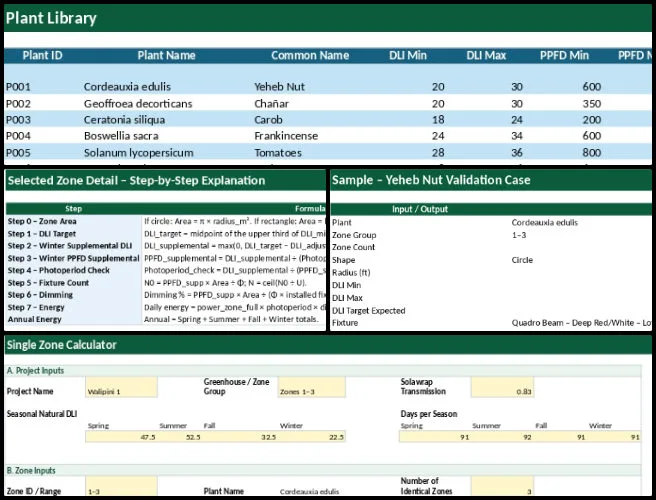
Jay Nair (BIM Designer) continued work on the Aquapini and Walipini Planting and Harvesting documents and created a spreadsheet-based lighting energy calculator to support greenhouse lighting analysis. He added new features based on greenhouse design requirements, adjusted input parameters, refined calculation logic, and organized outputs to help evaluate lighting configurations and identify energy-saving options. These updates improve the stability and adaptability of shared systems, supporting the broader goal of sustainable human support webs. See the collage below portraying the work done this week.
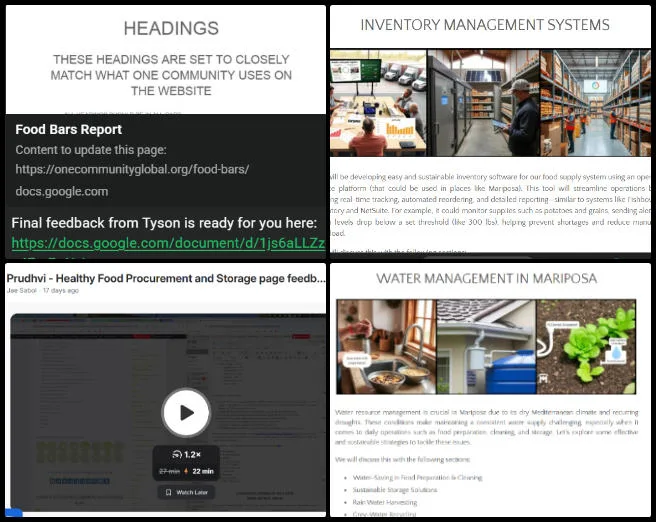
Prudhvi Marpina (Data Analyst) continued supporting the Highest Good Food website development, Highest Good Network software development, marketing, and administration activities. He worked on the Food Procurement and Storage page by updating and arranging images in WordPress based on the latest corrections and review feedback. He also reviewed suggested corrections for the Food Bars page and implemented the required updates. In Phase 5 governance, he updated action items with detailed explanations and added deliverable-related action items to the Phase 5 document. This effort strengthens sustainable human support webs through structured and organized workflows.
In marketing and promotion, Prudhvi coordinated with Shameera regarding BlueSky posting workflows, Buffer scheduling, and analytics tracking processes. He also supported One Community administration by taking over Alpha Team responsibilities for Week 687, updating the weekly WordPress page, and providing feedback to the administration team for the reporting period. This work supports One Community’s mission of sustainable human support webs. See below for images showcasing his work.
HIGHEST GOOD ENERGY PROGRESS
One Community is pioneering sustainable human support webs through Highest Good energy that is more sustainable, resilient, supports self-sufficiency and includes solar, wind, hydro and more:
- Learn about the open source sustainable-energy foundations and sustainable human support webs: Solar, Hydro, and Wind
- Explore our research into the most sustainable products and companies for saving water and energy: Insulation, Eco-laundry, Lightbulbs and Light Bulb Companies, Doors and Door Companies, Windows and Window Companies, Toilets, Faucets and Faucet Accessories, Urinals, and more.
This week, the core team continued contributing to the Highest Good Energy initiative. They completed an initial review and final review of the Food Bars webpage and provided feedback and suggested revisions as needed. They also met with Chelsea to continue work on the cost analysis for the tools and equipment required for phase 2 of the food infrastructure project. In addition, they completed the list of tools and equipment needed to support the cost analysis for phase 3 of the food infrastructure project. This work contributes to sustainable human support webs, as shown in the collage below.
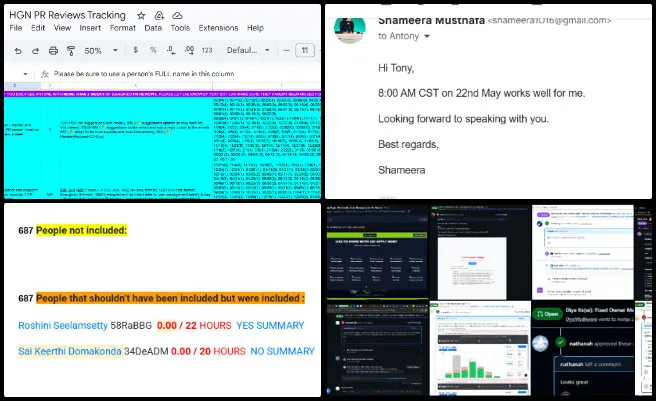
Shameera Musthafa (Data Analyst) continued contributing to the Highest Good Energy initiative. She supported One Community Administration and the PR Review Team by coordinating PR review workflows, reviewing the work of the Admin and PR teams, and providing feedback to improve accuracy, clarity, and consistency across deliverables. She organized and categorized project images, created visual collages, and finalized blog-related content as part of PR review coordination. Shameera also contributed to the Highest Good Energy report pages and related visualizations and helped the hiring process by interviewing and evaluating candidates. This work plays a key role in sustainable human support webs. See below for images showcasing her work.
HIGHEST GOOD EDUCATION PROGRESS
One Community is pioneering sustainable human support webs through Highest Good education that is for all ages, applicable in any environment, adaptable to individual needs, far exceeds traditional education standards, and more fun for both the teachers and the students. This component of One Community is about 95% complete with only the Open Source School Licensing and Ultimate Classroom construction and assembly details remaining to be finished. We’ll report on the final two elements to be finished as we develop them.
With over 8 years of work invested in the process, the sections below are all complete until we move onto the property and continue the development and open sourcing process with teachers and students – a development process that is built directly into the structure of the education program and everything else we’re creating too:
- Program Overview: Education Open Source Hub
- How the components work together in designing human orchestrated eco-abundance and sustainable human support webs: How to use the Education for Life Program
- Lesson Plans for Life – Lesson Plans How-to
- Foundations of Outstanding Leaders, Teachers, and Communicators
- Curriculum for Life
- Teaching Strategies for Life
- Learning Tools and Toys for Life
- Evaluation and Evolution
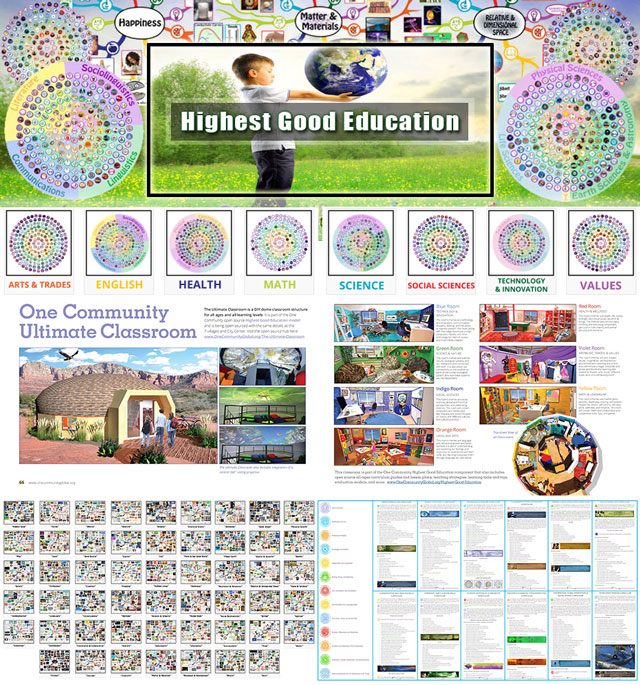
Highest Good Education: All Subjects | All Learning Levels | Any Age – Click image for the open source hub
HIGHEST GOOD SOCIETY PROGRESS
One Community is pioneering sustainable human support webs through a Highest Good society approach to living that is founded on fulfilled living, the study of meeting human needs, Community, and making a difference in the world:
- Read the Highest Good society overview and : Highest Good Society
- Learn about the model for fulfilled living and sharing and sustainable human support webs : A Day in the Life
- Learn about the 4 economic models: RBE | For-profit | Non-profit | Entrepreneurship
- Learn about our open source community collaboration and management software: The Highest Good Network
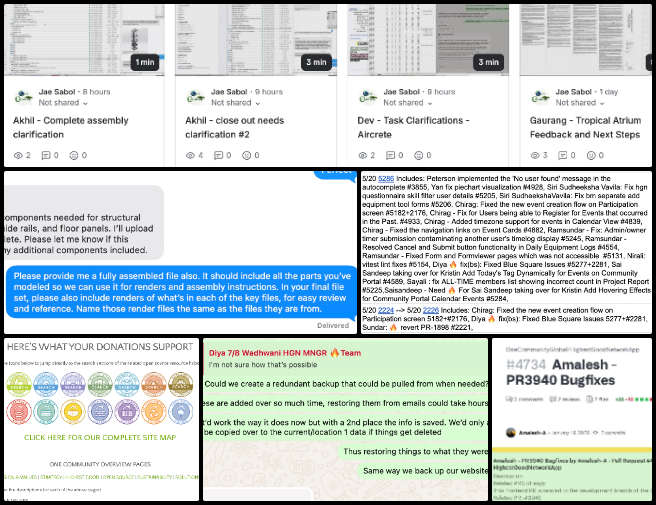
This week, the core team completed over 36 hours managing volunteer work reviews, handling emails, overseeing social media accounts, supporting web development, and identifying and integrating bug fixes for the Highest Good Network. They also interviewed and onboarded new volunteer team members. Additionally, they produced and integrated the video above, which highlights how making a sustainable life accessible to everyone serves as a foundational element of One Community’s broader mission. The following images showcase highlights of this work. These updates strengthen sustainable human support webs by improving consistency and organization.
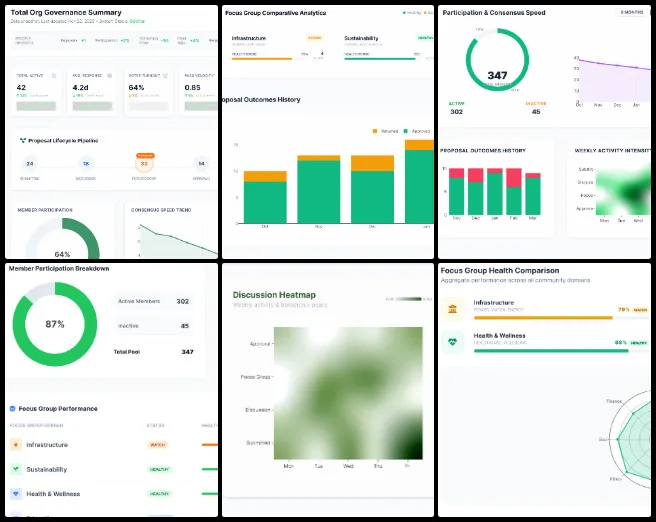
Pooja Kulkarni (UI/UX Designer) continued editing and refining content and design across governance dashboards, including the Community Outreach, Sustainability, Infrastructure, Education, and Health and Wellness modules, by improving layout clarity and consistency. She worked on multiple iterations of the Total Org Governance Summary and governance analytics dashboards for the One Community Global platform, focusing on public-facing reporting, governance visibility, and analytics presentation. The work included refining dashboard structures for governance summaries, proposal pipeline tracking, participation metrics, consensus health, activity trends, and focus group performance. This work supports sustainable human support webs through scalable and replicable solutions. Multiple layout options were compared to improve information hierarchy and balance detailed analytics with quick-glance summaries for public and internal users. Additional updates expanded proposal lifecycle visualizations, governance health indicators, participation trends, workflow pipelines, heatmaps, outcome history tracking, and domain performance summaries while aligning the designs with stakeholder feedback and future needs such as weekly reporting views, export functionality, and reusable governance summary formats. This work contributes to sustainable human support webs; the images below highlight key aspects of her work.
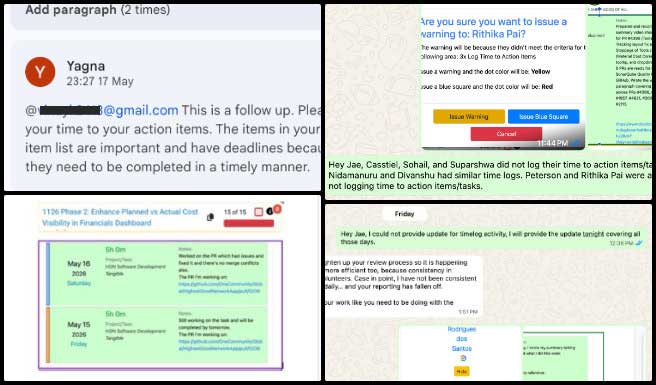
Yagna Reddy Badvel (Data Analyst & Team Administrator) continued supporting ongoing administrative operations by reviewing team submissions, validating documentation and tracking records, and ensuring workflow requirements were followed. He reviewed and tracked multiple time log compliance issues across the team, ensuring hours were properly assigned to action items and tasks. Additionally, Yagna followed up with Casstiel, Sohail, and Suparshwa regarding missing task assignments, identified similar time log patterns from Hemanth Nidamanuru and Divanshu, and issued warnings where necessary. He also addressed Peterson and Rithika Pai for not logging time against action items and tasks while maintaining administrative tracking and supporting reporting accuracy and accountability. These updates strengthen the stability and flexibility of shared systems, advancing the broader goal of sustainable human support webs. See the collage below portraying the work done this week.
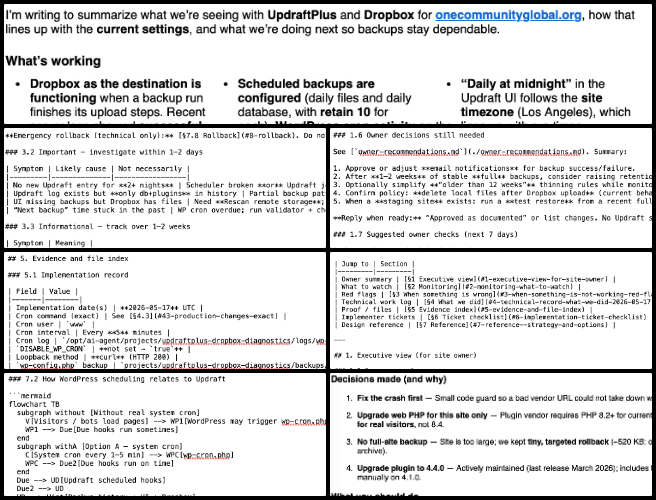
Jin Hua (Website, AdWords, and Analytics Administrator) fixed two critical issues related to the One Community website. The first issue involved the backup system not running as frequently as required. The second issue involved resolving a fatal error that blocked all website editing. Our website is the foundation for sharing all our open source plans for sustainable human support webs. See below for images and Highest Good Network page related to this website restoration work.
ADMINISTRATION TEAM
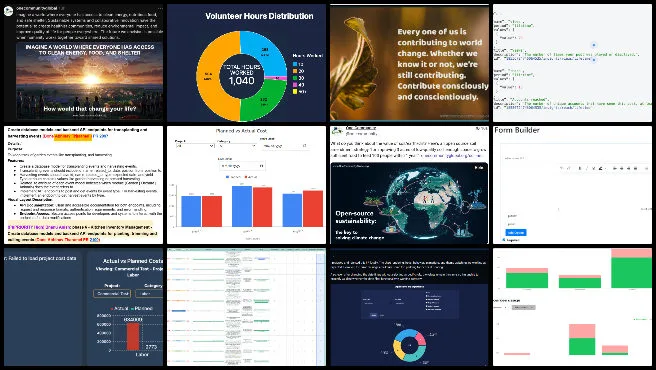
The Administration Team’s summary, which covers their work on the Highest Good Network, was managed by Devendranath Chowdary Maganti (Data Analyst) and includes Divanshu Bakshi (Team Admin), Hemanth Sai Venkata Srinivasa Kumar Nidamanuru (Administrative Assistant), Leo Lishin Shiu (Software Engineer), Mridul Bhushan (Volunteer Project Strategy Analyst and Team Administrator), Olawunmi “Ola” Ijisesan (Administrative and Management Support), Priyanshi Sharma (Data Analyst and Team Administrator), Rishitha Adepu (Administrator), Sai Keerthi Domakonda (System Administrator), Sai Sree Dongari (Data Analyst), Sayantan Paul (Frontend Tester and Software Team Administrator), Shravya Chilukoori (Software Developer), and Tanmay Nihal Harwani (Data Scientist). The Administration Team supports the Highest Good Network, a tool designed to track and measure progress while developing systems that contribute to facilitating sustainable human support webs. Through administrative support, documentation, testing, training, recruitment, analytics, and content management, the team helps advance this mission, aligning with One Community’s vision of building a replicable and sustainable future model.
This week, Divanshu tested and published Mastodon updates, verified reported pull request issues, documented action items, developed a Python script to prevent duplicate image postings, and updated the Weekly Mastodon Report using archived data. Hemanth tested 26 pull requests in a local environment, verified functionality across dashboards, reports, forms, inventory, analytics, filtering, exports, responsiveness, and backend-driven updates, approved pull requests that met requirements, and documented reproducible issues through GitHub review comments. These testing, automation, and quality assurance efforts improved workflow reliability, software functionality, and communication systems supporting sustainable human support webs.
Leo compiled and revised summaries from 17LeDCC team members, created collages for the weekly blog, tested Instagram API access, and scheduled weekly Facebook and Instagram posts through Business Suite. Mridul finalized Blog #687 summaries across multiple teams, checked formatting and guideline compliance, managed Twitter/X and LinkedIn content, completed weekend analytics tasks, and finished a final dry run review for an OC candidate. These content management, analytics, and communication efforts strengthened outreach, reporting accuracy, and administrative coordination supporting sustainable human support webs.
Ola resized and uploaded social media images, reviewed CSV-based performance data in spreadsheets, created document management folders for weekly filing, and organized digital workspaces for administrative and PR review teams. Priyanshi continued frontend QA testing across multiple Highest Good Network pull requests, validating chart rendering, filters, dark mode behavior, and UI consistency while documenting issues related to errors, chart mismatches, rendering gaps, and functionality concerns. These administrative organization, testing, and usability improvement efforts enhanced workflow efficiency, accessibility, and software quality supporting sustainable human support webs.
Rishitha managed interviews, hiring feedback, blog combination and SEO updates, bio administration, Threads content uploads, dashboard data updates using Python scripts, and volunteer tracker maintenance in Excel. Sai Keerthi completed development pull request testing, verified implemented changes against requirements, and reviewed weekly team submissions for blog accuracy and completeness. These administrative, testing, and content review efforts improved coordination, reporting systems, and development accuracy supporting sustainable human support webs.
Sai Sree tested multiple pull requests covering routing, charts, filters, tooltips, forms, search, modal behavior, sorting, dashboard navigation, layout issues, and event-related workflows, while also scheduling an interview and requesting specific pull request reviews. Sayantan handled administration tasks related to blog submissions, peer admin reviews, feedback tracking, warning escalation, and administrator guidance, while also testing software updates involving APIs, charts, filters, event management, permissions, sorting, and UI behavior, documenting remaining issues where applicable. These software testing, administrative, and workflow management efforts improved collaboration, system functionality, and team coordination supporting sustainable human support webs.
Shravya tested multiple pull requests in the development environment, reviewed team members’ work, shared feedback, and coordinated weekly blog updates. Tanmay reviewed team submissions, prepared collages, created the weekly blog, tested the Total Organization Summary Dashboard, documented issues, updated tracking sheets, and assigned tasks for reported problems. These testing, coordination, and dashboard management efforts improved reporting systems, team collaboration, and administrative workflows supporting sustainable human support webs. Highlights of the team’s contributions are shown in the collage below.
HIGHEST GOOD NETWORK PROGRESS
 One Community is pioneering sustainable human support webs through open source Highest Good Network® software that is a web-based application for collaboration, time tracking, and objective data collection. The purpose of the Highest Good Network is to provide software for internal operations and external cooperation. It is being designed for global use in support of the different countries and communities replicating the One Community sustainable village models and related components.
- Learn about our open source community collaboration and management software: The Highest Good Network
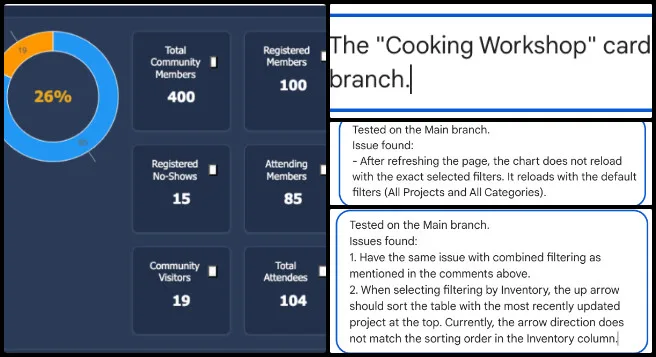
This week, the core team continued testing Highest Good Network pull requests. This effort highlights One Community’s commitment to reinventing the sustainability industry. They performed HGN PR testing on the Main branch and confirmed fixes for 12 PRs. Testing identified unresolved issues in several PRs related to project inventory sorting, participation card color display, dark mode UI elements on the Activity Attendance page, project and filter interaction in the Financial Dashboard, backend implementation for edit and view history on the Materials page, page navigation for Event Tracking, trend percentage placement and visual semantics in drop-off and no-show cards, dark mode functionality on the Lessons form page, attendance and completion percentage calculations on the Log Attendance page, and dark mode styling in the PR Reviewer Promotion modal. Testing could not be completed for 7 PRs because there was not enough data available on the Main branch. This work contributes to sustainable human support webs. See the Highest Good Society and Highest Good Network pages, and the collage below, for an overview of the team’s contributions.
ALPHA SOFTWARE DEVELOPMENT TEAM
The Alpha Software Team, working on the Highest Good Network software, was managed by Lin Khant Htel (Frontend Software Developer). The team includes Maithili Kalkar (Software Engineer), Som Ramnani (Software Engineer), Sai Sandeep Koritala (Software Engineer), and Casstiel Pi (Software Engineer). The Highest Good Network software is a key part of creating measurable global transformation. The software supports social architecture, construction, production, and maintenance processes that contribute to the open source project and resilient ecosystems. Designed to be portable and scalable, the Highest Good Network is ideal for off-grid and sustainable living communities, reflecting One Community’s open source commitment on pioneering sustainable human support webs.
This week, Lin managed the team summary covering multiple contributors, noted that one team member was on leave, and tracked weekly progress across active tasks and pull requests. He also reviewed PR #5238 by examining the code and running tests locally, with all tests passing without issues. In addition, Lin checked Alpha team members’ weekly summaries, photos, and videos as part of team management responsibilities connected to sustainable human support webs.
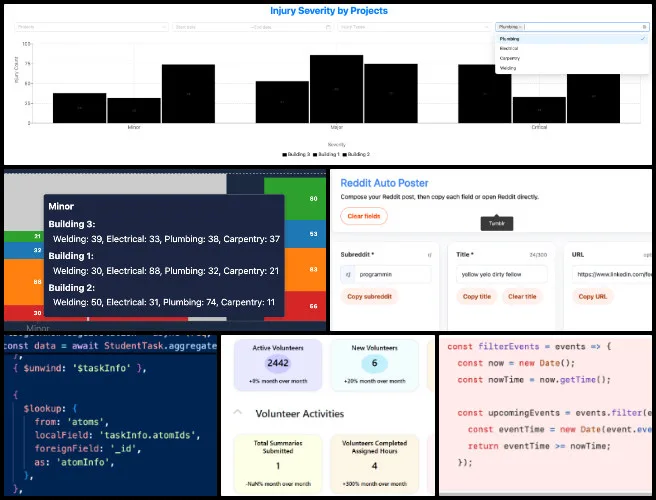
Casstiel worked on multiple fixes for the Lesson List and Injury Severity Dashboard components to resolve rendering, styling, and filtering issues. A page crash caused by lesson card interactions was fixed by replacing a deprecated parsing package and adding null-safe parsing logic for lesson content rendering. Additional dark mode updates improved readability across lesson cards, editable fields, headers, and footers where text previously became unreadable. The Injury Severity Dashboard also received fixes for chart color mapping, legend ordering, and filter styling, and these improvements aligned with sustainable human support webs.
Maithili continued completing the Reddit auto poster pull request by testing functionality and fixing issues found during testing. Multiple SonarCloud issues related to duplicate code and maintainability were resolved by creating a separate helper class and refactoring parts of the implementation. She also updated the related pull request with the latest changes and reviewed the project bug list to identify an issue involving email delivery failures in the Send Emails tab, which connected with ongoing work related to sustainable human support webs.
Sai focused on resolving dashboard bugs affecting data visibility and filtering behavior across multiple routes. In PR 2217, he fixed an issue where the Total Org Summary route failed to display completed task data for users within the organization after identifying missing backend database queries. He also moved to PR 5278 to investigate a dashboard filter issue where selections such as week by week, month by week, and year by year caused an error screen, and this debugging work related closely to sustainable human support webs.
Som revisited PR #5163 to resolve merge issues in MyCases.jsx by keeping the shared date-filtering helper from the development branch and removing conflicting inline filter logic. He confirmed that filter values matched the shared helper logic and verified that the More button continued using the correct filtered event list. Som also revisited PR #5189 and resolved merge conflicts in MyCases.jsx and MyCases.module.css while preserving the working list-view column header enhancement and cleaner dark-mode styling, which remained connected to sustainable human support webs. See the collage below to view the team’s work.
BINARY BRIGADE SOFTWARE DEVELOPMENT TEAM
The Binary Brigade Team, which presented their work on the Highest Good Network software, was managed by Roshini Seelamsetty (Software Engineer) and included Manoj Puttaswamy (Software Engineer), Alisha Walunj (Software Engineer), and Harsha Rudhraraju (Software Engineer). The Highest Good Network software is our tool for managing and objectively measuring progress, ensuring that all contributions are tracked and aligned with our mission, pioneering sustainable human support webs. It supports social architecture, construction, production, and maintenance processes that contribute to open-source projects and resilient, sustainable ecosystems.
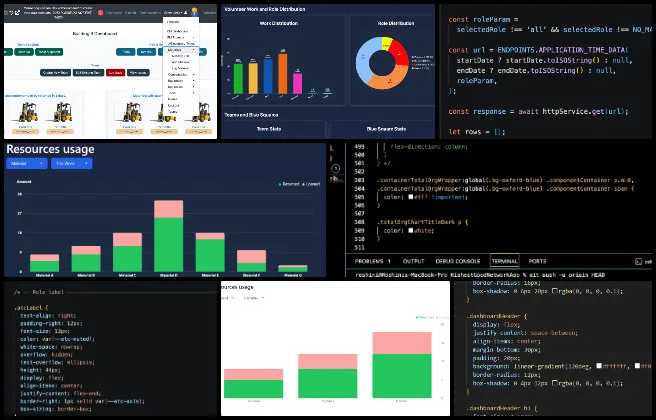
This week, Harshavarma worked on improving graph layout and UI alignment issues by repositioning graphs toward the y-axis for better readability, updating the main component, fixing alignment issues in the resource usage section, improving graph positioning, adding icons, and enhancing responsiveness across different screen sizes and devices. He also reviewed reported UI issues against the Figma design, continued development to address remaining differences, and created and submitted a pull request for previously completed work. Manoj continued working on the BMDashboard inventory section by restructuring header navigation, moving BM Dashboard links and project navigation under the Other Links dropdown, adding a BM Dashboard section with a collapsible BM Projects accordion, implementing nested sub-accordions for inventory categories including Materials, Consumables, Equipment, Reusables, and Tools, adding category icons, integrating navigation bars into Equipment and Tools pages, and introducing shared CSS styling for consistent navigation design across inventory pages. The team’s efforts continue sustainable human support webs with practical and measurable progress.
Roshini worked on fixing mentor label text visibility issues in dark mode within the Role Distribution chart in the Total Org Summary Dashboard by updating chart label styling and improving readability for mentor role analytics. She also reviewed the management document and started working on resolving the issue where the Global Volunteer Network map in the Total Org Summary Dashboard was not populating, which affects the display of volunteer geographical distribution data. Alisha worked on the task to enhance the usability and insights of the Most Frequent Keywords Mind Map by fixing display issues through adjustments to the learning strategy component. This progress reflects ongoing sustainable human support webs through collaborative development.
She also resolved merge conflicts and updated the applicationtimechart files, including applicationtimechart.jsx and applicationtimechart.module.css. In addition, she worked on the task to create a dropdown filter based on village frontend requirements, where she focused on resolving merge conflicts and debugging issues related to a failed SonarQube quality gate. She also addressed SonarQube issues in the files Masterplan.jsx, VillageDetails.js, and BiddingHomepage.jsx. See the Highest Good Society and the Highest Good Network pages for more on how this supports pioneering sustainable human support webs. Highlights of the team’s contributions are shown in the collage below.
CODE CRAFTERS SOFTWARE DEVELOPMENT TEAM
The Code Crafters Team’s summary, covering their work on the Highest Good Network software, was managed by Sai Keerthi Domakonda (Software Engineer). The team includes contributions from Sphurthy Satish (Software Engineer). Their work contributes to One Community’s mission of pioneering sustainable human support webs through collaborative software development and continuous system improvements.
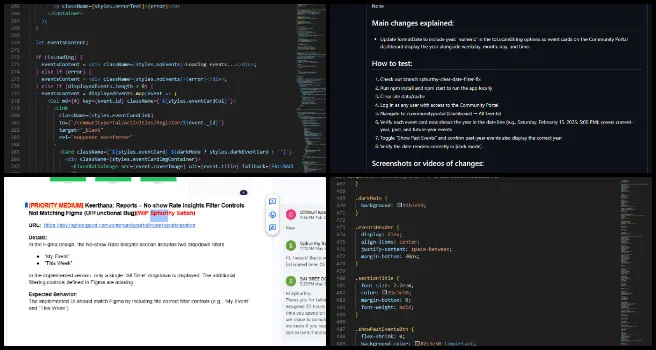
This week, Sphurthy Satish started working on a UI and functional bug related to the No-show Rate Insights section in the Reports page. The task involved identifying inconsistencies between the implemented version and the Figma design, specifically regarding missing filter controls. The Figma design includes two dropdown filters, “My Event” and “This Week,” while the implemented version currently displays only a single “All Time” dropdown. She focused on reviewing the existing implementation, comparing it with the expected design behavior, and analyzing the required updates to align the UI with the specified Figma requirements for the participation reports page. See the Highest Good Society and the Highest Good Network pages for more on how this supports pioneering sustainable human support webs. The collage below showcases the team’s accomplishments for the week.
DEV DYNASTY SOFTWARE DEVELOPMENT TEAM
The Dev Dynasty Team’s summary, covering their work on the Highest Good Network software, was managed by Shravya Chilukoori (Administrative Software Engineer) and Neeraj Kondaveeti (Software Engineer). The team includes Adithya Cherukuri (Volunteer Software Engineer), Deekshith Kumar Singirikonda (Developer), Rithika Pai (Software Engineer), and Saurabh Jayant Dipte (Software Engineer). The Highest Good Network software helps manage and objectively measure processes that support making a sustainable human support web through social architecture, construction, production, and maintenance systems.
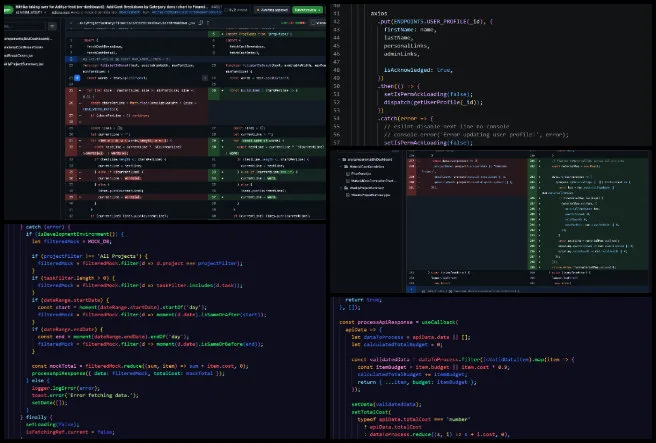
This week, Adithya worked on the labor cost variance and budget benchmarking feature for the sustainable human support web Highest Good Network software development project by implementing variance calculation logic for dollar and percentage differences with conditional formatting for over-budget and under-budget metrics, connecting dropdown filters to mock database data using synchronization hooks, expanding mock data across a thirty-day range with date filtering using moment.js, restoring overwritten consumables dashboard UI enhancements, resolving application crashes caused by missing item properties, integrating pagination logic with low-stock badges and sticky headers, fixing dropdown asset name rendering, and resolving remaining linting issues.
Deekshith worked on improving the responsiveness and structure of the booking and authentication modules for the sustainable human support web project by updating the top logo and navigation bar styling using responsive CSS properties including clamp(), flexbox alignment, adaptive spacing, wrapping behavior, image scaling, and container sizing to improve layout consistency across different screen sizes and prevent overflow issues. He also updated the PermissionWatcher authentication component to support user acknowledgment flows and permission updates through Axios API requests, added logic for updating user profile information and acknowledgment states, refreshed profile data after updates, improved error handling and loading state management for asynchronous operations, and aligned the codebase with ESLint requirements by removing console statements and improving maintainability within the authentication workflow.
Neeraj worked on Participation page enhancements for the sustainable human support web project by adding the Organizer dropdown to the Social and Recreational Management section based on approved Figma specifications, improving filtering functionality for events, insights, and participation data while maintaining consistency with the existing UI structure, updating and managing the related pull request and branch changes, verifying the implementation within the Participation reporting flow, and starting work on the Listing and Bidding Dashboard issue where the “Demand across Villages” graph was not generating on the main branch by analyzing graph components, reviewing previous responsiveness and dark mode fixes, and investigating chart rendering and data visibility issues.
Rithika worked on multiple frontend and backend BM Dashboard pull requests for the sustainable human support web project by fixing security vulnerabilities in bmNewLessonController.js through validation and sanitization of projectId before MongoDB ObjectId queries, resolving SonarQube issues, removing unused variables, fixing middleware optional chain and empty catch block issues, resolving yarn.lock conflicts, updating the Material Cost Correlation Chart with improved X-axis labels, tooltip details, legend differentiation, and corrected default dropdown selections, fixing the Tools and Equipment Tracking layout so charts display side by side on desktop, adding the missing ToolsStoppageHorizontalBarChart component, resolving backend API 404 issues verified through Postman, and fixing CI build failures caused by missing HTML tags, cognitive complexity issues, accessibility problems, and missing PropTypes in the Cost Breakdown by Category donut chart feature.
Saurabh worked on pull requests PR 3405 and PR 4479 for the sustainable human support web project by resolving merge conflicts across JSX components, CSS module files, and test files, fixing SonarCloud issues related to unused imports, duplicate CSS properties, missing PropTypes validation, and accessibility color contrast violations, and resolving a Netlify build failure caused by duplicate CSS properties and an unclosed CSS block in the grouped injury severity chart component. Take a look at the images below to see some of the progress made in this work.
LUCKY STAR SOFTWARE DEVELOPMENT TEAM
The Lucky Star Team’s summary, covering their work on the Highest Good Network, was managed by Tanmay Nihal Harwani (Data Scientist) and Sohail Uddin Syed (Software Engineer). The team includes contributions from Veda Bellam (Software Engineer), Vinay Krishna (Software Engineer), and Shravya Kudlu (Software Development Engineer). Their work supports One Community’s mission of pioneering sustainable human support webs through cross-functional software development and ongoing system improvements.
This week, Shravya worked on understanding the requirements needed to complete an unfinished pull request by reviewing the related implementation and previously completed work, resolving merge conflicts, continuing development on two WBS items related to search results functionality and a Phase 4 student-teacher task, reviewing relevant code, performing testing, and preparing the changes for submission with pull requests expected for two requests. Sohail worked on the Experience Donut chart by redesigning the component and stylesheet, adding experience labels and hover behavior, improving data presentation and filtering, updating the chart to fetch filtered applicant data, validating date inputs and role filters, handling empty and error states more clearly, displaying segment counts while keeping the total centered, supporting mobile-friendly legend display, implementing dark mode styling, and addressing reviewer feedback through follow-up fixes related to filter behavior, UI layout, and chart and control interactions contributing to One Community’s mission of pioneering sustainable human support webs.
Veda worked on updates across the HighestGoodNetworkApp project involving the Job Application Listing Page, Application and Job Posting Page permissions, and Listing and Bidding Platform modules by resolving SonarQube issues in the job application form page for the users’ view, addressing pull request feedback, improving backend permission handling for question sets, fixing frontend and accessibility issues related to keydown listener handling, navigation logic, optional chaining conditions, error logging, button styling, WCAG contrast improvements, hover state behavior, WebSocket initialization, and parsing error logging, and resolving SonarQube issues associated with the migration from .css to .module.css files while preparing the related pull request for review furthering One Community’s mission of pioneering sustainable human support webs through improved platform functionality.
Vinay K worked on fixing the “Most Frequent Keywords” mind-map visualization issue in the Total Construction Summary dashboard by debugging data binding between Lessons Learned entries and the visualization component, ensuring consistent rendering across project and date range filters, adding fallback messaging when no data is available, improving loading and error states for better user feedback, and continuing investigation of edge cases and rendering validation as part of the ongoing work. See the Highest Good Society and the Highest Good Network pages to learn more about how this work supports pioneering sustainable human support webs. Look at the collage below to view the team’s work for the week.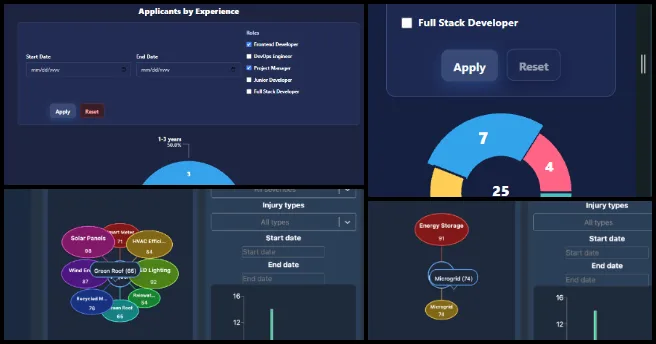
REACTONAUTS SOFTWARE DEVELOPMENT TEAM
The Reactonauts team summary, which covers their work on the Highest Good Network, was managed by Diya Wadhwani (Software Developer) and Divanshu Bakshi (Data Analyst) and it includes Aseem Deshmukh (Software Developer), and Sayali Sable (Software Engineer). This effort supports sustainable human support webs by improving organized workflows, structured processes, and reliable systems that make sustainable living more accessible to everyone.
This week, Aseem worked on the phase 3 past events visibility issue and checked the existing implementation to identify whether any code issues were preventing past events from displaying. She also worked on PR #4310 by merging the updated development branch into the cost-plannedvsactual branch and updating expensebarchart.jsx to add the required filter functionality, supporting continued improvements to sustainable human support webs.
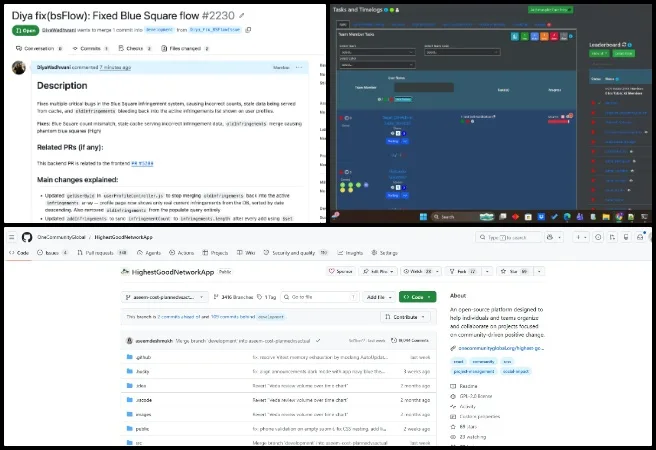
Diya worked on limiting user profile team-code visibility to active teams and adding permission-based visibility controls for reports and PR dashboard navigation. Diya fixed the weekly summaries team-code suggestions endpoint by adding an is active and true filter to the userprofile.distinct query in getalldistinctteamcodes, which reduced the returned team codes from 95 to 93 in backend PR #2228. Diya also analyzed the current permission structure, mapped new permissions for multiple report pages, including total org summary, actual cost breakdown, team locations, promotions, and PR dashboard access, and started moving the PR dashboard dropdown under other links using a new access dashboard permission before pausing to address production issues. These contributions advance sustainable human support webs by refining technical and design processes. Diya then fixed a blue square count mismatch where getuserbyid was merging oldInfringements into active infringements, removed that merge, synced infringement count to infringements length after add and delete actions, fixed a stale allusers cache write-back in addInfringements, updated deletebluesquare to clean oldinfringements older than one year, and updated modifybluesquares to use res.data.infringements from the API response in backend PR #2230 and frontend PR #5289, improving the accuracy and reliability of sustainable human support webs.
Sayali worked on multiple pull requests for bug fixes, reviewer feedback, and feature updates across the HGN software platform. On PR #5279, she fixed two firefox timer issues related to the ding sound and time complete popup by handling autoplay behavior with promise-based play calls, adding an audio unlock useeffect, and triggering the modal and chime locally when the remaining time reached zero. On PR #5261, she fixed dark mode readability issues in the weekly summaries report by adding CSS overrides for card content and yellow bio highlight text. On PR #5266, she confirmed that the expand all trackers feature worked as expected and checked a pre-existing dark mode header issue in the development branch. On PR #5223, she retested badge assignment across user types, confirmed there were no errors or duplicate badges, and removed an error toast on profile load by logging the error silently. This work helps expand sustainable human support webs through open-source sharing and transparency. And Sayali resolved merge conflicts, fixed a stuck send email modal, restored missing component imports in routes.jsx, and responded to reviewer concerns related to existing backend behavior and a missing permission on a test account. On PRs #5225 and #2225, she fixed the all members list in the project report by adding project history to the userprofile model, creating a getalltimeprojectmembership endpoint, updating the frontend to display all-time members separately, converting projectId to a mongoose objectId, and resolving a redux persist caching issue, helping strengthen the functionality and consistency of sustainable human support webs. To learn more about how this work supports creating a complete sustainability strategy, visit the Highest Good Society and Highest Good Network pages. Below is the collage showcasing the Reactonauts team’s work for the week.
SKYE SOFTWARE DEVELOPMENT TEAM
The Skye Team’s summary, covering their work on the Highest Good Network, was managed by Sayantan Paul (Frontend Tester and Software Team Administrator) and Anthony Weathers (Software Engineer). The team includes Chirag Bellara (Software Engineer), Nirali Patel (Full Stack Developer), Peterson Rodrigues dos Santos (Full-Stack Developer), Radia Ahmed (Software Engineer), and Sharadha Kasiviswanathan (Software Engineer). The Highest Good Network software is committed to pioneering sustainable human support webs by objectively tracking and managing progress across social architecture, construction, production, and maintenance processes, utilizing transparent, scalable systems that strengthen accountability, coordination, and resilient ecosystems.
This week, Anthony finalized additional test cases for the currentWarningsController file and pushed updates for PR 2167. He continued work on PR 5146 by confirming that renaming warning trackers takes priority over reordering and added logic to prevent reordering while a tracker is being renamed so the behavior remains consistent with existing rename restrictions. Chirag worked on completing open tasks and pull requests by addressing merge errors and reported bugs in pull request 5421, checking in fixes, requesting re-reviews, resolving merge issues in pull request 5166, and creating videos outlining next steps for the latest news display fix on the Community Calendar screen and the Attendance Confirmation functionality on the Database Design screen, along with related task summaries. This progress contributes towards creating sustainable human support webs through small impactful actions leading to larger, lasting changes in ecosystems and social systems.
Nirali resolved merge conflicts and gate issues across five pull requests, fixed blockers affecting validation checks, stabilized the branches, verified functionality, and prepared all five pull requests for review. Peterson resolved conflicts in pull request 4255 for the Permission Management page by adding a loading spinner after submitting permission updates and improving autocomplete behavior so correctly typed usernames remain visible even when spaces are added after the name in the input field, while also resolving conflicts in additional pull requests under testing. This progress reflects progressive expansion of sustainable human support webs through collaborative development.
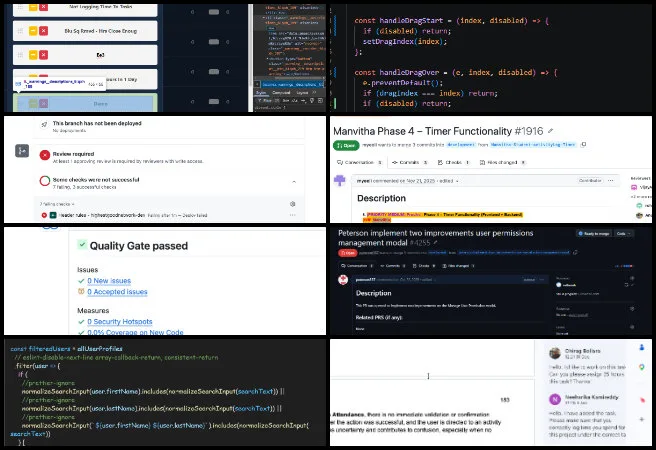
Radia reviewed the HGN Phase I Bugs and Needed Functionalities document to prioritize work, fixed a bug in PR 4450 that prevented the Tools and Equipment page from loading, updated dark mode styles for action buttons, added optional chaining in LogTools.jsx to prevent crashes caused by missing data, merged the latest development branch, resolved merge conflicts and CSS issues, and submitted the pull request with documentation. She also continued work on PR 4614 by addressing dark mode consistency and merge conflicts. Sharadha worked on frontend pull request 4225 related to Phase 4 Daily Log functionality by testing updates locally, reviewing UI behavior and interaction flows, identifying issues affecting stability, and continuing integration work. These developments support sustainable human support webs by improving system efficiency and usability.
She also completed merge conflict resolution and fixed failing tests for frontend PR 4432 and backend PR 1916 related to Phase 4 Timer Functionality, ensuring the timer features worked correctly across both systems and preparing the pull requests for merge. See the Highest Good Society and the Highest Good Network pages to learn more about how establishing sustainable human support webs is central to One Community’s goals, demonstrated through transparent, collaborative innovation within the Highest Good Network open source hub. See the collage below for the team’s work.
SOFTWARE PR REVIEW TEAM A-N
The PR Review Team’s summary for members with names starting with A–N was managed by Sai Sree Dongari (Data Analyst). The Highest Good Network is a foundation for measuring our results in pioneering sustainable human support webs. This week’s active members of this team were Amaresh Chaudhary Nara (Software Engineer), Carl Bebli (Software Developer), Deepigha Japamony (Software Engineer), Jaden Wong (Software Engineer), and Nathan Hoffman (Software Engineer). They reviewed all Highest Good Network PRs shared in this week’s update. Learn more about how the Highest Good Network open source hub measures progress toward pioneering sustainable human support webs. The collage below shows a compilation of this team’s work.
SOFTWARE PR REVIEW TEAM O-Z
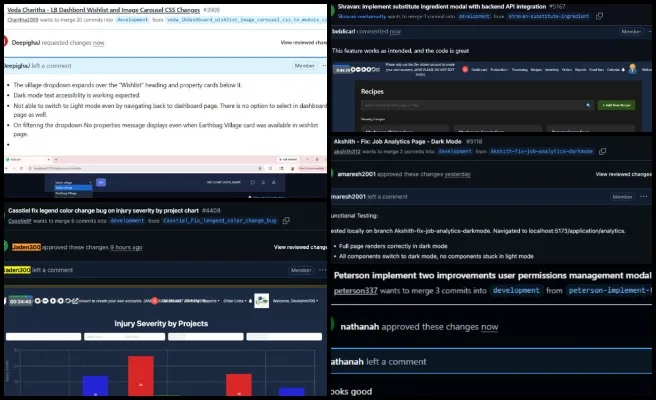
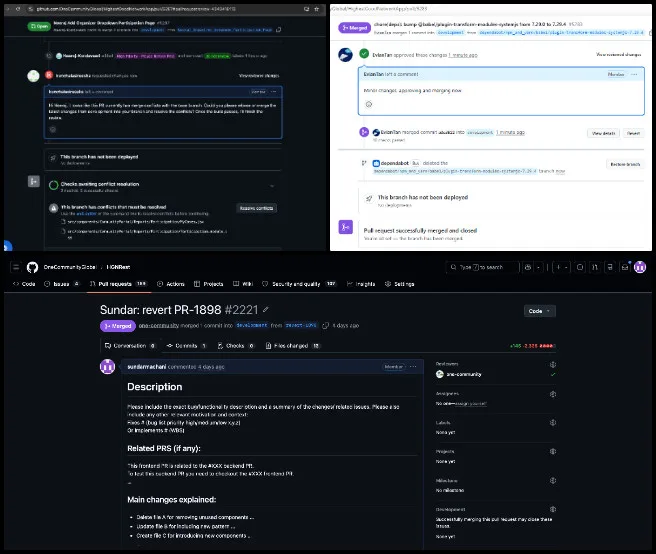
The PR Review Team’s summary for members with names starting with O–Z was managed by Shameera Musthafa (Data Analyst). The Highest Good Network is a foundation for measuring our results in sustainable human support webs. This week’s active members of this team were Sireesha Kunchala (Software Engineer), Sundar Machani (Software Engineer), and Yiyun Tan (Software Engineer). They reviewed all the Highest Good Network PRs (Pull Requests) shared in this week’s update. Learn more about how the Highest Good Network open-source hub measures progress towards our goal of sustainable human support webs. The collage below shows a compilation of the work from this team.
AND WE PRODUCED THIS WEEKLY UPDATES BLOG – CLICK HERE TO SUBSCRIBE
FOLLOW ONE COMMUNITY’S PROGRESS (click icons for our pages)
INVESTOR PAGES
GET INVOLVED
DONATE | WAYS ANYONE CAN HELP | MEMBERSHIP
CLICK HERE FOR ALL PAST UPDATES