One Community
Permaculture World Building – One Community Weekly Progress Update #714
At One Community, we are committed to permaculture world building, a regenerative approach to designing communities where people and planet thrive together. Our all-volunteer team is developing sustainable approaches to food, energy, housing, education, economics, social architecture, and fulfilled living, grounded in global stewardship practices. We create everything as open source and freely shared, so the complete process is available to anyone who wants to use it. As our model becomes self-replicating, it will anchor a global collaboration of teacher/demonstration hubs, creating a world that works for everyone and serving “The Highest Good of All.”
- Here’s our project overview
- Here’s our world-change methodology
- Here’s how this becomes self-replicating
- Here’s how we are open source and free-sharing all the do-it-yourself designs
OUR MAIN OPEN SOURCE HUBS
Click on each icon to be taken to the corresponding Highest Good hub page.

One Community’s physical location will forward this movement as the first of many self-replicating teacher/demonstration communities, villages, and cities to be built around the world. This is the November 23, 2026 edition (#714) of our weekly progress update detailing our team’s development and accomplishments:
Permaculture World Building
One Community Progress Update #714
Video coming soon
DONATE | COLLABORATE | HELP WITH LARGE-SCALE FUNDING
CLICK HERE IF YOU’D LIKE TO RECEIVE AN EMAIL EACH WEEK WHEN WE RELEASE A NEW UPDATE
YOU CAN ALSO JOIN US THROUGH SOCIAL MEDIA


ONE COMMUNITY WEEKLY UPDATE DETAILS
HIGHEST GOOD HOUSING PROGRESS
One Community is advancing permaculture world building through Highest Good housing that is artistic and beautiful, more affordable, more space efficient, lasts longer, DIY buildable, and constructed with healthy and sustainable materials:
- Learn about: Our Upcoming Crowdfunding Campaign
- Learn about the different village models and permaculture world building: 7 Sustainable Village Models
- Visit the open source portals for the first two: Earthbag Village OS Hub | Straw Bale Village OS Hub
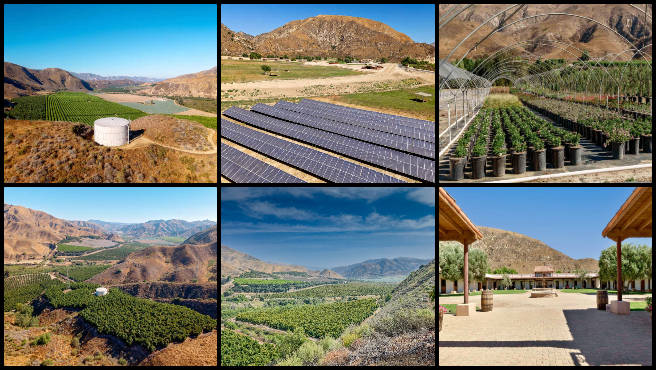
This week, the core team continued working on the Highest Good Housing component of property research. They viewed several properties in California, added photos of Rancho Temescal, and identified a real estate company specializing in large California properties. They further researched Rancho Temescal’s revenue sources and updated the goats document with three references regarding steel fencing posts and fuel-based preservative toxicity. The images below highlight this property research, which supports One Community’s work on permaculture world building.
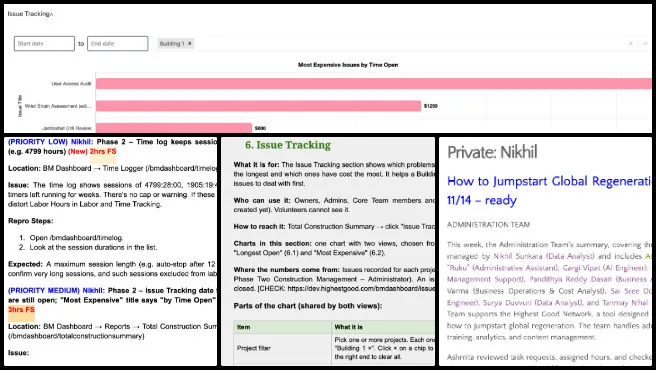
Bhaskar Nikhil Sunkara (Data Analyst) continued testing the Phase 2 Construction Management dashboards and forms, retesting tool bugs F12 and F13 and confirming issues related to purchase request dates and tool condition values. He reported seven bugs covering tool purchases, material records, material availability, time logs, issue tracking, and chart behavior, and sent the related bookmarks to Jae. He stress-tested the Tools Purchase Request form with invalid and boundary inputs and verified its validation behavior. He also tested the Issue Tracking, Issues Breakdown, Risk Profile, Project Status, Injury Severity, and Labor sections while checking existing reports to avoid duplicate bugs. He found that a previously reported Tools and Equipment Tracking layout issue remained present on Dev and added his findings to the existing report contributing to One Community’s mission of advancing permaculture world building.
He also updated the Phase 2 test tracker with the week’s results, transferred ownership to the Administration account, and added Surya as an editor. For the Highest Good Network User’s Manual, he wrote sections 5 through 7 covering Tools and Equipment Tracking, Issue Tracking, and Issues Breakdown, and corrected the contents and heading text. He prepared and led Surya’s onboarding call, explained the Phase 2 testing process and tracker, divided the remaining testing work, reviewed Surya’s first two bug reports, and coordinated manual section assignments. He completed Sunday administration work for blog #713. For social media work, he designed a 14-day test comparing posting strategies on X and LinkedIn, began posting three times per day on each platform, and scheduled three X posts for Sunday. The images below highlight his Administration, software testing, documentation, and social media work, supporting One Community’s work on permaculture world building.
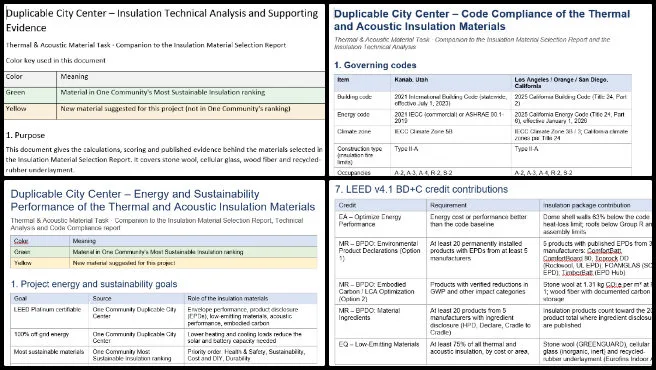
Fnu Bhargav Madhu (Civil Engineer) continued working on reference documents for One Community’s Most Sustainable Materials series. He worked on thermal and acoustic insulation materials for the Duplicable City Center. He prepared code compliance, energy, and sustainability reports for the insulation scope, covering the requirements for Kanab, Utah, and Southern California. He also documented outstanding decisions requiring input from the supervisor. He reviewed the Cupola roof presentation and identified the roof as a hipped wood truss roof rather than a low-slope roof. He prepared a revised Cupola roof material report containing corrected R-values, existing and additional insulation options, and the advantages and disadvantages of each material. He also reviewed the approved dormer report and identified an overstated R-value for aircrete and an incorrectly stated egress clear height of 41 inches instead of the required minimum of 24 inches. He reviewed the Design Track documents and documented how the recessed grille affects insulation at the building entrances contributing to One Community’s mission of advancing permaculture world building.
Additionally, he reviewed published research related to the project requirements and prepared a supporting evidence report containing 33 sources. The report includes NOAA climate data indicating 4,317 heating degree days for Kanab, studies reporting aircrete R-values ranging from R-1.0 to R-1.6 per inch, tested wall and floor sound ratings, Oak Ridge National Laboratory research on wood fiber insulation, and embodied carbon data from environmental product declarations. Based on the findings, stone wool was identified as the primary insulation material, cellular glass was designated for the Sunrise Patio only, and wood fiber was added as an additional material option. The images below highlight his sustainable-materials research and documentation work, supporting One Community’s work on permaculture world building.
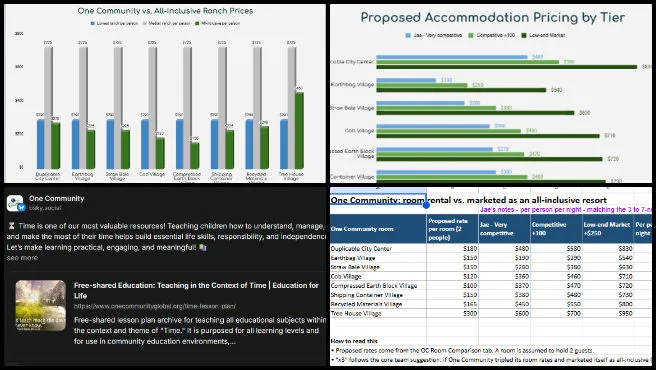
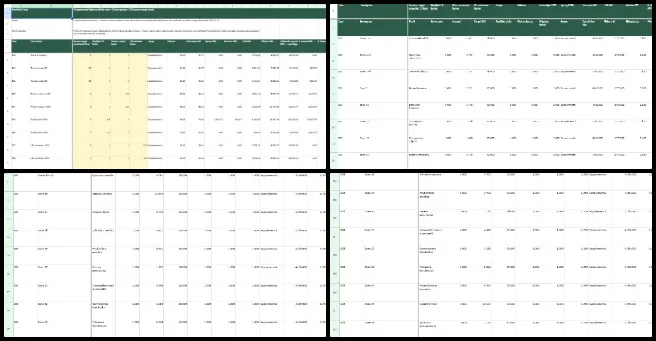
Shameera Musthafa (Data Analyst) continued supporting the OC Administration and the PR Review Team by coordinating PR review workflows, reviewing the work of both teams, and providing feedback to ensure accuracy, clarity, and consistency across deliverables. She organized and categorized project images, created visual collages, and finalized blog-related content as part of PR review coordination. She also reviewed the rental revenue projections, visualizations, and master financial sheets for the housing project. Additionally, she managed the One Community Bluesky social media account by creating and publishing posts to share project updates and support outreach and engagement. The images below showcase her financial, administrative, and outreach work, supporting One Community’s work on permaculture world building.
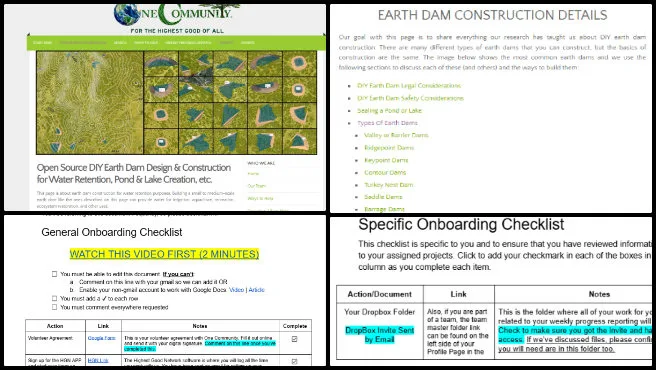
Vinay Singh (Construction Manager) completed his onboarding with One Community. He set up his Highest Good Network (HGN) account, reviewed the onboarding materials in Google Docs, and left comments where requested. He also began Task 1, the DIY Earth Dam Tutorial Review and Improvements, by reading the published tutorial to understand its scope and how the existing guidance is organized. The images below highlight his onboarding, construction management preparation, and DIY earth dam tutorial review, supporting One Community’s work on permaculture world building.
DUPLICABLE CITY CENTER PROGRESS
One Community is advancing permaculture world building through a Duplicable and Sustainable City Center that is LEED Platinum certified/Sustainable, can feed 200 people at a time, provide laundry for over 300 people, is beautiful, spacious, and saves resources, money, and space:
- Learn about this building, its function, and permaculture world building: Duplicable City Center Open Source Hub
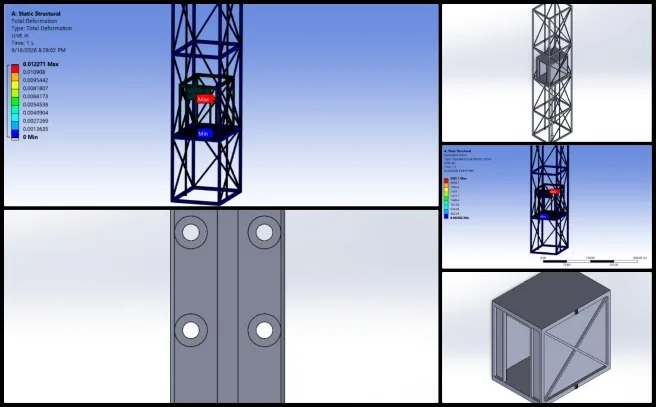
This week, Nidish Reddy Koppula (Mechanical Engineer) continued working on the Duplicable City Center design. He continued working on the elevator shaft and guide rail analysis, focusing on the loading conditions acting on the structural and guiding components. He refined the analysis setup, checked boundary conditions, and evaluated stress and deformation results for the shaft under the applied load cases. Nidish also reviewed localized stress regions and compared the results with the expected structural behavior to determine whether additional mesh refinement or design adjustments were needed. In parallel, he worked on the guide rail model and reviewed the associated loading and support conditions. This open source Duplicable City Center project contributes to advancing permaculture world building. The collage below shows his work for this week.
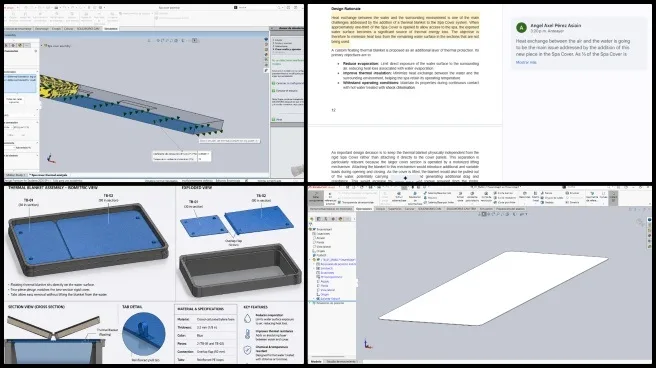
Angel Axel Pérez Asiain (Mechanical Engineer) continued working on the Duplicable City Center design by selecting a cover for the Sustainable Spa. He worked on a new model for the thermal blanket accessory of the SPA cover. Considering the lifting mechanism planned for the complete cover and the thermal energy losses that may occur when the SPA is not fully covered, he researched and developed a complementary thermal blanket solution. He began modeling the accessory in SolidWorks to integrate it into the overall SPA cover design. Angel also researched and selected the material to be used, taking into account its cost, global availability, and ease of assembly. The material selection and design approach were aligned with the project’s sustainability and open-source objectives. This open source Duplicable City Center project supports advancing permaculture world building. The images below show his work.
HIGHEST GOOD FOOD PROGRESS
One Community is advancing permaculture world building through Highest Good food that is more diverse, more nutritious, locally grown and sustainable, and part of our open source botanical garden model to support and share bio-diversity:
- Learn about the structures and permaculture world building: Hoop House Hub | Aquapini & Walipini Open Source Hub
- See what we’ll be growing: Gardens & Hoop Houses | Large-scale Structures | Food Forest | Tropical Atrium
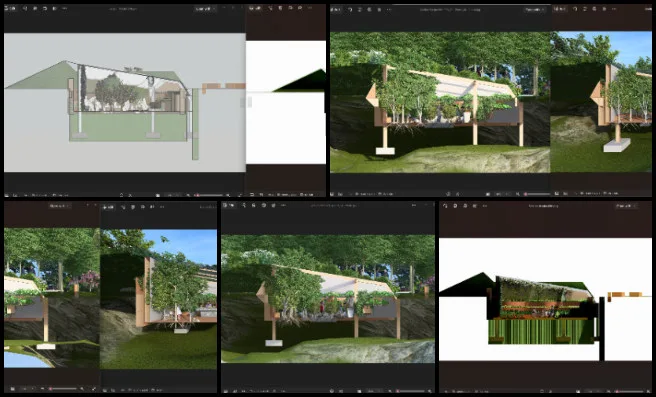
This week, Zoey Zou (Landscape Architect) continued developing presentation graphics for the Aquapini and Walipini projects. She completed four Walipini 1 section perspective graphics, refining cut surfaces, terrain, planting, underground conditions, and Photoshop post-processing for a consistent presentation style. She tested ways to combine greenhouse models within a shared terrain model for elevation graphics and explored model simplification when file size and performance became limiting. Using SketchUp, Enscape, Lumion, and Photoshop, she compared workflows for producing clear vertical sections and perspective sections. She then identified a workflow for creating both view types directly in Lumion and produced three sets of section and section perspective views for Walipini 2. She continued refining these outputs in Photoshop to improve soil, grading, cut surfaces, planting, and the overall visual presentation supporting One Community’s work in permaculture world building. See the collage below for examples of her work.
Jay Nair (BIM Designer) worked on sensitivity analyses for the Walipini 1 lighting energy calculator. He examined how variations in daily light integral (DLI) targets, available canopy daylight, usable fixture output, and canopy height affect supplemental lighting requirements and energy consumption. He also began preparing a fixture and commissioning checklist covering equipment specifications, installation requirements, lighting performance verification, and operational settings. His work focused on evaluating calculation assumptions and developing procedures to validate fixture performance and lighting conditions across the greenhouse zones furthering One Community’s mission of advancing permaculture world building. See the collage below for examples of his work.
HIGHEST GOOD ENERGY PROGRESS
One Community is advancing permaculture world building through Highest Good energy that is more sustainable, resilient, supports self-sufficiency and includes solar, wind, hydro, and more:
- Learn about the open source sustainable-energy foundations and permaculture world building: Solar, Hydro, and Wind
- Explore our research into the most sustainable products and companies for saving water and energy: Insulation, Eco-laundry, Lightbulbs and Light Bulb Companies, Doors and Door Companies, Windows and Window Companies, Toilets, Faucets and Faucet Accessories, Urinals, and more.
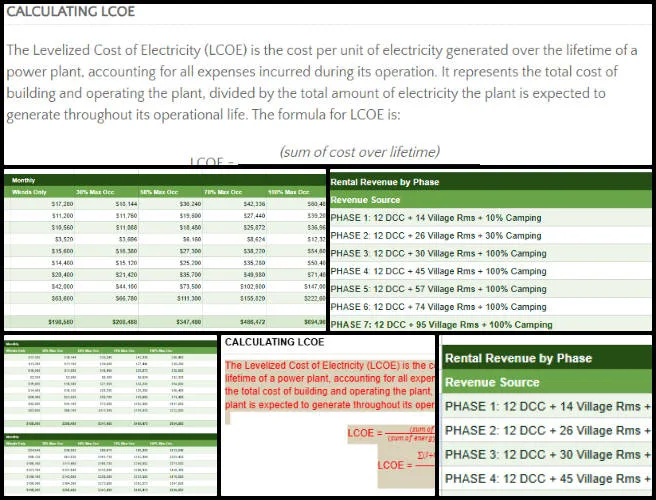
This week, the core team reviewed messages from the previous month to confirm that all requests for theHighest Good Energy initiative, part of One Community’s work, had been addressed. They then began learning how to update webpages by watching a training video and reviewing documentation and existing pages. Afterward, they started making updates to the Hydro Power page. They also reviewed the Residency Timeline, Rental Revenue, and Enclosure 6b, which covers anticipated monthly expenses and rental income. They made several edits to one of the tabs in Enclosure 6b to ensure that the information updated correctly and reflected accurate figures. See the image below for highlights of their work advancing permaculture world building.
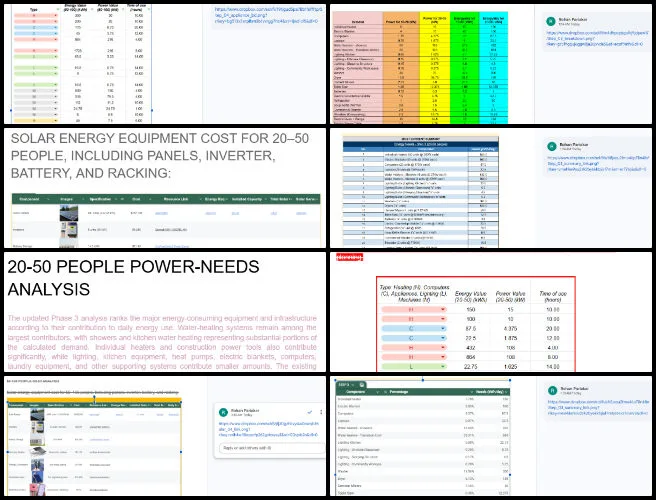
Rohan Pariakar updated the Step 3 and Step 4 energy analysis sections of One Community Global’s Highest Good Energy project report, incorporating revised power-needs information, equipment-level calculations, phase summaries, and solar infrastructure cost analyses. He reviewed the 20-50 person and 50-100 person energy requirements and updated the corresponding report content and supporting visuals. For Step 3, he reviewed the solar expansion requirements of 961 additional 450 W panels, representing 432.45 kW of installed capacity, bringing the cumulative solar installation to approximately 775.8 kW with expected daily generation of approximately 2,595 kWh. For Step 4, he updated the solar cost analysis for 2,689 additional panels, representing 1,210.05 kW of installed capacity and approximately 1,985.85 kW of cumulative capacity, with expected daily generation of approximately 6,643 kWh furthering One Community’s mission of advancing permaculture world building.
Rohan also replaced linked tables in the report with linked pictures and connected the images to the specific spreadsheet cell ranges they represent. Fresh screenshots were captured for the Step 3 and Step 4 energy summaries, appliance-type breakdowns, percentage-wise usage tables, and solar infrastructure cost tables. He also updated the shared folder to store the linked images and added a shared-folder access link to the report. The collage below shows some of his work contributing to permaculture world building.
HIGHEST GOOD EDUCATION PROGRESS
One Community is advancing permaculture world building through Highest Good education that is for all ages, applicable in any environment, adaptable to individual needs, far exceeds traditional education standards, and more fun for both the teachers and the students. This component of One Community is about 95% complete with only the Open Source School Licensing and Ultimate Classroom construction and assembly details remaining to be finished.
With over 8 years of work invested in the process, the sections below are all complete until we move onto the property and continue the development and open sourcing process with teachers and students – a development process that is built directly into the structure of the education program and everything else we’re creating too:
- Program Overview: Education Open Source Hub
- How the components work together in designing human orchestrated eco-abundance and permaculture world building: How to use the Education for Life Program
- Lesson Plans for Life – Lesson Plans How-to
- Foundations of Outstanding Leaders, Teachers, and Communicators
- Curriculum for Life
- Teaching Strategies for Life
- Learning Tools and Toys for Life
- Evaluation and Evolution
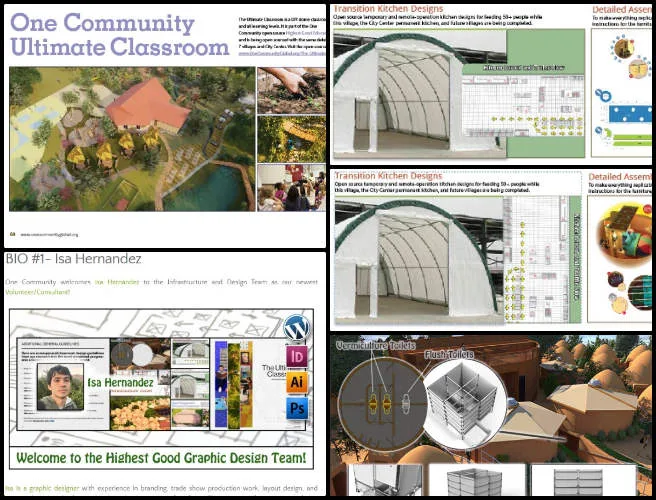
This week, Isaiah “Isa” Hernandez (Graphic Designer) worked across several projects, including updating content for the 7 Villages book, creating his personal bio, and preparing and sending the final versions of The Ultimate Classroom book. He updated existing materials for the 7 Villages book, completed his assigned bio content, and finalized The Ultimate Classroom deliverables for submission while addressing the remaining project requirements. The images below show some of his work contributing to permaculture world building.
HIGHEST GOOD SOCIETY PROGRESS
One Community is advancing permaculture world building through a Highest Good society approach to living that is founded on fulfilled living, the study of meeting human needs, Community, and making a difference in the world:
- Read the Highest Good society overview and permaculture world building: Highest Good Society
- Learn about the model for fulfilled living and sharing: A Day in the Life
- Learn about the 4 economic models: RBE | For-profit | Non-profit | Entrepreneurship
- Learn about our open source community collaboration and management software: The Highest Good Network
This week, the core team completed over 40 hours of work managing volunteer work reviews, handling emails, overseeing social media accounts, supporting web development, and identifying and integrating bug fixes for the Highest Good Network. They also interviewed and onboarded new volunteer team members. Additionally, they produced and integrated the video above, advancing permaculture world building and demonstrating how this concept supports One Community’s broader mission. The following images showcase their work.
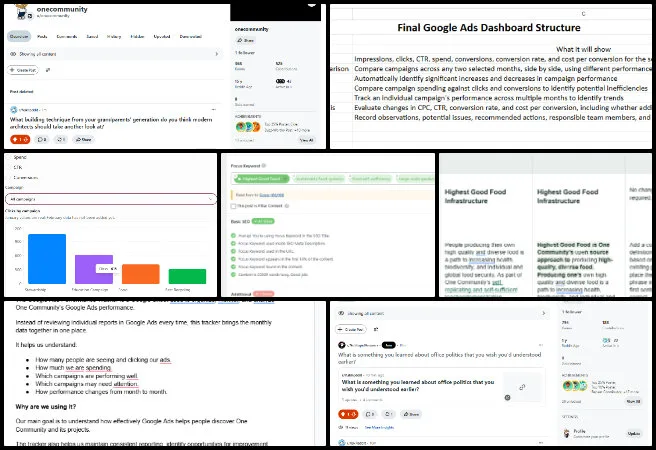
Adhya Rastogi (Business Analyst) continued developing the Google Ads tracking workbook by correcting formatting issues, data inconsistencies, and errors following its transfer from Excel to Google Sheets. She started preparing a step-by-step tutorial for monthly reporting, finalized the planned interactive charts, and worked on the Monthly Campaign Analysis worksheet to support performance comparisons. Adhya also reviewed the Highest Good Food page for SEO improvements, researched relevant primary, secondary, and long-tail keywords, and updated the SEO title, meta description, and social media metadata contributing to One Community’s mission of advancing permaculture world building.
She prepared a side-by-side optimization document comparing the original content with proposed revisions, focusing on keyword placement, content structure, and readability while preserving the original meaning. Additionally, Adhya published Reddit posts through the PostByPurpose and One Community accounts, monitored engagement on previous posts, and drafted new discussion questions for future posting. See the collage below for highlights of her work advancing permaculture world building for the Highest Good Network.
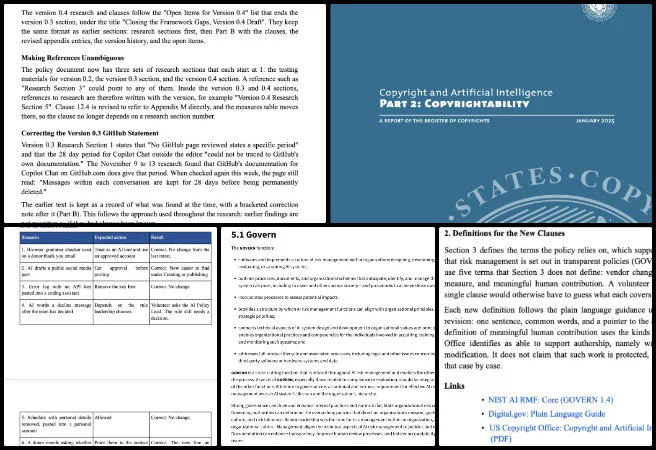
Anagha Sunil Bharadwaj (Legal Research and AI Policy Specialist) continued her research on perpetual purpose trusts across US jurisdictions and their practical implications. She worked on the One Community AI Usage Policy, moving the version 0.4 research into the main policy document and preparing it for team review. Anagha added definitions for the terms used in the new clauses, and updated the technical work guidance note, the tool register, the volunteer quick reference and the briefing outline to match those clauses. Anagha then tested the revised quick reference against eight scenarios. She also corrected an earlier finding on GitHub’s data retention, rechecked the status of state AI rules in Colorado and Illinois, and checked GitHub’s retention terms against its own documentation. Anagha updated the leadership cover summary, handoff note and version history, and wrote a research note with sources for the week’s work. See the collage below for her week’s work, furthering One Community’s mission of advancing permaculture world building for the Highest Good Network.
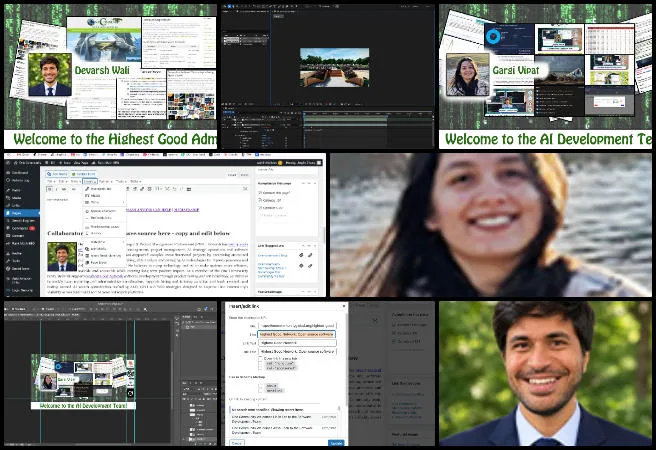
Jinglin Zhang (Graphic Designer) continued working on AI video generation and content creation. She created the website bios and volunteer announcement materials for Devarsh and Gargi, completed related content and uploaded the materials to WordPress. Jinglin also added full-length music tracks to several previously created AI-generated video clips and adjusted the video loops to continue playing throughout the music until the audio ended. See the collage below for her work advancing permaculture world building for the Highest Good Network.
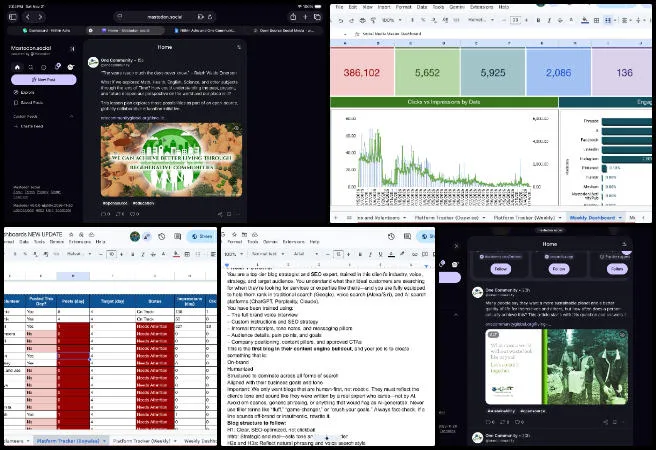
Nithin Adhru (Marketing Manager) updated the social media manager master tracker to include the correct individuals responsible for managing each social media platform and tracked whether they were publishing the required posts across all platforms. He created a master ChatGPT prompt template to generate spreadsheet-based templates for different types of social media content, including Instagram carousels. Nithin also developed a GPT prompt to generate blogs optimized for Generative Engine Optimization (GEO), including an FAQ section. After gaining access to Mastodon, he published at least three posts per day on the platform. See the collage below for his week’s work, advancing permaculture world building for the Highest Good Network.
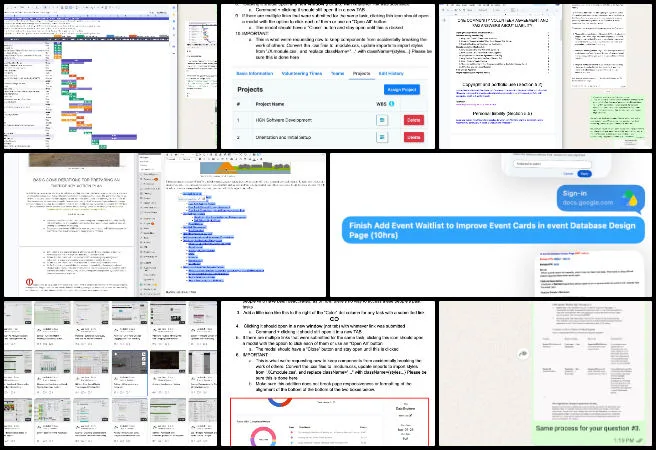
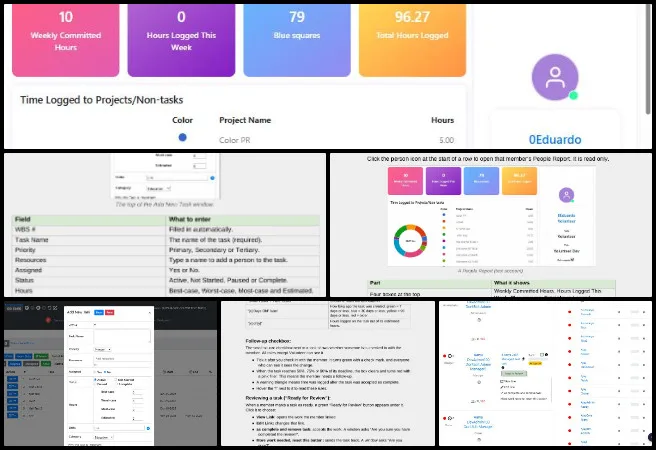
Sethuraman Karunanithi (Industrial Engineer) continued working on the Manager section of the Highest Good Network User’s Manual by testing the Manager role on the Dev site and checking each part of the section against the current version. He updated the Teams part to show that the Edit button now opens the “Update Team Name” window and that Edit and Delete now sit under an “Actions” heading. Sethuraman then opened every remaining window and button available to a Manager, closing each one without saving, and corrected the User Management part after finding that Send Setup Link, Create User, Pause, Delete and Reset Password are greyed out for Managers, leaving Set Final Day as the only active option. He also added the questionnaire icon, the committed hours filter, the Setup Invitation History window and the People Report supporting One Community’s mission of advancing permaculture world building.
In Team Member Tasks, Sethuraman documented how a Manager reviews a task marked “Ready for Review”, how the follow-up checkbox works and what the task age labels mean. He covered the Add New Task window and its fields, along with the Edit, Suggest, Move, Copy and Import Tasks options on the WBS page. For member profiles, he added the Volunteering Times, Teams, Projects and Edit History tabs, explained how blue squares are opened from a profile, and noted that a Manager can view another member’s Timelog but cannot change it. The Manager section now runs to 30 pages with page numbers in the Contents, and emails and personal details are blurred in every screenshot. One earlier issue remains open on the Dev site, where PR Promotions still does not load pending promotions. See the collage below for his work advancing permaculture world building.
Valentina Collini (Graphic Designer) continued creating branded social media graphics aligned with One Community’s visual standards to support outreach and communicate its mission. She also worked on reviewing and refining volunteer biographies, making corrections to improve accuracy, consistency, and overall presentation. In addition, Valentina carefully checked content for errors and implemented necessary updates, helping maintain the quality of both the website and promotional materials. Her work contributed to strengthening One Community’s online presence while supporting the organization’s mission of advancing permaculture world building. See the images below for her week’s work toward the Highest Good Network.
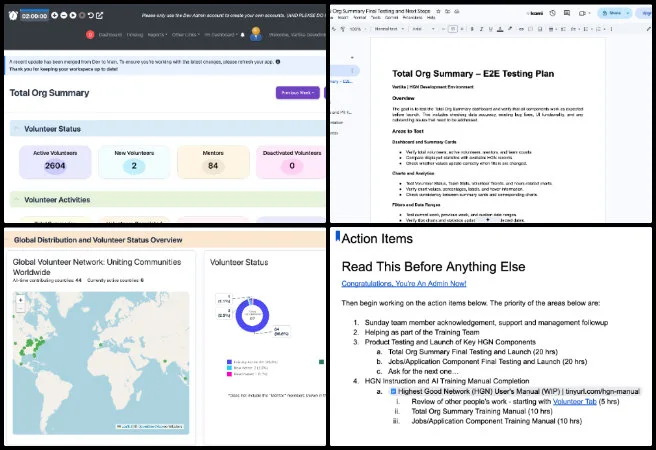
Vartika Shekhar (Product Engineer) worked on setting up her development environment and preparing for end-to-end testing of the Highest Good Network Total Org Summary Dashboard. She configured frontend and backend repositories, installed dependencies, established a MongoDB connection, and verified that both applications ran locally. Vartika also obtained development access and reviewed existing testing documentation, requirements, and reported issues. She developed a detailed testing plan covering dashboard statistics, charts, date filters, data accuracy, exports, dark mode, and responsiveness, along with procedures for reviewing outstanding pull requests. Vartika also completed Sunday administration tasks, reviewing volunteer submissions, providing feedback, and preparing the weekly team summary. See the images below for her work advancing permaculture world building.
ADMINISTRATION TEAM
This week, the Administration Team’s summary, covering their work on the Highest Good Network, was managed by Nikhil Sunkara (Data Analyst) and includes Ashmita Pal (Data Analyst), Fnu Rukmangada “Ruku” (Administrative Assistant), Gargi Vipat (AI Engineer), Olawunmi “Ola” Ijisesan (Administrative and Management Support), Pandithya Reddy Dasari (Business Analyst), Prathik Raju (Data Analyst), Sachit Varma (Business Operations & Cost Analyst), Shreyas Harish (Data Engineer), Surya Duvvuri (Data Analyst), and Tanmay Nihal Harwani (Data Scientist). The Administration Team supports the Highest Good Network, a tool designed to track and measure progress in advancing permaculture world building. The team handles administrative support, documentation, testing, training, analytics, and content management.
Ashmita posted content on One Community’s Tumblr, including photo, link, and text posts with captions, alt text, and tags, and tracked the posts on the Social Media Master Dashboard. She reviewed task requests, assigned and updated hours, checked Basic Software documents, and tested several PRs on Dev, including the Event Popularity page, Issues Breakdown chart labels, Material Cost NaN fix, and Risk Profile layout reinforcing permaculture world building.
Ruku completed the final draft of the Deadline Admin and Results Tracking Dashboard specification and its three-frame Figma wireframe, covering the daily workflow, task thresholds, metrics, charts, filters, data fields, and Assigner Analytics. Alongside the dashboard work, she completed daily Deadline Administrator duties, tracked extension requests and follow-ups, escalated cases when needed, and reported a dashboard bug showing different numbers for the same task. Their dashboard, testing, and administration work supports advancing permaculture world building.
Gargi updated the AI announcement task based on the action plan developed after testing and submitted the revised work to Jae for review. She continued developing the Assistant Manager section of the HGN User’s Manual by testing pages on the development site, comparing them with the Volunteer section, and documenting role features and permissions. She also reviewed corrections as a Corrections Administrator and followed up on pending fixes. Ola supported Google Workspace operations by clearing and organizing files and updating Dropbox folders for the administrative and PR teams. She reviewed a settings change in the summary report and updated her summary and images. Their documentation and administrative work contributes to advancing permaculture world building.
Pandithya updated the PR Analytics Dashboard manual based on manager feedback and added supporting images. She tested multiple PRs across HGN Phase I, HGN Phase II, and the Application/Job Posting Page, added requested HGN tasks, checked team documents for pending requests, and reviewed the Step 2 training document and administrators’ comments on volunteer documents. Prathik tested multiple Total Construction Summary dashboard sections and logged bugs related to Rental Tracking, Injury Severity, dark mode, Project Status, Material Consumption, PDF exports, labor hours, and Project Risk Profile. His other work included confirming fixes to bar labels and the Issues time-range filter, reviewing volunteer time logs, providing warnings and comments, and reviewing the weekly blogs for Vartika and Nikhil. These testing, documentation, and administration activities help with advancing permaculture world building.
Sachit updated Jae on the association matrix, including its new layout, progress on the top funder contact list, and cleaned-up contacts for other funders. After Jae’s feedback, he turned it into a plan that gives each top funder its own tab with contact details, organization categories, and source links. He also researched Anthropic co-founders’ public giving pledges and past giving and scored each person using the funder rubric. Shreyas assigned HGN tasks to developers and members, followed up on their progress, and tested pull requests as part of Basic Software Product Testing and Task Adding Admin. His other work included preparing the Alpha Team’s blog #713 summary and collage by reviewing team members’ Google Docs and Dropbox folders and updating the related documents. Their research, software, and administrative work is part of advancing permaculture world building.
Surya met with Nikhil to discuss the dashboards tested so far, previously identified bugs, bug-reporting procedures and formats, and the process of adding content to the user manual. He identified and reported Rental Tracking bugs, added Rental Tracking content to the user manual, prepared Highest Good Housing content for Blog #713, and updated the Step 2 training document. Tanmay updated 11 bios, followed up on missing summaries and photographs, and consolidated content for Weekly Blog #713 with SEO updates. He managed Threads content and social media tracking, checked titles and descriptions for inconsistencies, and performed final testing of merged PRs to identify remaining issues. Their training, documentation, social media, and software work provides another example of advancing permaculture world building. The collage below shows this team’s work.
HIGHEST GOOD NETWORK PROGRESS
 One Community is advancing permaculture world building through open source Highest Good Network® software that is a web-based application for collaboration, time tracking, and objective data collection. The purpose of the Highest Good Network is to provide software for internal operations and external cooperation. It is being designed for global use in support of the different countries and communities replicating the One Community sustainable village models and related components.
- Learn about our open source community collaboration, management software, and permaculture world building: The Highest Good Network
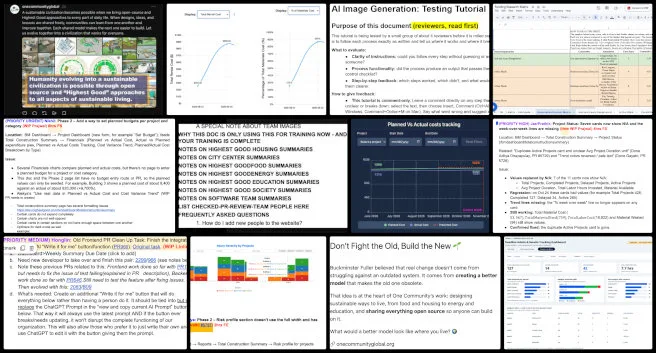
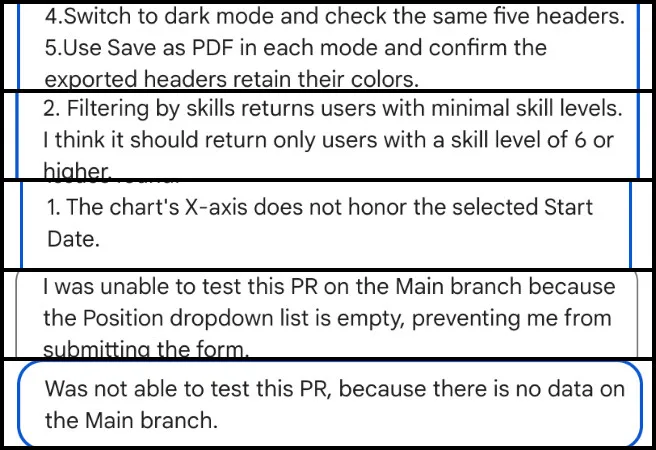
This week, the core team continued HGN PR testing on the main branch for the Highest Good Network, a platform advancing permaculture world building, and confirmed 10 PRs as fixed and one PR as not fixed. It was unable to test eight PRs because the required data was not available on the Main branch. The team reported two new issues: fixing the Weekly Team Summaries page displaying expired team codes and correcting the Date filter issues on the Application/Job Posting page in the Planned vs. Actual Cost Tracking chart under Financial Tracking. It also provided details and recommendations for fixing issues related to PR #5632, “Total Org Summary: Color-Coded Sections for the Weekly Update PDF/Screenshot.” See the collage below to view their week’s work.
ALPHA SOFTWARE DEVELOPMENT TEAM
The Alpha Team’s summary, covering their work on the Highest Good Network, was managed by Lin Khant Htel (Frontend Software Developer) with a team consisting of Deepigha Japamony (Software Engineer), Maithili Kalkar (Software Engineer), and Priyanka Ajit Mutha (Software Engineer). Their work supported One Community’s mission of cross-functional software development and system improvements, advancing permaculture world building.
This week, Lin managed and reviewed the team summary, reviewed PR #2519 by checking the code and running tests locally, checked Alpha Team members’ weekly summaries, photos, and videos, and shared pending pull requests for review. Deepigha worked on draft backend PR #2529 to fix the LB Dashboard Bid Overview page and make the bidListing collection the single data source for the Bidding page, the Bid Overview page, and bid submission. She fixed village data retrieval for listings, made the listing endpoint return a 400 error for invalid IDs instead of a 500 error, and updated the bid submission process to use the logged-in user, validate bid dates and amounts, save bids, update the listing’s current price without allowing simultaneous bids to lower it, and create notifications contributing to One Community’s mission of advancing permaculture world building.
She also updated the Bid model with new fields and data types and added eight unit tests covering successful submissions and error cases. Postman testing is still pending, and she noted a separate issue in the bidsController.postBids endpoint, which always returns a 500 error, for a later fix. As part of the team’s work on permaculture world building, Maithili worked on the Instagram and Threads auto-poster integration with the latest dashboard. She resolved merge conflicts and SonarCloud issues in the HGNRest and HighestGoodNetworkApp pull requests, addressed issues caused by recent development branch updates, and cleared remaining blockers in the frontend and backend pull requests. She also started on the dashboard integration pull request, fixing existing issues and resolving conflicts with the updated development branch.
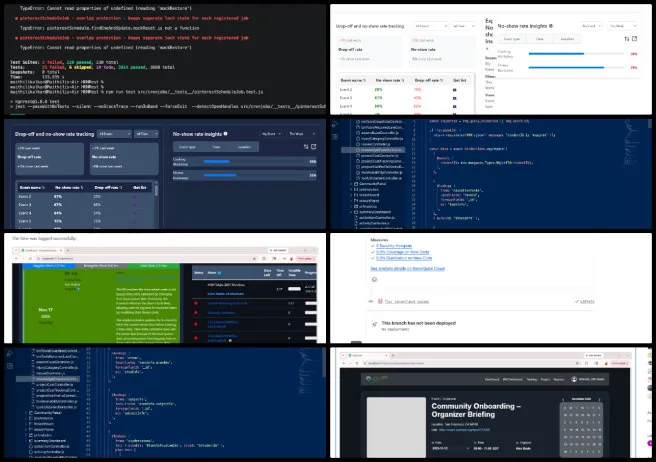
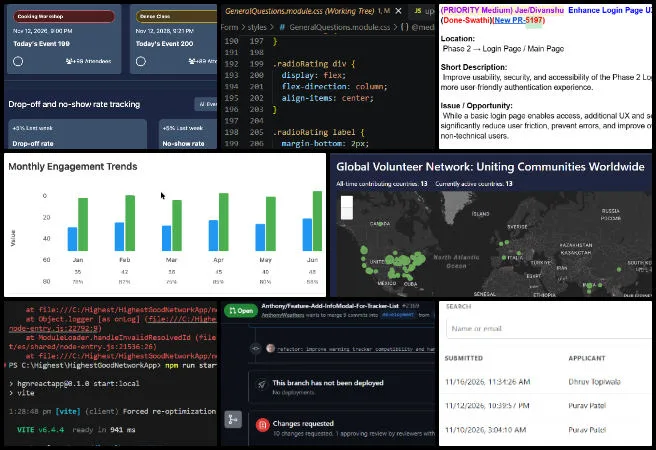
Priyanka reviewed and tested several merged and open pull requests for the Social and Recreational Management and Event Participation Analytics pages. She compared the development implementation with the expected deliverables, tested calendar, card, and list views, dark mode, no-show tracking, event analytics, PDF export, and responsive behavior, and documented working features, missing requirements, and follow-up items. She found mobile layout problems in the analytics charts and created a frontend fix for the affected sections. She also fixed the No-show Rate Insights export modal, tested its close and PDF actions on desktop and mobile in light and dark modes, isolated its styles so the No-show list was not affected, ran code-quality checks, and pushed the updated branch for review furthering One Community’s mission of advancing permaculture world building. See the collage below for highlights of this week’s work.
BINARY BRIGADE SOFTWARE DEVELOPMENT TEAM
The Team Binary Brigade’s summary, covering their work on the Highest Good Network, was managed by Vartika Shekhar (Product Engineer) and Roshini Seelamsetty (Software Engineer) with a team consisting of Aarya Amit Shah (Software Engineer), Aditya Krishnamurthi (Software Engineer), Aditya Varun Dhayapulay (Software Engineer), Alekya Jogini (Software Engineer), Amaan Syed (Software Engineer), Anushka Dwivedi (Software Engineer), Dhruv Topiwala (Full Stack Software Engineer), Mahika Kakkad (Software Engineer), Mahitha Pasupuleti (Software Engineer), Niket Pathak (Software Engineer), Prajwal Gangadhar Melinamane (Software Engineer), Revathi Srinivasan (Software Engineer), Rohit Srikanth (Software Engineer), Shreya Shailesh Bandodkar (Software Engineer), Shubham Jakhete (Software Engineer), and Snehita Kandula (Software Engineer). Their work supported One Community’s software development and system improvements, contributing to the open-source tools and collaboration needed for permaculture world building.
This week, Aarya completed additional Permissions Management functionality by implementing unsaved permission change summaries, fixing default role permission behavior, and adding tests. He also submitted pull requests for these changes, addressed a permissions-test hotfix, and began updating permission names, descriptions, and missing permissions for task 1582. Aditya Krishnamurthi worked on dark mode fixes for the Survey and Feedback Form, corrected the Material Usage Record popup behavior for materials without project usage data, and added tests. He also began implementing a confirmation message for the Confirm Attendance button and a mock activity page contributing to One Community’s mission of advancing permaculture world building.
Aditya Varun worked on timer-splitting improvements, Job Form Builder fixes, and Project Status merge conflict resolution. He also submitted Phase 3 frontend and backend pull requests covering secondary-login access, location suggestions, activity-card accessibility, and Community Calendar stability. He validated changes through automated tests and browser scenarios, updated documentation, and investigated existing permissions-test failures. Alekya worked on the Phase 2 Total Construction Summary dashboard by updating chart titles, configuring dashboard sections to open by default, resolving reviewer feedback on chart label responsiveness, merging the latest development changes, and verifying the Financials date input icon in dark mode. She also reviewed and approved changes replacing sample chart data with real project data furthering One Community’s mission of advancing permaculture world building.
Amaan integrated the Student Viewing Evaluation Results dashboard with authenticated backend APIs, replacing mock data with actual evaluation records and verifying overall scores, assignment results, grading statuses, and teacher feedback. He also improved the Assign Lesson Plan feature by adding validation, authorization restrictions, concurrency controls, and safeguards against duplicate assignments, completing 81 frontend and 80 backend tests. Anushka added 26 unit tests and 14 MongoDB integration tests for application analytics, covering date ranges, role filters, country and region grouping, and comparison calculations. She corrected previous-period totals to include countries without current applicants, passed all 40 tests with 100% service coverage, and submitted the related pull request supporting One Community’s mission of advancing permaculture world building.
Dhruv reviewed pull requests related to the HGN Software Team Questionnaire Dashboard, focusing on incomplete questionnaire indicators across multiple pages and automatic removal of the indicator after questionnaire submission. He also worked on implementing a Closing Out indicator for blue square emails. Mahika addressed timer-related review feedback by improving save retries, preserving entered time after failed saves, validating server-side time limits, and adding tests. She also separated a backend timer fix into its own branch and implemented an intangible time entry popup requiring a reason and date, with light and dark mode testing reinforcing permaculture world building.
Mahitha worked on the HGN Skills Questionnaire integration by implementing questionnaire completion tracking, API functionality, dashboard access restrictions, reminder components, and related tests. She also continued Kitchen and Inventory dashboard improvements, investigated failing tests and access-control logic, and reviewed requirements for the HGN Team Skills Dashboard and Phase 2 Summary Dashboard. Niket enhanced the Global Distribution Map with improved cluster markers, zoom settings, responsiveness, and light and dark mode styling. He also updated the Supplier Performance Chart with configurable targets, threshold-based colors, improved tooltips, performance summaries, and administrator controls advancing permaculture world building.
Prajwal worked on the Social and Recreational Management pages and BM Dashboard Total Construction Summary by addressing review feedback on participation reports, correcting Upcoming Events calendar filtering, and improving No-show Rate Insights. He also added backend functionality for project budgets, implemented a Set Budget form, updated planned cost calculations, and corrected the Cost Breakdown chart to display actual project names. He fixed Project Status calculations to reflect total, completed, active, and delayed projects, labor hours from completed time logs, and available material stock contributing to One Community’s mission of advancing permaculture world building.
Revathi improved the Upcoming Events section by adding Show More and Show Less functionality, dark mode styling, and PDF export. She also updated the People Report summary cards to improve layout, typography, spacing, and responsiveness while preserving the existing design. Rohit worked on the Listing and Bidding Dashboard by connecting the Conversion Funnel to real MongoDB records and developing an API for user activity across different stages of the bidding process. He added date-range and listing filters, corrected property details navigation, and implemented property-view tracking through a new ListingView model. He also investigated user identity inconsistencies across collections and identified mock data dependencies in the Insights from Reviews analytics section furthering One Community’s mission of advancing permaculture world building.
Roshini resolved merge conflicts in PRs #2358 and #5567, both related to fixing task-completed data not populating across the application. She also continued working on resolving merge conflicts in PR #5779, which addresses duplicate Actual vs Planned Costs and Planned vs Actual Costs Tracking charts displaying different values on the Financials Tracking dashboard enabling permaculture world building.
Shreya reviewed PR #5802 for mandatory questionnaire reminders before dashboard access, verified Administrator access, and investigated missing Help Request eligibility functionality. She also reviewed PR #5885 for the permanent questionnaire onboarding link and tested its development deployment, identifying a staging authentication error that prevented further authenticated testing. Additionally, she reviewed PR #2456 for weekly questionnaire summary status and documented concerns involving merge conflicts, permission checks, inactive-member filtering, and week-start consistency demonstrating permaculture world building.
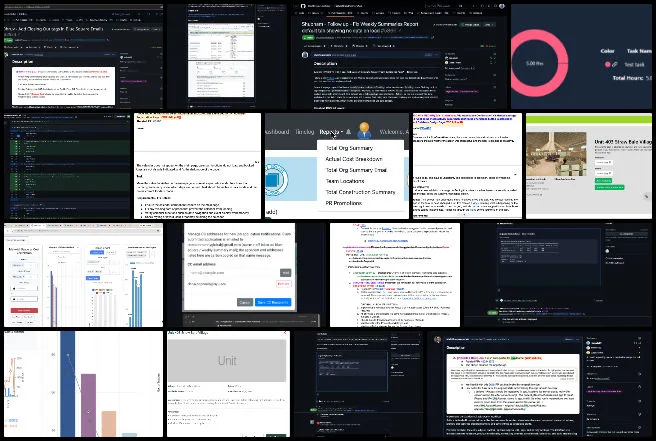
Shubham worked on the Teams page by correcting active and inactive member counts, improving status indicators, and updating labels. He also implemented actionable rental and low-stock dashboard cards, added material quick actions, and developed backend functionality for rental returns, due-date extensions, and reminder emails. Snehita completed end-to-end testing for the Blog Publishing and Mailing component, verified email delivery across different modes, tested outbox actions and unsubscribe functionality, and prepared production email configuration instructions. She also addressed reviewer feedback on mock data seeding and fixed Consumables list calculations and related unit tests. These contributions supported One Community’s software development and testing efforts, improving the tools used for collaboration, reporting, and project management as part of its permaculture world building initiative. The collage below shows the team’s work for the week.
DEV DYNASTY SOFTWARE DEVELOPMENT TEAM
The Dev Dynasty Team’s summary, covering their work on the Highest Good Network, was managed by Aadit Trivedi (Software Engineer and Software Team Administrator) with a team consisting of Aakash Vidiyala (Software Engineer), Akshay Viswanath (Software Engineer), Amaresh Chaudhary Nara (Software Engineer), Ansh Shah (Software Engineer), Gayatri Sawant (Software Engineer), Linlin Fan (Software Engineer), Mahathi Ganimisetti (Data Analyst), Richa Sapre (Software Developer), Sai Manojna Velagala (Software Engineer), Shreevaths Karawal Satish Rao (Software Engineer), Sripriya Srikanth (Software Engineer), and Yuxuan Wang (Software Engineer), supporting One Community’s mission of permaculture world building.
This week, Aakash posted 27 pull request reviews and re-reviews across 26 pull requests, approving 19 and requesting changes on 8, testing each before posting, and while the dev API returned errors for deploy previews, he ran the backend locally against the dev database with writes blocked. Akshay updated the Loss Tracking chart to use existing material records instead of sample data, showing actual material names and the current year and calculating monthly waste percentages from recorded waste and approved purchases, and added regression tests and fixed the year sorting issue flagged by SonarCloud, supporting permaculture world building.
Amaresh traced the Promotion Eligibility dashboard reporting zero reviews for everyone to the eligibility calculations reading only legacy records, and fixed it in PR #5574 and backend PR #2498 by combining the actual PR review entries into the weekly calculation, with regression tests and over ninety percent coverage on the new code. He also moved thirty-six unrelated files into their own PR #5888, restored four financial KPI tiles on the Weekly Project Summary in PR #5892 while fixing dark and light mode contrast, and fixed village IDs appearing instead of village names on the Listing and Bidding platform in PRs #5898 and #2526, contributing to permaculture world building.
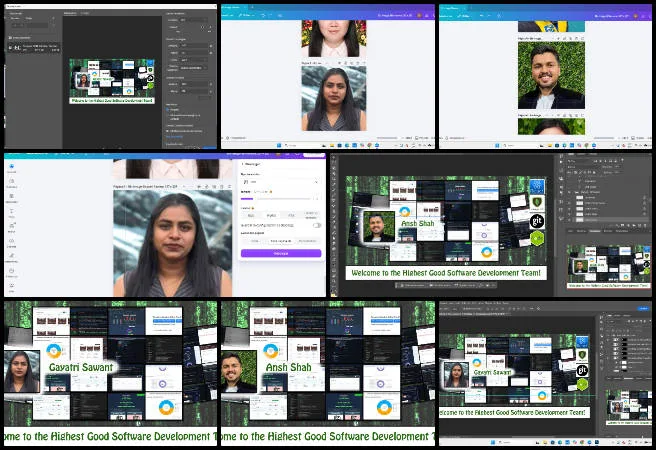
Ansh completed the timer debugging and refactoring task, resolving merge conflicts, keeping the remaining timer time after logging, and addressing SonarCloud issues with 69 automated tests passing, and fixed the task numbering issue in the Dashboard and Work Breakdown Structures in both the frontend and backend. Gayatri finished two Building Management Dashboard tasks on the Total Construction Summary page, replacing the Loss Tracking card’s sample line chart with a donut chart of loss by category, a bar chart of loss by project, and a monthly trend line sharing project and month filters in PR #5877, and completing PR #5863, furthering One Community’s mission of permaculture world building.
Linlin resolved the 404 error on the activities registration page and completed its confirmation modal with dark mode and tests in PR #5880, built a “Write it for me” option in the weekly summary editor that drafts text from the week’s time-entry notes with confirmation before replacing existing text in PR #5891, and added a Show All Tasks and Truncate Tasks toggle to Team Member Tasks in PR #5883. Mahathi completed the Injury Incident Entry Form in the Building and Inventory Management Dashboard, with validation across project details, severity, dates, worker categories, and descriptions, saving records through the backend so new incidents appear in the Injury Severity by Projects chart, supporting permaculture world building.
Richa gave each material in the Loss Tracking chart a consistent color across years with line patterns for each year, verified in light and dark mode, and worked on the tool purchase approval task, adding Approve and Reject actions for Owners and Administrators across the frontend and backend. Sai Manojna fixed the mismatch between saved PR grades and the Promotion Eligibility dashboard, so the backend now uses saved grades to calculate cumulative review totals and weekly eligibility and the dashboard refreshes after a grade or weekly quota changes, contributing to permaculture world building.
Shreevaths fixed issue logging and team editing in the Building Management Dashboard, so newly logged issues now appear in the Issue Dashboard alongside injury records, consequences are preserved, and resolved issues get the correct status and closure date. Sripriya built a Food Sources pie chart for the Kitchen and Inventory Dashboard in PR #5879, showing the share of food that is freshly grown, purchased, or preserved with kitchen and date filters and dark mode, along with a seasonal chart in PR #5881 and backend unit tests in PR #2519. Yuxuan continued the multi-select and auto-suggest tag filtering task, updating the frontend to support multiple tag selections, combined filtering, and improved tag management, and addressing issues found during testing. Their work supports permaculture world building. The following images showcase their work.
SKYE SOFTWARE DEVELOPMENT TEAM
The Skye Team’s summary, covering their work on the Highest Good Network, was managed by Anthony Weathers (Software Engineer) and includes Jaden Wong (Software Engineer), Purav Patel (Software Engineer), and Swathi Angadi (Software Engineer). This work advances the team’s objectives and supports One Community’s mission of permaculture world building.
This week, Anthony continued addressing reviewer feedback and merge conflicts for PR #5588 and PR #3600. For the warning tracker hotfix, he replaced the previous information collection request handling with the skipFetch value introduced in PR #5770, verifying that it prevented repeated requests without causing undefined returns in components outside the scope of PR #5588. He also reviewed additional feedback, requested clarification on a review comment, committed the resulting changes, and resolved a SonarQube issue. For PR #3600, he addressed new reviewer feedback, resolved merge conflicts, and investigated a failing test that was no longer valid due to changes in his implementation. He removed the outdated test, documented the reason in the pull request description, and created a video for Jae to review his proposed approach to handling failures during permission change log creation when roles are changed through User Management. These contributions support One Community’s broader permaculture world building efforts.
Jaden worked on two Community Portal bug fixes and opened a pull request for each. For PR #5890, he fixed unreadable government holiday labels in dark mode by adding the missing light- and dark-mode styles. He also adjusted calendar tooltips to prevent screen clipping, removed the Register button from informational holiday modals, and replaced a translucent badge background to address a SonarQube contrast issue. For PR #5831, he improved the Participation report’s Drop-off and No-show Rate table sorting tests by adding mock event data and coverage for ascending and descending sorting. He also updated assertions to use Testing Library queries to meet lint requirements. All five tests passed, ESLint reported no errors in the changed files, and both pull requests were documented using the team template. Purav contributed 20 hours to the HGN Software Development project, building a full-stack Job Application Analytics CRM across backend PR #2516 and frontend PR #5882 contributing to One Community’s mission of advancing permaculture world building.
Additionally, on the backend, he added paginated application and summary metric endpoints, Owner and Admin authorization, database indexes, and tests covering pagination, search, authorization, and error handling. He also fixed middleware routing that prevented JWT attachment to the applications list endpoint. On the frontend, he built the analytics page with summary cards, searchable and paginated application listings, experience and applicant-source charts, responsive dark-mode styling, and navigation access controls. He also added component tests and addressed SonarQube issues. Additionally, for PR #5554, he resolved layout alignment issues between the Global Distribution map and Volunteer Status chart, verified 23 passing chart tests, and documented the remaining fixes for reviewers. Their work contributes to One Community’s software development objectives and supports its broader permaculture world building efforts.
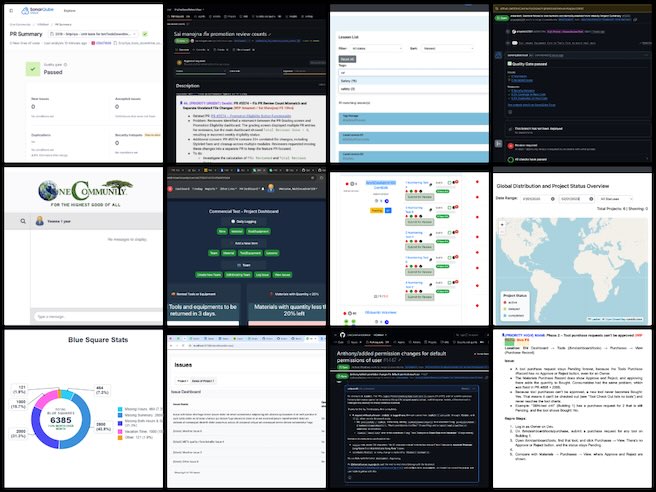
Swathi addressed reviewer feedback across multiple pull requests, including Promotion Eligibility, PR Grading, Review for This Week, and Edit to Reorder. She implemented requested changes, added regression tests, and fixed issues identified during reviews. She also addressed SonarQube duplication and lint issues by creating reusable test utilities and updating existing tests. Additionally, she improved CSS Modules and dark-mode styling, investigated failing tests and build issues, and prepared screenshots and videos to demonstrate changes. She resolved merge conflicts, restored missing code, and validated functionality before pushing updates for further review. These contributions support One Community’s ongoing software development work and its broader permaculture world building goals. Please review the image collage below to see the Skye Team’s key accomplishments and progress throughout the week.
SOFTWARE PR REVIEW TEAM A-Z
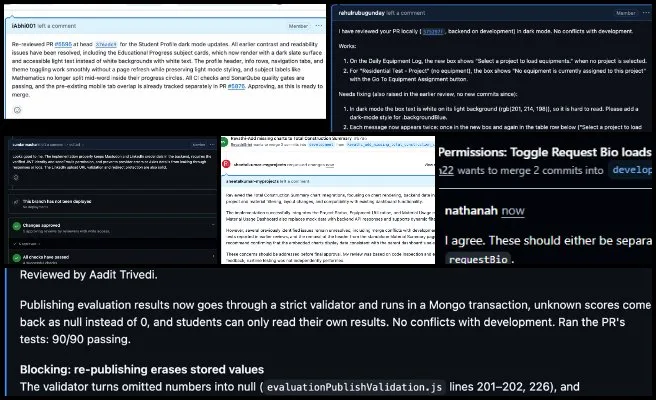
The PR Review Team’s summary for members with names starting with A–Z was managed by Sai Sree Dongari (Data Analyst). The Highest Good Network is a foundation for measuring our results in advancing permaculture world building. This week’s active members of this team were Aadit Trivedi (Software Quality Assurance & Team Coordinator), Mallikharjuna Abhiram Mulpuri (Software Engineer), Nathan Hoffman (Software Engineer), Rahul Rubugunday (Software Engineer), Sheetal Kumar (Software Engineer) and Sundar Machani (Software Engineer). They reviewed all Highest Good Network PRs shared in this week’s update. Learn more about how the Highest Good Network open source hub measures progress toward advancing permaculture world building. The collage below shows a compilation of this team’s work.
AND WE PRODUCED THIS WEEKLY UPDATE – CLICK HERE TO SUBSCRIBE
FOLLOW ONE COMMUNITY’S PROGRESS (click icons for our pages)
INVESTOR PAGES