One Community
Creating a Sustainable Luxury Living Experience – One Community Weekly Progress Update #701
At One Community, creating a sustainable luxury living experience means proving that beautiful, comfortable living and environmental responsibility aren’t mutually exclusive. As an all-volunteer team, we’re designing self-replicating models across housing, energy, food, and social architecture that make fulfilled living accessible and enjoyable. Everything is built for “The Highest Good of All” and open sourced for anyone to freely share and replicate. From this foundation, we’re seeding a global network of teacher/demonstration hubs, regenerating our planet while showing that sustainability can be abundant, not sacrificial.
- Here’s our project overview
- Here’s our world-change methodology
- Here’s how this becomes self-replicating
- Here’s how we are open source and free-sharing all the do-it-yourself designs
OUR MAIN OPEN SOURCE HUBS
Click on each icon to be taken to the corresponding Highest Good hub page.
One Community’s physical location will forward this movement as the first of many self-replicating teacher/demonstration communities, villages, and cities to be built around the world. This is the August 24, 2026 edition (#701) of our weekly progress update detailing our team’s development and accomplishments:
Creating a Sustainable Luxury Living Experience
One Community Progress Update #701

DONATE | COLLABORATE | HELP WITH LARGE-SCALE FUNDING
CLICK HERE IF YOU’D LIKE TO RECEIVE AN EMAIL EACH WEEK WHEN WE RELEASE A NEW UPDATE
YOU CAN ALSO JOIN US THROUGH SOCIAL MEDIA


ONE COMMUNITY WEEKLY UPDATE DETAILS
HIGHEST GOOD HOUSING PROGRESS
One Community is creating a sustainable luxury living experience through Highest Good housing that is artistic and beautiful, more affordable, more space efficient, lasts longer, DIY buildable, and constructed with healthy and sustainable materials:
- Learn about: Our Upcoming Crowdfunding Campaign
- Learn about the different village models and creating a sustainable luxury living experience: 7 Sustainable Village Models
- Visit the open source portals for the first two: Earthbag Village OS Hub | Straw Bale Village OS Hub
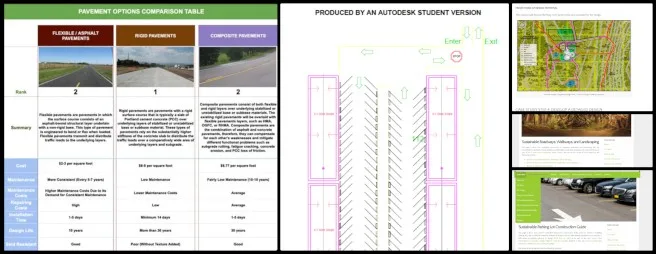
Sagar Chavan (Transportation Engineer) continued working on the Sustainable Roadways and Sustainable Parking Lot Designs project and related AutoCAD plans. He worked with Chanikya to review and improve materials related to sustainable roadway and parking lot design. Sagar discussed the current progress of the roadway plans and identified additional components needed to develop a complete and adaptable roadway design package. He reviewed roadway profiles for cut and fill estimates and cross-sections for pavement cost estimates, along with supporting design elements such as drainage, grading, signage, and ADA considerations. Sagar also reviewed the existing roadway documentation to identify available materials and determine which components may need to be developed during later phases. He discussed how these roadway design elements can be incorporated into the open-source tutorial and adapted for different locations while maintaining sustainable design principles. He also worked on organizing the available plans and supporting documentation to help establish a clear roadway design process that can be applied to different project conditions. His work supports creating a sustainable luxury living experience by strengthening practical, open source guidance for sustainable transportation and integrated water management systems. See below for some of the pictures related to this work.
DUPLICABLE CITY CENTER PROGRESS
One Community is creating a sustainable luxury living experience through a Duplicable and Sustainable City Center that is LEED Platinum certified/Sustainable, can feed 200 people at a time, provide laundry for over 300 people, is beautiful, spacious, and saves resources, money, and space:
- Learn about this building, its function, and creating a sustainable luxury living experience: Duplicable City Center Open Source Hub
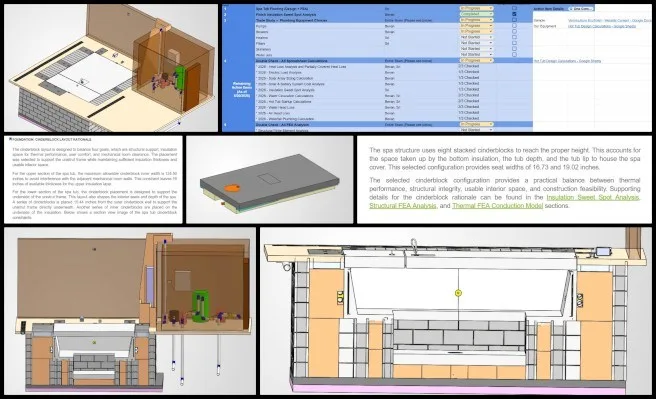
This week, Bevan Chiu (Mechanical Engineer) continued his work finishing the City Center Eco-spa Designs. He updated the cinderblock rationale writeup and CAD model based on the insulation sweet spot results. For the CAD model, he updated the insulation thickness, plumbing panels, decking, joists, and outer cinderblock layout dimensions to maximize insulation thickness within the mechanical room wall constraint while maintaining proper spacing between the cinderblocks. Bevan also corrected the affected mates and component dimensions resulting from these changes. For the final report, he updated the cinderblock specifications, including the height of the eight cinderblocks and the seat dimensions for the updated layout. This open source Duplicable City Center project focuses on creating a sustainable luxury living experience. For more details, refer to the image below.
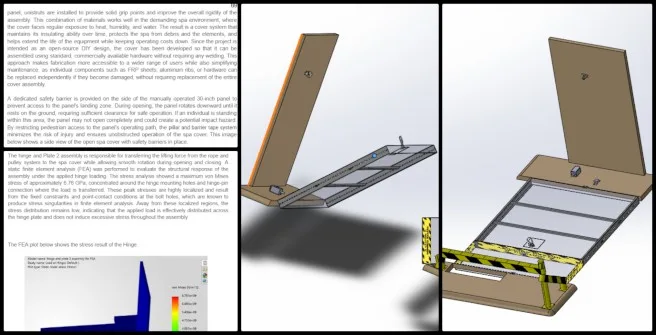
Shivarama Krishna Revanuru (Mechanical Engineer) continued working on the Duplicable City Center design. He worked on the project report by making changes to the images and adding the material strength values to the FEA report to show that the FEA results meet the required test criteria. He also researched the feasibility of using a thermal blanket for the spa cover and evaluated whether it would be suitable for the project requirements. In addition, Shivarama worked on the recent suggestion from Jae regarding the implementation of a thermal blanket in the spa cover and reviewed how it could be incorporated into the existing design. This open source Duplicable City Center project helps in creating a sustainable luxury living experience. The images below illustrate aspects of this work.
Nidish Reddy Koppula (Mechanical Engineer) continued working on the Duplicable City Center design. He worked on gathering and organizing the technical information developed throughout the elevator project for inclusion in the final report. He compiled the CAD design work, finite element analysis results, structural design decisions, hydraulic system assumptions, guide rail and bracket details, material selections, door and enclosure concepts, and other relevant engineering information. He also worked on structuring the final report, documenting the major design updates, recording analysis results and assumptions, and preparing the project documentation in a clear and consistent format. This open source Duplicable City Center project contributes in creating a sustainable luxury living experience. See the collage below for a snapshot of his work this week.

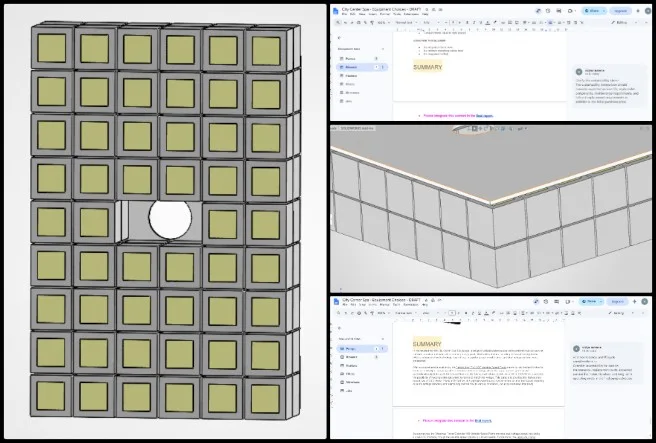
Sri Vidya Sai Thumu (Mechanical Design Engineer) continued developing the City Center Eco-spa Designs. She updated the Concept 2 spa flooring design by refining the two-layer cinderblock base and changing the block arrangement to a running bond pattern. She incorporated Rockwool insulation within the cinderblock cavities and reviewed the layout for structural support, thermal insulation, alignment, and constructability. Sri Vidya also reviewed pump and blower trade studies for the spa system, compared hardware options based on performance, electrical requirements, durability, maintenance, and installation considerations, and identified additional system requirements for final equipment selection. This open source Duplicable City Center project focused on creating a sustainable luxury living experience. See the image below for more on this progress.
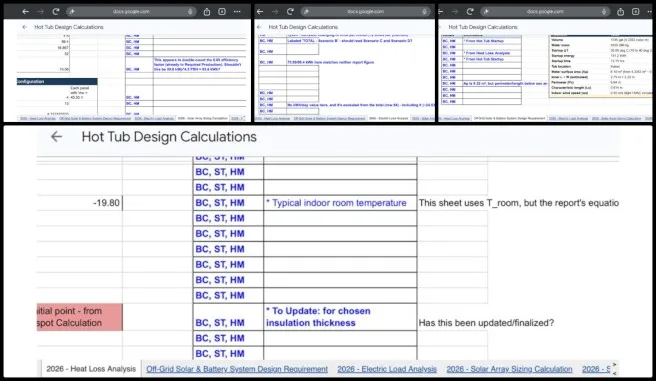
Harshada Memane (Mechanical Engineer) continued developing the City Center Eco-spa Designs, reviewing the Hot Tub Design report and its calculation spreadsheets as part of the FEA Validation and Calculation Review task. The report was checked section by section, covering the spa cover FEA results, structural FEA results, foundation and insulation layout, and the solar array and cost sections, with nine comments posted where results were unsupported, inconsistent, or incomplete. Issues flagged included a folding handle stress result with no stated material or yield strength, a bolt pretension stress exceeding the stated yield strength unaddressed in the safety factor conclusion, mismatched insulation thickness values for the same constraint, unresolved placeholders in the foundation layout, a self-contradiction in solar array sizing, a panel count mismatched with the wiring description, and a spa volume figure with conflicting values affecting the flow rate calculation, furthering One Community’s mission of creating a sustainable luxury living experience.
Work then moved to the spreadsheet, checking formulas across the Heat Loss Analysis, Off-Grid Solar and Battery Design Requirement, Electric Load Analysis, Solar Array Sizing, Solar and Battery Cost Analysis, Insulation Sweet Spot Analysis, and Water Circulation Calculations tabs against reported outputs. This found a missing energy value excluded from one scenario’s total, two mislabeled scenario totals, a double-counted efficiency factor in panel production, a cost line item not reflecting an updated panel quantity, and a question on which cost horizon supports the recommended insulation thickness range, resulting in six additional comments posted. This open source Duplicable City Center project contributed in creating a sustainable luxury living experience. The collage below offers a closer look at this work.
HIGHEST GOOD FOOD PROGRESS
One Community is creating a sustainable luxury living experience through Highest Good food that is more diverse, more nutritious, locally grown and sustainable, and part of our open source botanical garden model to support and share bio-diversity:
- Learn about the structures and creating a sustainable luxury living experience: Hoop House Hub | Aquapini & Walipini Open Source Hub
- See what we’ll be growing: Gardens & Hoop Houses | Large-scale Structures | Food Forest | TA
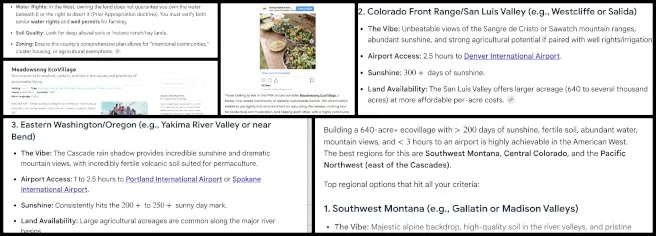
This week, the core team continued working on the Master Tools, Equipment, and Materials/Supplies List for the Large-scale Garden, Botanical Garden, and other Highest Good Food components, created the Site Locations document to compile specific regions in the United States that align with project goals regarding sustainable development, evaluating potential property locations based on surface and subterranean water availability, annual sunshine, moisture accumulation frequency, soil fertility, and elevation. Other factors will be added and organized in order of their importance to the chosen property. Their efforts contribute to One Community’s mission of creating a sustainable luxury living experience through open-source collaboration, ecologically responsible innovation, and a focus on long-term global development. The collage below portrays the team’s efforts and achievements for the week.
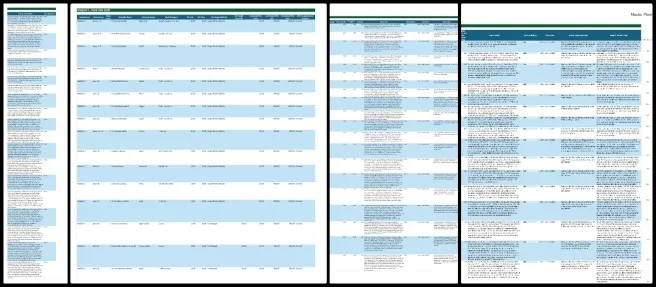
Jay Nair (BIM Designer) continued working on the Aquapini and Walipini Planting and Harvesting documents. He worked on synchronizing the Walipini 1 lighting calculator data with the Master Plant Library to improve consistency between the spreadsheet sections. He also worked on resolving two lighting target values that were physically inconsistent with the calculation requirements and filled in missing uniformity values needed for the zone calculations. These updates focused on improving the reliability of the input data and maintaining consistent calculation parameters across the lighting energy calculator. These efforts improve the stability and adaptability of shared systems, supporting the broader goal of creating a sustainable luxury living experience. See the collage below portraying the work done this week.
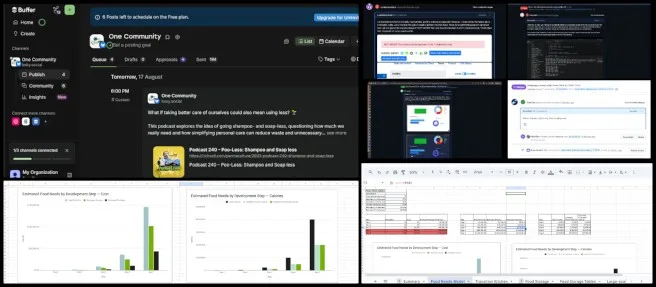
Shameera Musthafa (Data Analyst) continued working on the Highest Good Food initiative, supported OC Administration and the PR Review Team by coordinating PR review workflows, reviewing the work of both the Admin and PR teams, and providing feedback to ensure accuracy, clarity, and consistency across all deliverables. She organized and categorized project images, created visual collages, and finalized blog-related content as part of PR review coordination, ensuring that both visual and written materials were properly curated and documented. Additionally, she contributed to the Highest Good Food report pages and related visualizations. Shameera also managed the One Community Bluesky social media account, creating and publishing posts to help share project updates and increase outreach and engagement. In addition, she supported the hiring process by interviewing and evaluating candidates. This work plays a key role in creating a sustainable luxury living experience. See below for images showcasing her work.
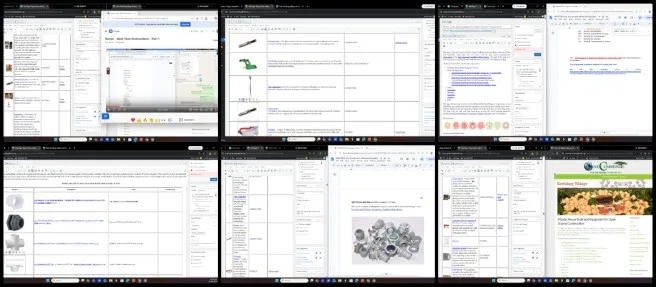
Navya Eeshani Boyapati (Web Designer) continued working on the Aquapini/Walipini. She worked on Task 873: Update the Tools and Equipment for Open Source Construction Page by reviewing the existing webpage content, updating and organizing the page as needed, correcting formatting and spacing issues, checking for content errors, and making revisions to improve consistency, accuracy, and overall webpage quality. See the collage below for a snapshot of this week’s work towards creating a sustainable luxury living experience.
HIGHEST GOOD ENERGY PROGRESS
One Community is creating a sustainable luxury living experience through Highest Good energy that is more sustainable, resilient, supports self-sufficiency and includes solar, wind, hydro, and more:
- Learn about the open source sustainable-energy foundations and creating a sustainable luxury living experience: Solar, Hydro, and Wind
- Explore our research into the most sustainable products and companies for saving water and energy: Insulation, Eco-laundry, Lightbulbs and Light Bulb Companies, Doors and Door Companies, Windows and Window Companies, Toilets, Faucets and Faucet Accessories, Urinals, and more.
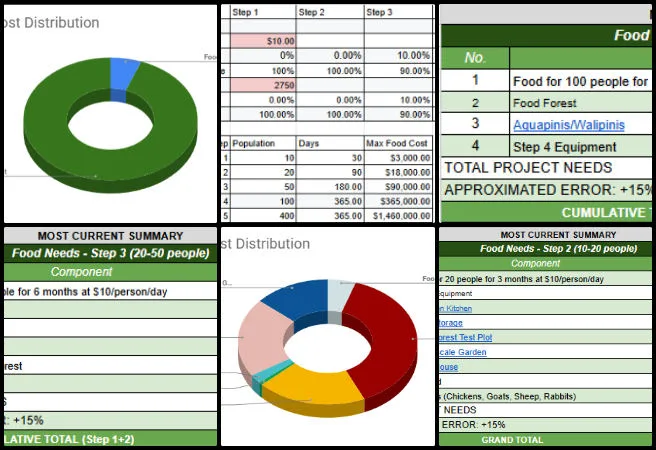
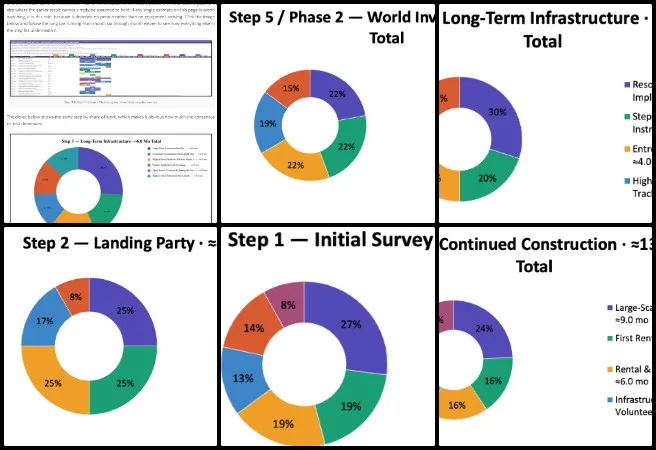
This week, the core team continued contributing to the Highest Good Energy initiative, part of One Community’s work creating a sustainable luxury living experience. They updated the food infrastructure cost analysis and added chart summaries for each step to the Highest Good Food document, along with donut graphs showing cost distribution. The team also added all images to a Dropbox folder and included brief descriptions of each image in the document. They then reviewed Shameera’s work on food calorie and cost needs, communicated with Jae, and revised the page to improve the current predictions. See the collage below for a snapshot of their work this week.
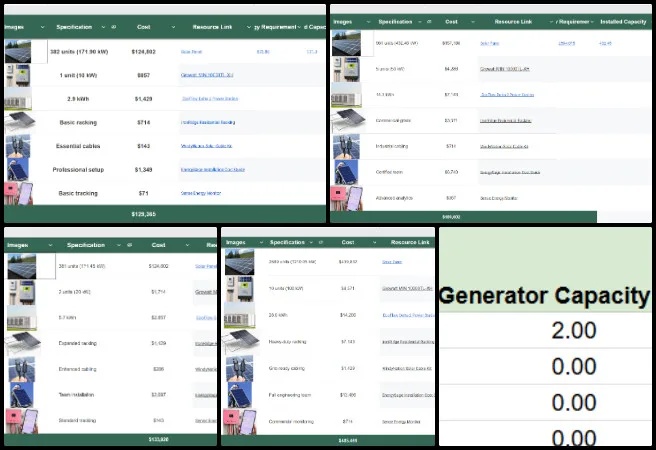
Rohan Pariakar (Operations and Supply Chain Analyst) continued working for the Highest Good Energy initiative, part of One Community’s broader work creating a sustainable luxury living experience. He worked on developing the phased energy and infrastructure model by incorporating additional equipment and infrastructure requirements into the 3-10, 10-20, 20-50, 50-100, and 100-200 person phases. The energy model was extended from the original hourly equipment analysis to calculate phase-specific daily energy requirements while accounting for equipment additions and scaling factors at each stage. Additional requirements, including manufacturing and workshop equipment, advanced infrastructure, the Ultimate Classroom, and Straw Bale Village, were incorporated into the later phases and their impact on daily energy demand was reviewed.
Rohan also revised the solar sizing methodology to move beyond the original 1.6 MW reference capacity and size the solar infrastructure according to the project’s actual daily energy requirements. The relationship between installed PV capacity and expected daily generation was clarified using 4.46 peak sun hours per day and 75% system efficiency. Revised solar infrastructure tables were developed for each phase to track new installed capacity, cumulative installed capacity, expected daily solar generation, panels, inverters, battery storage, mounting systems, wiring, installation labor, and monitoring systems. The revised solar calculations currently indicate approximately 1.986 MW of cumulative installed capacity by the 50-100 person phase. The 100-200 person phase was also updated with additional infrastructure requirements, although its final solar sizing remains pending further validation of the current energy demand inputs. The solar worksheets were also updated to distinguish installed capacity in kW from energy consumption and generation in kWh/day, contributing to One Community’s mission of creating a sustainable luxury living experience. See the collage below for highlights of his work.
HIGHEST GOOD EDUCATION PROGRESS
One Community is creating a sustainable luxury living experience through Highest Good education that is for all ages, applicable in any environment, adaptable to individual needs, far exceeds traditional education standards, and more fun for both the teachers and the students. This component of One Community is about 95% complete with only the Open Source School Licensing and Ultimate Classroom construction and assembly details remaining to be finished.
With over 8 years of work invested in the process, the sections below are all complete until we move onto the property and continue the development and open sourcing process with teachers and students – a development process that is built directly into the structure of the education program and everything else we’re creating too:
- Program Overview: Education Open Source Hub
- How the components work together in designing human orchestrated eco-abundance and creating a sustainable luxury living experience: How to use the Education for Life Program
- Lesson Plans for Life – Lesson Plans How-to
- Foundations of Outstanding Leaders, Teachers, and Communicators
- Curriculum for Life
- Teaching Strategies for Life
- Learning Tools and Toys for Life
- Evaluation and Evolution
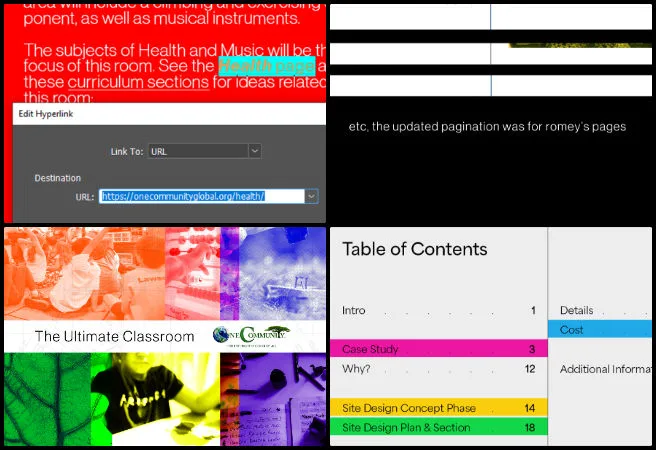
This week, Isaiah “Isa” Hernandez (Graphic Designer) continued working on the spreads for The Ultimate Classroom book. He received feedback on the book, including discussions about reordering certain spreads, selecting a quote to include, and exploring options for the assets from the original cover and a different direction for the newer cover. Isa was also assigned five bios for the weekly blog, thus created content and updated webpages. See the collage below for his work this week, creating a sustainable luxury living experience.
HIGHEST GOOD SOCIETY PROGRESS
One Community is creating a sustainable luxury living experience through a Highest Good society approach to living that is founded on fulfilled living, the study of meeting human needs, Community, and making a difference in the world:
- Read the Highest Good society overview: Highest Good Society
- Learn about the model for fulfilled living, sharing, and creating a sustainable luxury living experience: A Day in the Life
- Learn about the 4 economic models: RBE | For-profit | Non-profit | Entrepreneurship
- Learn about our open source community collaboration and management software: The Highest Good Network
This week, the core team completed over 34 hours managing volunteer work reviews, handling emails, overseeing social media accounts, supporting web development, and identifying and integrating bug fixes for the Highest Good Network. They also interviewed and onboarded new volunteer team members. Additionally, they produced and integrated the video above about creating a sustainable luxury living experience and how creating a sustainable luxury living experience serves as a foundational element of One Community’s broader mission. The following images showcase their work.
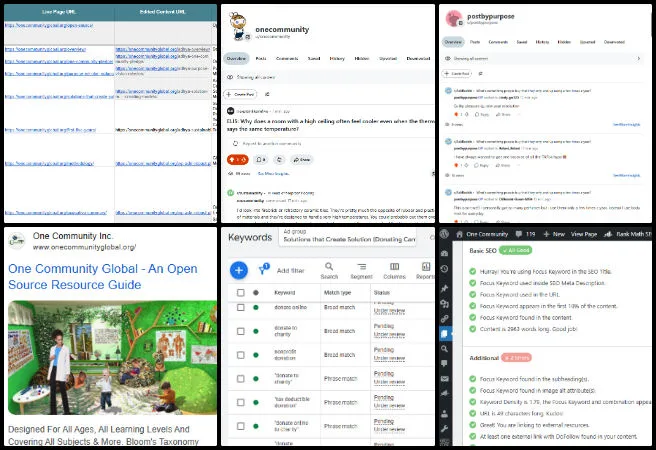
Adhya Rastogi (Business Analyst) continued Reddit engagement using the One Community and PostByPurpose accounts by publishing a new post, contributing relevant comments, monitoring interactions, and identifying opportunities for future participation. She submitted the weekly summary after completing the Reddit activities and organized and uploaded the required weekly pictures to the shared Dropbox folder. She also optimized Google Ads for the Bloom’s Taxonomy and One Community Donations webpages by reviewing existing ads, refining targeting and ad copy, and adjusting relevant keywords and negative keywords. Adhya continued updating the Google Ads Campaign Tracking Spreadsheet with available campaign and ad group information to support ongoing monitoring and management furthering One Community’s mission of creating a sustainable luxury living experience. In addition, she completed SEO optimization for the Open Source and Site Map pages, reviewing keyword targeting, headings, content structure, metadata, readability, and internal linking. Adhya also reviewed analytics and updated the SEO tracking records with optimization progress and baseline information. See the collage below for highlights of her work towards creating a sustainable luxury living experience.
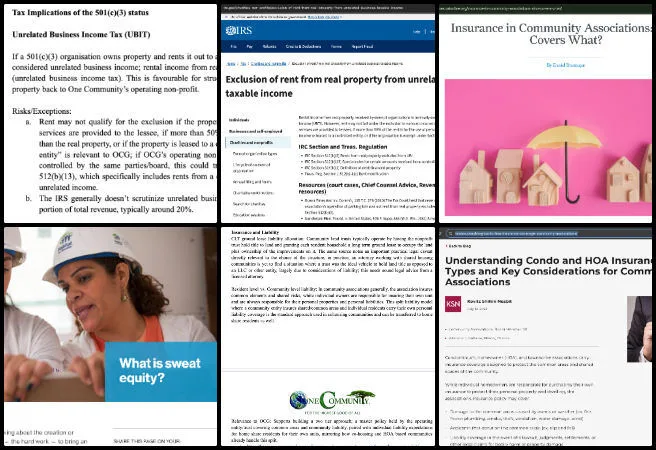
Anagha Sunil Bharadwaj (Legal Research and AI Policy Specialist) continued research on perpetual purpose trusts across US jurisdictions and their practical implications. She began research into how the Home Shares model fits within each of the four legal structures under consideration, examining case studies, including Habitat for Humanity’s sweat equity program, to assess applying labor-earned use-rights within a trust or title-based framework; researched tax implications for One Community’s 501(c)(3) status, including unrelated business income tax and excess benefit transactions, and compared the four options against each other; brainstormed how to structure the final deliverable for highest impact; researched insurance and liability aspects of the four options, including possible strict liability issues alongside Home Shares; and closed the week by collating all research and summarizing findings and conclusions in the working document, furthering One Community’s mission of creating a sustainable luxury living experience. See the collage below to see her week’s work.
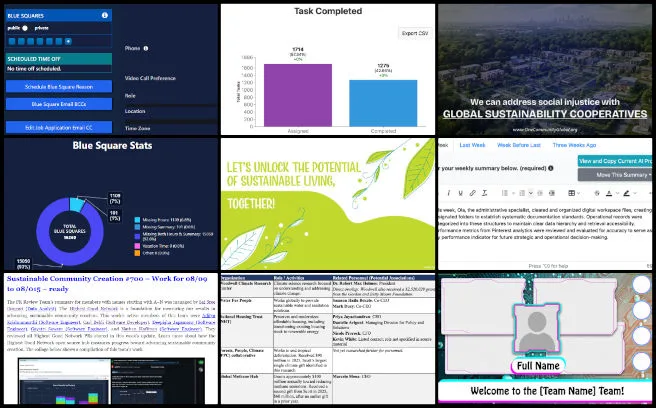
Devendranath Chowdary Maganti (Data Analyst) continued developing and organizing the Highest Good Economics (HGE) timeline materials to support the presentation of the project data and visualizations on the web page. He reviewed the HGE materials and developed the timeline dashboard based on the available project information. Devendranath made additional changes to the dashboard based on feedback from Jae, refining the data presentation and organization. He also worked on updating the Highest Good Society web page by making edits and integrating new project content and visualizations. In addition, he completed regular Administration Team duties and supported related administrative activities. See the collage below for weekly highlights of his work, contributing to creating a sustainable luxury living experience.
ADMINISTRATION TEAM
The Administration Team’s summary, which covers their work on the Highest Good Network, was managed by Devendranath Chowdary Maganti (Data Analyst) and includes Gargi Vipat (AI Engineer), Olawunmi “Ola” Ijisesan (Administrative and Management Support), Prathik Raju (Data Analyst), Sachit Varma (Business Operations & Cost Analyst), Sai Sree Dongari (Data Analyst), Tanmay Nihal Harwani (Data Scientist), and Yeshwanth Nanjegowda (Full-Stack Software Engineer). The Administration Team supports the Highest Good Network, a tool designed to track and measure progress while creating systems that support creating a sustainable luxury living experience. Through administrative support, documentation, testing, training, recruitment, analytics, and content management, the team helps advance this mission, aligning with One Community’s vision of building a replicable and sustainable future model.
This week, Gargi continued developing an AI-assisted workflow for volunteer announcement graphics, created reusable templates for HGN/Software Development and Administration, and developed a standardized content prompt for volunteer information and work samples. She tested and refined the workflow, addressed formatting, image handling, text display, and content consistency issues, shared progress with Jae for design review, and documented Gemini free-tier limitations. She also participated in hiring interviews, reviewed completed volunteer work, and incorporated it into her section of the weekly progress update blog. Ola organized digital workspace files, created designated folders, categorized operational records, and reviewed Pinterest analytics and performance metrics to verify data accuracy and maintain updated KPI records. These workflow, organization, and analytics activities played a role in creating a sustainable luxury living experience.
Prathik reviewed dashboards for the HGN Phase II Construction Management document, examined requirements for the Application Page Analytics task, requested clarification where needed, and completed daily team time log and hours tracking reviews. He also tested the Total Org Summary dashboard, identified data consistency and date-range issues across multiple charts, and documented findings for follow-up. In addition, he reviewed team summaries, images, and videos for weekly blog work, provided feedback, and reviewed Yeshwanth’s blog work with comments on required changes contributing to One Community’s mission of creating a sustainable luxury living experience.
Sachit completed 72 potential funding partner profiles, added more than 15 new funders, researched and removed redundant or mismatched funding sources, and standardized profiles around investments, affiliations, One Community fit, open questions, and suggested next steps. These dashboard, administrative, and funding research activities supported the goal of creating a sustainable luxury living experience.
Sai Sree organized review images, created visual collages, finalized PR Admin Team blog content, reviewed candidate profiles, prepared interview questions, completed four interviews, and recorded feedback for Jae. She also completed frontend testing across multiple application areas, checking chart rendering, form validation, search and filtering, navigation, responsive layouts, interface alignment, and light and dark mode compatibility furthering One Community’s mission of creating a sustainable luxury living experience.
Tanmay updated bio records, followed up with team members for missing summaries and photographs, merged content from multiple team blogs, and applied required SEO updates before publication. He also posted on Threads, updated the Social Media Master Dashboard, and maintained tracking sheets and volunteer records. These testing, recruitment, content management, and social media activities contributed to creating a sustainable luxury living experience.
Yeshwanth created Weekly Blog #700 for Team Dev Dynasty and Team Skye, prepared collages, organized Dropbox materials, wrote team summaries, and reviewed other administrators’ work with feedback on required changes. He also completed DEV environment frontend testing across HGN features covering material consumption, role permissions, job posting, user management, resource management, messaging, badges, project management, analytics, and participation dashboards. He verified filters, forms, charts, notifications, themes, and dashboard components, identified issues involving missing data, validation, dark mode, filtering, notification timing, and other UI functionality, and documented testing results for follow-up. These project administration, documentation, and software testing activities aligned with creating a sustainable luxury living experience. See the collage below for highlights of this week’s work.
HIGHEST GOOD NETWORK PROGRESS
 One Community is creating a sustainable luxury living experience through open source Highest Good Network® software that is a web-based application for collaboration, time tracking, and objective data collection. The purpose of the Highest Good Network is to provide software for internal operations and external cooperation. It is being designed for global use in support of the different countries and communities replicating the One Community sustainable village models and related components.
- Learn about our open source community collaboration, management software, and creating a sustainable luxury living experience: The Highest Good Network
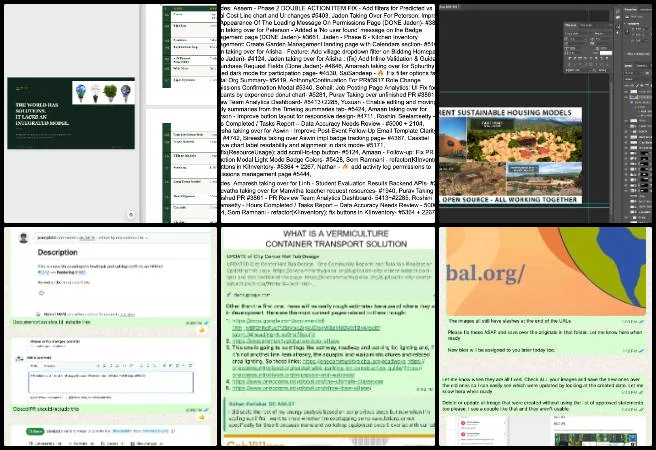
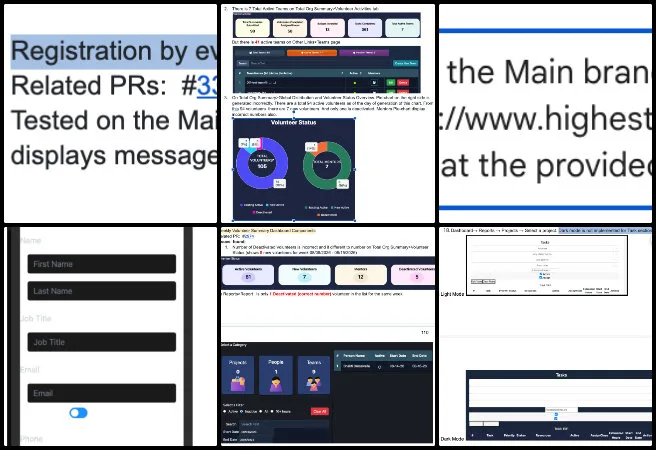
This week, the core team continued testing pull requests on the main branch for the Highest Good Network, a platform creating a sustainable luxury living experience. They performed HGN PR testing on the Main branch and confirmed 10 PRs as fixed. Three PRs were not fixed: PR #3661, which implements a message informing users when no users are found in the user table after entering a search term on the Badge page; PR #3453, which implements the Help Request Feedback Modal for the HGN Questionnaire Dashboard; and PR #5392, which updates the volunteer status donut chart section. The team also set up a test account to test PR #1150, Fix Most Hours in a Week badge. They created six new tasks and recorded Dark mode problems for two pages. The team was not able to test PR #4499, Fix Dark Mode for Longest Open Issues, or PR #4643 and #1980, Create a pie chart titled “Global Distribution of Projects,” because there was no data available on the Main branch. See the collage below to view the team’s work.
ALPHA SOFTWARE DEVELOPMENT TEAM
The Alpha Team’s summary, covering their work on the Highest Good Network, was managed by Lin Khant Htel (Frontend Software Developer) and Prathik Raju (Data Analyst) with a team consisting of Handika Harianto Ew Jong (Full Stack Developer), Maithili Kalkar (Software Engineer), Sai Sandeep (Software Engineer), Som Ramnani (Junior Software Engineer), and Yingshu Wang (Software Engineer), supporting One Community’s mission of cross-functional software development and system improvements. This work advances the team’s objectives, ensuring that all completed tasks directly contribute to creating a sustainable luxury living experience.
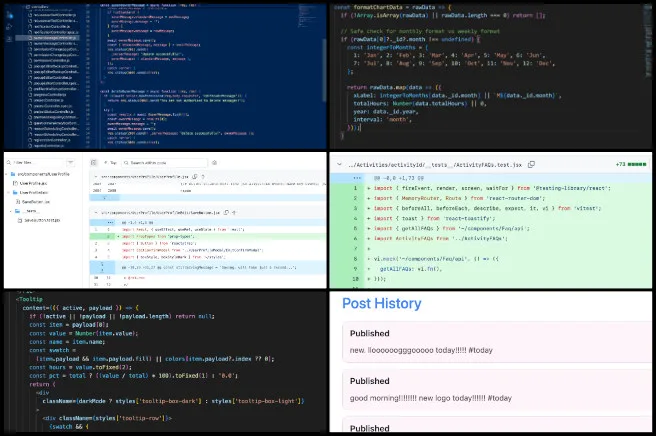
This week, Lin managed the team summary, reviewed PR #2331 by reviewing the code and running tests locally, and checked Alpha team members’ weekly summaries, photos, and videos as part of team management duties, supporting the goal of creating a sustainable luxury living experience. Handika worked on the YouTube auto-poster frontend by improving the announcements page styling and video details interface, replaced several D3.js charts with Recharts to improve tooltip behavior, updated related tests and empty states, removed unused code, and improved dark mode styling across several components, contributing to creating a sustainable luxury living experience.
Maithili resolved multiple issues with the Instagram publishing feature by correcting backend route registration, request headers, Meta token handling, media access, publishing status checks, authentication data, post history fields, CORS configuration, and frontend display issues, and verified the full flow from media upload and publishing through history retrieval and display, furthering creating a sustainable luxury living experience. Sai worked on PR #5451 by fixing x-axis labels and spacing in the Volunteer Trends line chart, improving chart formatting for larger datasets, adding checks to prevent empty rendering errors, and maintaining consistent behavior across light and dark modes, supporting creating a sustainable luxury living experience.
Som worked on PR #5456 by improving dark mode support across the Activity FAQ section, adding tests for themes, accordion behavior, search, filtering, and contact interactions, and replacing the inactive contact link with a button that copies the contact email and provides success or error notifications, advancing creating a sustainable luxury living experience. Yingshu continued improving the Volunteer Time scrolling behavior by assigning a dedicated identifier to the modal scroll container, updating SaveButton to preserve and restore only the targeted modal position, adding support and validation for the new property, updating regression tests, and confirming that all 14 related tests, ESLint checks, Git diff checks, and the production build passed, contributing to creating a sustainable luxury living experience. The collage below offers a visual representation of the team’s work for the week.
BINARY BRIGADE SOFTWARE DEVELOPMENT TEAM
The Team Binary Brigade’s summary, covering their work on the Highest Good Network, was managed by Roshini Seelamsetty (Software Engineer) and Prathik Raju (Data Analyst) with a team consisting of Amaan Syed (Volunteer Software Engineer), Mahitha Pasupuleti (Software Engineer), and Sita Ram Prasad Martha (Software Engineer). Roshini coordinated the weekly summary workflow, ensuring all technical milestones align with the project’s goal to contribute to creating a sustainable luxury living experience.
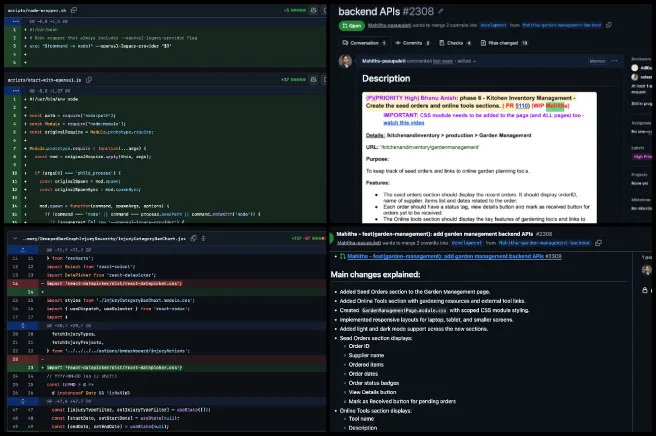
This week, Amaan worked on multiple frontend pull requests across the Building Materials, Reports, and Project Management dashboards. His work included merging development changes, resolving conflicts, restoring Materials page functionality, updating validation behavior, improving image previews, navigation, and dark mode presentation, updating inventory page layouts and action controls, stabilizing project color assignments across Injury Severity and Injury Type charts, updating chart tooltip styling, improving responsive navigation and scrolling behavior in the Resource Management Dashboard, adding permission-related feedback, addressing code quality findings, resolving a production build issue, and validating functionality across filters, permissions, responsive layouts, and dark mode, supporting the goal of creating a sustainable luxury living experience.
Mahitha worked on Garden Management functionality covering garden calendar events, seed inventory, and seed order workflows. Her work included updates to frontend layouts, spacing, alignment, readability, event information, status displays, popups, and accessibility, along with backend controller logic, API integration, validation, date and ID handling, status management, and database operations. She also addressed code quality and security findings, simplified query logic, limited updates to permitted fields, reduced controller complexity, expanded automated test coverage, updated tests for controller changes, and addressed ESLint, formatting, accessibility, maintainability, and SonarCloud findings across affected files, contributing to creating a sustainable luxury living experience.
Sita Ram completed the backend for the Promotion Eligibility Dashboard, alongside Swathi on frontend; the PR is open for review and covers every spec requirement. He built the “Review for This Week” grouping, filtering the reviewer table into three Owner-configurable groups determined automatically from an alphabetical range rather than a stored list. He rebuilt the Weekly Requirements and Remaining Weeks columns after finding they measured something different from Required PRs, fixing three related issues — including one that would have offered 46 unreviewed accounts for promotion, furthering One Community’s mission of creating a sustainable luxury living experience. Sita Ram also completed Process Promotions, placing newly promoted reviewers onto matching teams; after finding the required placement data didn’t exist across 1,112 teams, he built it, plus a preview step before placements take effect. Finally, he added a History column for past PR counts and a review-rating column, writing 145 tests and verifying against real data. See the collage below for highlights of this week’s work.
DEV DYNASTY SOFTWARE DEVELOPMENT TEAM
The Dev Dynasty Team’s summary, covering their work on the Highest Good Network software, was managed by Yeshwanth Nanjegowda (Full-Stack Software Engineer) and Rithika Pai (Software Engineer). The team includes Aditya Dubey (Software Engineer), Akshay Viswanath (Software Engineer), Amaresh Chaudhary Nara (Software Engineer), Bosu Babu Bade (Software Developer), Gayatri Sawant (Software Engineer), Mahathi Ganimisetti (Data Analyst), Shreevaths Karawal Satish Rao (Software Engineer), Sireesha Kunchala (Software Engineer), and Yuxuan Wang (Software Engineer). The Highest Good Network software supports creating a sustainable luxury living experience by helping teams coordinate resources, track project progress, manage operations, and improve efficiency across construction, maintenance, production, and community systems while supporting long-term sustainability goals.
This week, Rithika completed work on the Material Cost Correlation Chart by addressing date-picker, clear-icon, legend-contrast, and dark-mode issues, resolving repeated merge conflicts, and integrating the new charts into the existing dashboard structure. She also worked on network-failure handling and upload-status feedback by improving failed-upload cleanup, file-extension handling, resolving frontend conflicts, correcting a branch mismatch, and verifying the changes through testing contributing to One Community’s mission of creating a sustainable luxury living experience.
Aditya took over three abandoned development tasks, improving resource-filter dropdown icons, selected-period indicators, responsive behavior, hover contrast, and dark-mode styling. He also repaired routing for the email-management module so its sender, outbox, and template pages could be accessed, corrected broken social-platform icon paths, added routing tests, and investigated a separate job-page routing issue involving the applicant-source chart. These improvements contribute to creating a sustainable luxury living experience by strengthening the reliability, accessibility, and usability of digital systems used to coordinate resources, communication, analytics, and community operations.
Akshay replaced outdated Popular PRs mock data with duration-aware backend requests, added loading and error states, test data, rendering tests, and supporting documentation. He also corrected dark-mode styling and authorization behavior in the HGN Help modal and continued dark-mode improvements across Announcements, Attendance, Leaderboard, and Team Member Tasks while resolving CSS Module and contrast issues supporting One Community’s mission of creating a sustainable luxury living experience.
Amaresh corrected Team Member Tasks dropdown sizing, overflow, dark-mode contrast, icon colors, toggle visibility, and submitted-task link behavior. He also fixed a date-picker dark-mode styling issue caused by leaking global CSS, connected Event Participation Analytics to real event data, restored a missing backend route, improved chart tooltips and navigation, and scoped global CSS selectors across 111 files to prevent styles from affecting unrelated components contributing to One Community’s mission of creating a sustainable luxury living experience.
Bosu improved HGN Questionnaire Dashboard access and security by replacing restrictive client-side eligibility logic with backend-authoritative validation, ensuring authenticated user identities are used for help requests, and improving questionnaire-submission handling. He corrected profile navigation by exposing the proper user identifier, added frontend and backend tests, and converted the HGN form entry page into a forms catalog while preserving the existing questionnaire, permissions, responsive layout, and dark-mode behavior contributing to One Community’s mission of creating a sustainable luxury living experience.
Gayatri corrected data mismatches across the Total Org Summary dashboard, aligning volunteer and mentor counts between charts and summary cards, preventing double-counting in the Total Volunteers donut chart, and standardizing percentage rounding between chart labels and legends. This work supports creating a sustainable luxury living experience by improving data accuracy, system security, accessibility, and operational visibility for teams managing collaborative and sustainability-focused community activities.
Mahathi enhanced the Applicant–Volunteer Ratio analytics dashboard by restoring backend data retrieval, adding Count and Percentage views, calculating hiring and conversion rates, implementing multi-role and date-range filtering, and improving labels, legends, tooltips, no-data handling, responsive behavior, and light and dark modes. She also investigated Leaderboard mobile responsiveness and horizontal-scrolling behavior furthering One Community’s mission of creating a sustainable luxury living experience.
Shreevaths improved responsive behavior for the Project Status interface across tablet, mobile, and ultra-wide displays, corrected chart overflow, prevented tooltips from rendering off-screen, and fixed graph behavior when displaying date-related errors. Sireesha updated the bid-overview feature to use the correct backend endpoints, corrected response handling, resolved merge conflicts and case-sensitive import problems that caused deployment failures, addressed SonarQube issues, stabilized Project and Material dropdown dimensions, fixed layout shifts, and restored the Material filter Reset button behavior contributing to One Community’s mission of creating a sustainable luxury living experience.
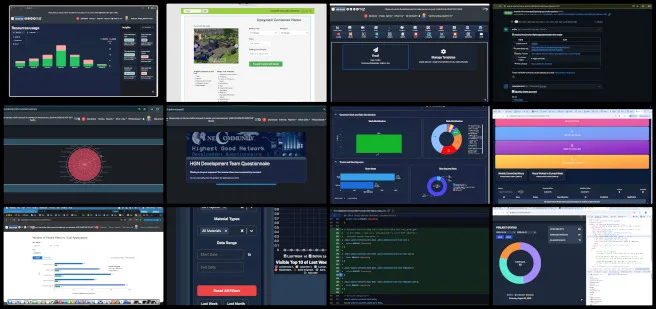
Yuxuan corrected the Active Teams and Team Code display by preventing long team names from pushing table columns off-screen, preserving responsive layouts, and updating backend logic so displayed team codes are derived from active members with valid codes. He also added frontend and backend tests covering table behavior, active and inactive members, invalid or missing codes, ties, and teams without eligible codes. Together, these updates contribute to creating a sustainable luxury living experience by improving workforce analytics, project tracking, materials management, team coordination, and responsive access to the systems that support efficient community planning and operations. See below for a collage highlighting the team’s work.
SKYE SOFTWARE DEVELOPMENT TEAM
Team Skye’s summary this week, covering their work on the Highest Good Network, was managed by Yeshwanth Nanjegowda (Full-Stack Software Engineer) and Anthony Weathers (Software Engineer), includes Jaden Wong (Software Engineer), Ken Zou (Software Engineer), Purav Patel (Software Engineer), and Swathi Angadi (Software Engineer). The Highest Good Network software contributes to creating a sustainable luxury living experience by streamlining collaboration, resource planning, project tracking, and operational management across construction, maintenance, production, and other community-focused systems designed to support efficient and sustainable living.
This week, Anthony continued finalizing the role-change logout notification hotfix by adjusting dark-mode styling for the role-change modal, removing commented code, and testing the implemented functionality and edge cases. He investigated a case where a role change matching a user’s added or removed permissions could bypass the modal while retaining the permission-change status, discussed the behavior and possible approaches, finalized the remaining changes, and submitted the update for review. He also met with Ken to discuss an issue and determined that Ken’s implementation was functioning correctly and that the problem originated from another contributor’s commit furthering One Community’s mission of creating a sustainable luxury living experience.
Jaden corrected a team configuration issue affecting navigation from dynamically loaded team data on the PR Grading Screen, moved remaining inline styles into CSS Modules, and created a new branch to address the related configuration and page-not-found behavior. He also corrected Redux state handling in the PR Review Team Analytics page, replaced inline dark-mode overrides with CSS Module class toggling across analytics and duration-filter components, added dark-mode styling for backgrounds, text, tooltips, forms, and loading states, and removed leftover debugging statements from the header resize handler contributing to One Community’s mission of creating a sustainable luxury living experience.
Ken continued improving the Project Report Page by refining spacing, simplifying the layout, removing redundant components, and correcting components that had not been properly migrated to CSS Modules. He investigated Members table pagination, fixed dark-mode hover behavior in the Tasks table, and continued reviewing React Select filter styling. He also tested features involving Consumables and Materials dark mode, Wishlist functionality, Event Management, the 404 page, issue analytics, and Educator Task Submissions, identifying problems involving contrast, status indicators, CORS restrictions, text and link colors, date-input styling, while verifying working filtering and submission-status behavior supporting One Community’s mission of creating a sustainable luxury living experience.
Purav centralized permission keys across the application, replaced hardcoded permission checks with centralized references, corrected badge and user-permission checks, removed redundant Owner and Administrator bypasses, and fixed Badge Management access, editing, and badge-assignment behavior. He also investigated excessive Dashboard task payload data and updated the backend so completed tasks are excluded for individual users while still returning a completed-task count, reducing the response from approximately 5.24 MB to 3.73 MB by removing 1,239 completed tasks while retaining 2,091 active tasks. He added unit tests for filtering and user isolation, synchronized the interactive project map frontend and backend work with the latest development branch, resolved merge conflicts, and updated the map’s Start and End date inputs for dark mode contributing to One Community’s mission of creating a sustainable luxury living experience.
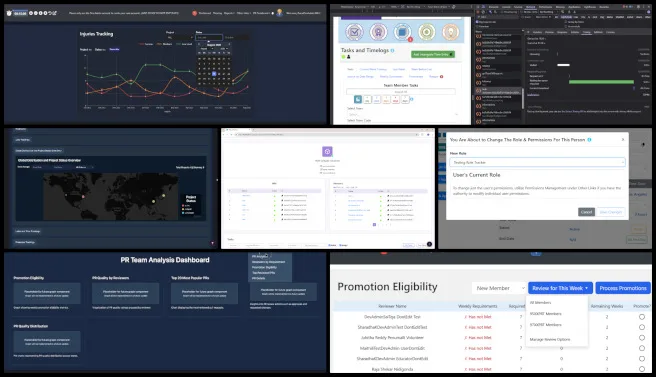
Swathi worked on the Review button functionality for the Promotion Eligibility Page by integrating the backend API to populate dropdown values, implementing an edit modal restricted to owners, adding dark-mode support for the updated interface, and making related UI adjustments to support the new functionality. This work contributes to creating a sustainable luxury living experience by improving system reliability, permissions, performance, accessibility, project management, and team workflows that support efficient and well-coordinated community operations. The images below provide examples of the work completed by the team.
SOFTWARE PR REVIEW TEAM A-N
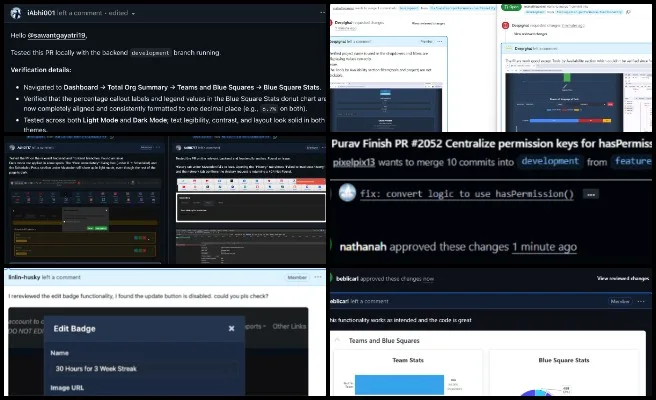
The PR Review Team’s summary for members with names starting with A–N was managed by Sai Sree Dongari (Data Analyst). The Highest Good Network is a foundation for measuring our results in creating a sustainable luxury living experience. This week’s active members of this team were Aditya Krishnamurthi (Software Engineer), Carl Bebli (Software Developer), Deepigha Japamony (Software Engineer), Linlin Fan (Software Engineer), Mallikharjuna Abhiram Mulpuri (Software Engineer), and Nathan Hoffman (Software Engineer). They reviewed all Highest Good Network PRs shared in this week’s update. Learn more about how the Highest Good Network open source hub measures progress toward creating a sustainable luxury living experience. The collage below shows a compilation of this team’s work.
SOFTWARE PR REVIEW TEAM O-Z
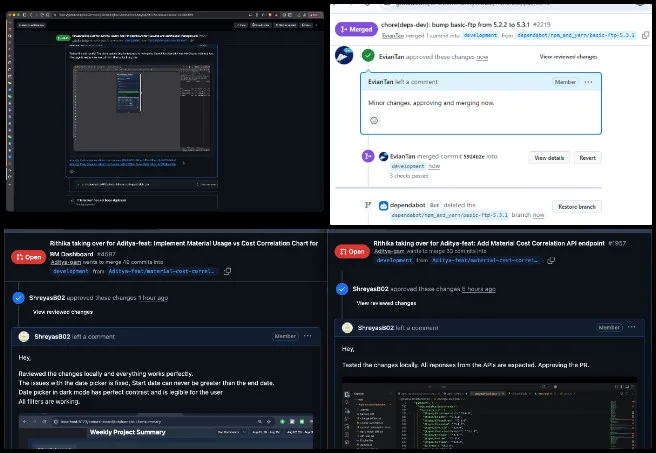
The PR Review Team’s summary for members with names starting with O–Z was managed by Shameera Musthafa (Data Analyst). The Highest Good Network is a foundation for measuring our results in creating a sustainable luxury living experience. This week’s active members of this team were Ruthwik Hosadurga Madhusudhana (Software Engineer), Shreyas Battula (Software Engineer), and Yiyun Tan (Software Engineer). They reviewed all the Highest Good Network PRs (Pull Requests) shared in this week’s update. Learn more about how the Highest Good Network open-source hub measures progress towards our goal of creating a sustainable luxury living experience. The collage below shows a compilation of the work from this team.
AND WE PRODUCED THIS WEEKLY UPDATES BLOG – CLICK HERE TO SUBSCRIBE
FOLLOW ONE COMMUNITY’S PROGRESS (click icons for our pages)
INVESTOR PAGES
GET INVOLVED
DONATE | WAYS ANYONE CAN HELP | MEMBERSHIP
CLICK HERE FOR ALL PAST UPDATES