One Community
Food Self-sufficiency Transition Plan
As the importance of food sustainability and self-sufficiency continues to grow, more people are seeking ways to reduce reliance on external sources. This page serves as a comprehensive resource and guide for affordable purchasing and preparing delicious meals for groups of 20 to 50+ people, while building the infrastructure needed to achieve food independence. For further insights on food sustainability, diversity, and self-sufficiency, explore additional resources at the Highest Good Food open source hub, the soil amendment page, and the hoop house and large-scale garden construction and planting details pages.
This page contains the following sections:
- What is a Food Self-Sufficiency Transition Plan
- Why create a Food Self-Sufficiency Transition Plan
- Ways to Contribute
- Consultants
- Food Self-sufficiency Transition Plan Details
- Production Schedule Overview
- Choosing Foods to Buy and How to Buy Them
- Weekly Shopping and Recipe Links
- Resources
- Summary
- FAQ
RELATED PAGES (click individual icons for complete pages)





CLICK THESE ICONS TO JOIN US THROUGH SOCIAL MEDIA


WHAT IS A FOOD
SELF-SUFFICIENCY TRANSITION PLAN
A food self-sufficiency transition plan provides a specific road map for groups of 20-50+ people to buy and prepare delicious, healthy, and affordable food while establishing the necessary infrastructure to produce their own food. To meet our open source and maximally adaptable and implementable global transformation goals, this food self-sufficiency transition plan has been created with the following goals:
- Minimize food packaging and food waste
- Reduce the daily food cost to less than $10 per person for a group of 50+ people, by sourcing ingredients through bulk purchases and cost-effective suppliers.
- Develop a comprehensive strategy for food preparation that includes both a temporary kitchen and a permanent kitchensolution, with clear guidelines for both.
- Create a scalable cooking strategy that can accommodate groups of 50+ people, with step-by-step instructions and ingredient lists.
- Develop a 3-day meal plan with whole-food-based dishes from global cuisines, ensuring vegan and omnivore options, and everything in between (Lacto Vegetarians, Ovo Vegetarians, Lacto-Ovo Vegetarians, Pollotarians, Flexitarians).
- Establish a shopping cadence that includes ordering fresh foods every 2 weeks and base foods (grains, canned goods, etc.) every 2 months, ensuring the inventory is consistently stocked and budgeted within the next 4 weeks.
- Ensure all meals meet or exceed 100% of the Recommended Dietary Allowances (RDA) for all essential nutrients, providing superior nutrition through carefully calculated, nutrient-dense, whole-food recipes tailored to diverse dietary needs.
- Ensure meal diversity and options for modifying and/or substitution meal options to meet all taste preferences
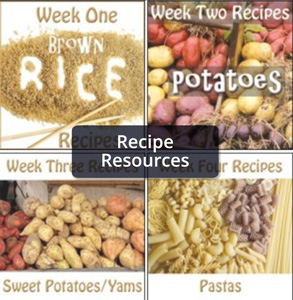
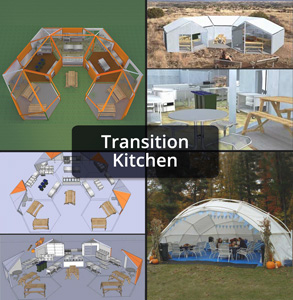
Click these images to be taken directly to the Transition Kitchen and/or the Weekly Recipes:
WHY A FOOD
SELF-SUFFICIENCY TRANSITION PLAN
This food self-sufficiency transition plan is designed to assist in situations where groups of people need to establish a temporary kitchen and prepare meals for large groups over extended periods. While many are inspired by the idea of growing their own food, few consider the detailed, strategic steps required to achieve true self-sufficiency—especially while maintaining superior nutrition. This plan addresses that gap by providing nutritionally complete, affordable, and scalable meal solutions.
As part of our global transformation goals, an open source transition plan is essential. It offers a practical and adaptable roadmap for communities—including sustainable teacher/demonstration communities, villages, and cities—to meet immediate food needs while building long-term self-reliance.
WAYS TO CONTRIBUTE TO EVOLVING THIS SUSTAINABILITY COMPONENT WITH US
SUGGESTIONS | CONSULTING | MEMBERSHIP | OTHER OPTIONS
KEY CONSULTANTS TO THE FOOD SELF-SUFFICIENCY TRANSITION PLAN
- Adam Weiss: Kitchen Operations Project Manager
- Ana Flavia Almeida: Architecture and Urban Planning Student
- Benjamin Sessions: Strategic Sales and Real Estate Entrepreneur and Food Connoisseur
- Brian Storz: Culinary Project Manager
- Chelsea Mariah Stellmach: Project Manager
- Dr. Matt Marturano: Naturopathic Dr. Developer of the COHERENT Method for Digestive Health
- Olayinka “Yinka” Omole: Recipe Reviewer and Data Entry Assistant
- Rihab Baklouti: Freelance Generalist
- Sandra Sellani: Business Author, Speaker, Consultant, and Vegan Chef
- Shivangi Patel: Graphic Designer
- Tyson Den-Herder: Educator and Electrical Engineer
- Zhide Wang: Mechanical Engineer
FOOD SELF-SUFFICIENCY
TRANSITION PLAN DETAILS
The transition from dependence on the traditional food system to a fully sustainable model requires careful planning and attention to numerous details. As we build the foundational components of One Community, we prepare meals for a group of 50 adults, accommodating preferences for vegans, omnivores, and everyone in between.
We discuss the details in the following sections:
- Large-Scale Food Preparation Rollout-Strategy Overview
- Transition Kitchen Design, Setup and Operation Overview
- Sustainable Eating Design Principles and Calculations
- How Much Food is Necessary
- Summary of Needs for 50 Active (Vegan & Omnivore) Adults
LARGE-SCALE FOOD PREPARATION ROLLOUT OVERVIEW

When planning to cook for 50 people a day, the goal is to set up a fully stocked commercial-sized kitchen. This will help reduce preparation, cooking, and cleaning times, which is especially important for intentional communities or self-sufficient hubs that may rely on volunteer labor.
Advantages of a Commercial Kitchen:
- Faster prep and cooking times: Equipment increases efficiency and speeds up processes.
- Efficient cleaning: Specialized tools and systems reduce cleaning time.
- Chef and sous-chef management: Once set up, they can effectively oversee cooking, cleaning, and staff coordination.
- Community involvement: Community members can contribute to cooking and cleaning based on established guidelines.
Challenges:
- High initial cost: Designing and building a commercial kitchen requires significant investment.
- Time investment: The process of planning and constructing a commercial kitchen takes considerable resources away from other action items.
In less permanent situations (like the One Community crowdfunding campaign), a temporary kitchen is needed. It should have basic equipment like an oven, pots & pans, knives, and other basic utensils. This setup is similar to a home kitchen and has worked for centuries. However, it requires more labor. For example, a chef and sous-chef alone can’t prepare as many meals as a commercial kitchen. For a group that makes a lot of baked goods or pasta (which takes time to make without machines), you’ll need 2 additional full-time staff members to help. In One Community’s case, these tasks will all fall under the community contribution model for equal and fair engagement (along with other tasks) as agreed upon by consensus. To minimize labor- plan the menu carefully. Reducing high-labor items like baked goods or pasta can cut down the need for extra staff. Careful planning ahead will help ensure the kitchen runs efficiently.
TRANSITION KITCHEN DESIGN AND SETUP OVERVIEW
One Community’s Transition Kitchen aims to enable our pioneer team to create a variety of affordable, delicious, and nutritious foods year-round. The Transition Kitchen will be used as our primary food preparation area until we build our main kitchen in the Duplicable City Center. The Transition Kitchen will thereafter be used to create meals and snacks on-site at the building locations of the seven villages. We’ll keep updating the open-source plans and add complete setup and maintenance details once we build it. Click the image below to see the full details and additional images of the transition kitchen.

Transition Kitchen Structure and Traffic Flow Pattern – Click for open source details page
SUSTAINABLE EATING DESIGN PRINCIPLES AND CALCULATIONS
The procurement, preparation, and consumption of food will require significant resources, especially in the early stages of transitioning to a sustainable food system. To guide decisions on food sourcing and meal planning, we’ve adopted eight key principles suggested by our consultant Dr. Matt Marturano:
NUTRITIONALLY-COMPLETE MEAL PLANS
Ensure meals meet 100% of the RDA for all nutrients.The food infrastructure is rooted in providing 100% of the Recommended Dietary Allowances (RDA) for all nutrients. This commitment ensures meals support optimal health for all participants, regardless of diet preference (vegan, vegetarian, pollotarian, pescatarian, omnivore). Guided by expert recommendations, meal plans are carefully crafted to meet baseline nutrition requirements, then adjusted to individual and seasonal needs.
NUTRITION-DENSE FOODS
Prioritize nutrient-rich foods, then consider cost. The core of the food model is nutrient density—prioritizing foods that deliver the most nutrition per calorie and per dollar. Recipes and purchasing decisions emphasize whole, unprocessed, and often homegrown ingredients. Cost-effectiveness is considered only after nutritional value, supporting long-term health and sustainability.
MINIMIZING SPOILAGE/WASTE
Balance shelf-stable items with fresh produce to reduce waste.To reduce waste, balance shelf-stable staples like grains and legumes with fresh produce from gardens, food forests, and aquaponics systems. These menus are designed around ingredient longevity and rotation, with integrated systems like food bars and repurposed leftovers minimizing food loss and maximizing efficiency.
FOOD EDUCATION
Teach members to understand their nutritional needs and food content. Community members are educated on the fundamentals of nutrition, including macronutrient ratios, caloric needs, and how these change based on activity and season. Visual resources and training will be available to empower individuals to make informed dietary choices and adjust their intake based on energy, satiety, and mental clarity.
REPLICABLE RECIPES
Use simple, easily replicable recipes. Recipes are designed to be simple, scalable, and replicable, allowing anyone to cook for the group regardless of culinary experience. By keeping the cooking process accessible, the project supports both food independence and large-scale sustainability replication by other communities.
ADAPTABLE RECIPES
Allow for adjustments in group size, activity level, and cuisine preferences. These menus can flex to meet changing needs—be it group size, dietary preferences, or cultural tastes. Core ingredients remain consistent, while variations in spices, herbs, and preparation methods allow for wide flavor diversity without sacrificing nutritional consistency or cost-efficiency.
TASTE AND PRESENTATION
Make food both nutritious and enjoyable. While nutrition is a top priority, food enjoyment is equally valued. Meals are designed to be visually appealing, flavorful, and satisfying. A focus on food artistry, communal dining, and intentional eating supports deeper appreciation and holistic well-being.
COHERENCE
Foster collaboration among all involved in the food process. The food system functions through collaborative effort—farmers, planners, cooks, and diners all play a role. Clear communication and shared values ensure that everyone involved in the food process is aligned with the broader goal: creating a nourishing, sustainable, and enjoyable food experience for all.
These principles aim to ensure a balanced, sustainable, and efficient food system. A detailed explanation is available on our Sustainable Food Nutrition Calculations page.
HOW MUCH FOOD IS NECESSARY
Sustainable nutrition practices require us to continually assess how much food is needed, as the answer depends on various factors. There is no one-size-fits-all answer—it depends on the specific circumstances.
Dr. Matt Marturano has provided guidelines and calculations to help us determine the amount of food required. For a detailed breakdown of how we arrived at these calculations for One Community, visit our Sustainable Food Nutrition Calculations page. You can also check out his guide, How to Get All Your Nutrition From Food, for a comprehensive and helpful explanation.
To develop our transitional food strategy, we answered four key questions that impact food requirements. These answers guide the design of our menus, keeping in mind the following:
- Group Profile: 50 people, ages 25-65, with a mean weight of 178 lbs and height of 70 inches, all highly active due to physical labor (as we are also in the preliminary construction phase).

Based on these estimations, we calculate that the average food needs for the pioneer group during the transition and construction phases:
Daily Needs per Person:
- ~130 grams of protein
- ~2750 calories (calculated using theMifflin-Jeor equation)
Daily Needs for 50 People:
- 6500 grams of protein
- ~137,500 total calories
Weekly Needs for 50 People:
- 50,000 grams of protein (rounded up from 45,500 grams)
- ~1,000,000 calories (rounded up from 965,000 calories) to ensure everyone’s needs are met.
For more information, please refer to the Sustainable Food Nutrition Calculations page.
SUMMARY OF NEEDS FOR 50 ACTIVE ADULTS
Based on all of the above, as shown on our Sustainable Food Nutrition Calculations page. page, here are our final weekly calculations for projected food needs for 50 active adults with a 178 pound average weight and mixed dietary preferences.
40% Omnivore, 30% Vegetarian, 30% Vegan Group of 50 Weekly Plan
- 700 lb vegetables
- 350 lb root vegetables
- 350 lb fruit
- 188 lb [dry] whole grains
- 188 lb [dry] legumes
- 49 lb meats (trimmed)
- 94 lb nuts/seeds
- 70 dozen eggs
- 400 servings dairy
- 21 lb dark leafy greens
CHOOSING FOODS TO BUY AND
HOW TO BUY THE
We follow a bulk food strategy, balancing nutrition and price. Below is an estimate of how often we use each type of food. Details are available in the full Food Procurement and Storage Plan and Food Bars pages.
Key Food Categories:
- Foundational Foods
- Supplemental Foods
- Food Bars
- Bulk Foods Procurement & Storage
FOUNDATIONAL AND SUPPLEMENTAL FOODS SUMMARY:

Foundational foods are the most affordable options, providing the core nutrition needed. Almost all meals should be founded on these staple foods that are cheap, store well, and calorically dense. We prioritize these for daily use:
- Brown Rice
- Potatoes
- Sweet Potatoes/Yams
- Pastas (Bowtie Pasta, Elbow Pasta, Fettuccine or Linguine, Orzo, Penne, Farfalle, Fusilli, or Spaghetti)

Supplemental = More expensive and occasionally used varieties of:
- Bulk Grains, Dried Beans and Legumes, Nuts, Seeds, Pastas, Spreads, etc, not listed above
- Fresh meats / more expensive meats and dairy items*
- Canned fish and seafood*
- Dried and Frozen Fruits
BULK DRIED GOODS PANTRY
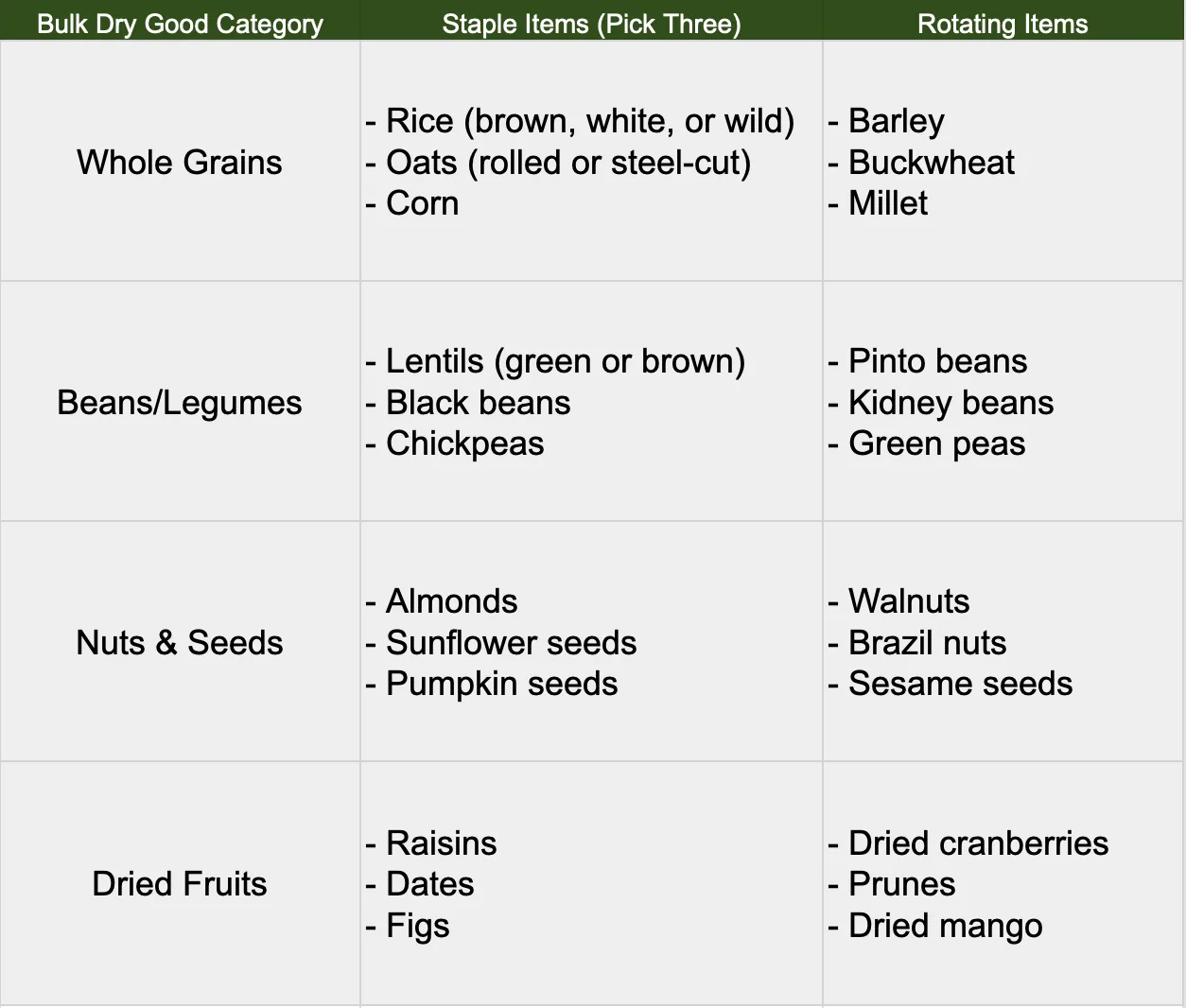
To start your own bulk dried goods pantry, focus on four main categories: whole grains, beans/legumes, nuts and seeds, and dried fruits. For each category, choose three staple items to keep on hand at all times. In addition to these staples, include a few rotating items based on factors like nutritional value, availability, cost, shelf life, ease of use, and variety. This approach ensures you have a well-stocked, versatile pantry that meets your needs.
Sample Pantry List: Bulk Dried Goods
SUGGESTED INITIAL DRY PANTRY
You can find the details of the breakdown of the needs for our bulk foods on the Food Procurement and Storage Plan page. Here is what the storage needs will look like for six weeks of bulk dried goods and four weeks of basic root vegetables and alliums.
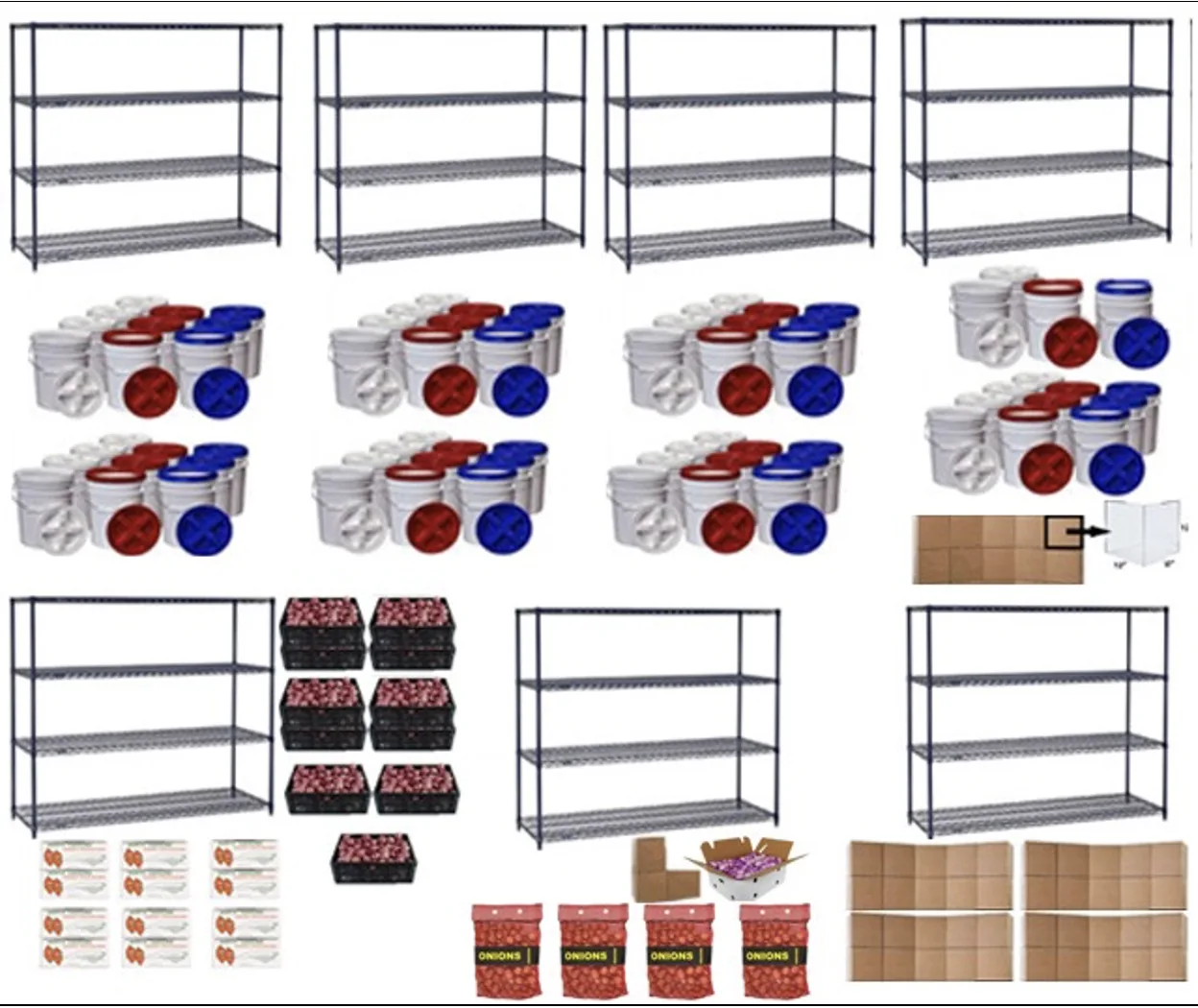
Bulk Dry Goods Storage Plan
To prepare for six weeks of food supply for 50 people, here’s what is needed:
Grains: 45 buckets
Legumes: 30 buckets
Nuts & Seeds: 25 boxes
Dried Fruits: 28 boxes
Storage Details:
Bucket Size: 13.4″ diameter, 17.6″ high (5 gallons)
Box Size: 12″ x 12″ x 12″
Shelf Size: 60″W x 14″D x 74″H
Ceiling Height: 96″
Shelving Setup: This setup uses basic, affordable shelving units and allows for organized, safe, and cost-effective storage of all bulk dry goods within the constraints of the space.
Buckets:
Each shelf holds 5 buckets across
Ceiling height allows storage of 1 bucket high per shelf
Each shelving unit holds 4 shelves x 5 buckets = 20 buckets
To store 75 buckets, 3 full shelving units are needed (60 buckets), plus 3 shelves on a 4th unit (15 buckets)
Boxes: Each shelf holds 5 boxes across and 2 boxes high = 10 boxes per shelf
To store 53 boxes, you need:
3 shelves on a 4th unit (holds 30 boxes)
1 additional shelving unit for the remaining 23 boxes
Root Vegetables & Alliums Storage Plan
Root vegetables (like potatoes, sweet potatoes, carrots, etc.) and alliums (onions, garlic) need a cool, dark place to store properly. These vegetables are kept off the ground and away from fresh fruits to prevent spoilage.
Daily Needs:
- Root Vegetables: 32 lbs per day
- Alliums: 4 lbs per day
Six-Week Supply:
- Root Vegetables: 1344 lbs
- Alliums: 168 lbs
Since storing this much in a warm environment for 6 weeks can be difficult, a 4-week supply is planned for now. Keeping these vegetables in dark, cool conditions will help preserve their freshness.
Learn more about the suggested initial pantry and the procurement, storage & preparation of grains, legumes, nuts & seeds, fruits, and alliums here.

PRODUCTION SCHEDULE OVERVIEW
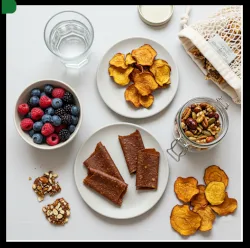 To make the kitchen staff’s job easier, the chef and sous-chef will prepare meals and key ingredients ahead of time, such as soups, stocks, and other bases. These can be made in advance to save time during daily meal prep. Stocks take longer to make but are essential for flavorful, healthy meals. Meals will be served at the same times each day. These times will be based on, best break times and best work times according to daylight and worksite temperatures.
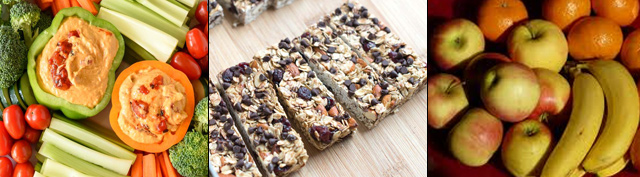
Given the heavy labor, healthy snacks will be available throughout the day to meet higher calorie needs. These snacks, like granola, crackers, mini-pretzels, fruits, veggies, and hard-boiled eggs, will be kept in cold and dry containers for easy access.
BI-WEEKLY SHOPPING AND RECIPE LIST
To effectively serve the One Community Team, we have created recipe options for omnivores, vegans, and everyone in between. Many meals can flexibly be created from either a vegan or omnivore based meal plan. Fresh foods will be purchased on a two week cycle, and non-perishables will be replenished every two months, with an additional month of food in reserve. We have two months of recipes (in 3-day sections) and shopping lists for each 2 week interval that can be found in our Recipe Build-Out Tool. With this (and all the information above) in mind, we have created the following recipe lists:
RESOURCES
SUMMARY
Our food self-sufficiency transition plan provides a clear roadmap for groups of 20-50+ people to purchase and prepare delicious, healthy, and affordable meals for under $10 per person per day while establishing the infrastructure to produce their own food. To guide this process, we first calculate the macronutrient ratios and caloric needs for the initial team of 50 people, scaling up from the needs of our current group. We then design a bulk food storage strategy that meets these nutritional needs, supplemented by basic fresh staples purchased weekly. Additionally, we create weekly menu sets to ensure both variety and balanced nutrition.
FREQUENTLY ANSWERED QUESTIONS
Q: How can you be sure your food ratios are correct?
A: Although much research has been done, we can not be sure that this is going to be the most versatile and complete list that will accommodate the needs and preferences of our team until we are on the property, understand the preferences of each individual, and see how each person’s caloric intake is affected by the labor they engage in. The ratios and items will be adjusted based on these needs, consensus, and the sources and costs of the particular foods that we can access from the property.
Q: Why are so many of the recipes vegan?
A: The vast majority of the preliminary recipes were donated by a vegan chef. We will create omnivore based recipes as well, specifically for the transition kitchen plans, which we anticipate will be used by an even broader audience than just our pioneer team.
Do you have any sustainable kitchen design suggestions?
Yes we do! Visit our Transition Kitchen Setupopen source designs and construction plans.
Q: I’m an omnivore or vegan, what if I don’t want to eat a vegan or omnivore diet?
The complete food self-sufficiency transition plan is designed to meet the needs of all dietary preferences through:
- Recipes that can be made vegan or omnivore:
- Vegan recipes were chosen that could easily have animal-based proteins added for omnivores
- Omnivore recipes were chosen that could easily be made with 100% vegan ingredients
- “Food bars are resource-efficient ways to provide diverse and nutritious food options to large groups of people in any environment” href=”https://onecommunityglobal.org/food-bars/”>Food Bars will be provided alongside the prepared meal to make adaptations available, giving community members the opportunity to eat better than 99.9% of the human population. The combination of a prepared meal and food bar will be like having a personal nutritionist and chef, serving the most diverse, nutritious, and fresh food possible.
- Recipes that can be made vegan or omnivore:
Q: How do you intend to produce spices, mill grain for flour, cooking oil, etc. etc.
To us, “100% food sustainability” means we will demonstrate and open source share a model that doesn’t need external food sources. Having achieved this, what we produce internally versus choosing to buy will be decided through the consensus process.
Q: What is One Community’s stance on pesticides, herbicides, and fungicides?
If it is not safe to eat, we will not be spraying it on our food. Here’s a video we feel is helpful in understanding why:


VIDEOS COMING AS WE IMPLEMENT THIS AS PART OF OUR CROWDFUNDING CAMPAIGN. THEY WILL INCLUDE: PREPARING EACH RECIPE, SHOPPING TIPS, TEMPORARY KITCHEN SETUP, AND MORE
SEE OUR HOW TO HELP AND/OR CROWDFUNDING CAMPAIGN PAGE TO HELP CREATE ALL THE TUTORIAL VIDEOS FASTER.