One Community
Food Bars
This page contains the open source food bar plans designed for One Community’s use during our crowd funding campaign and/or upon initial arrival on the property. Alongside each meal, we provide a food bar, a curated selection of additional food items high in protein, carbohydrates, and fat, as well a selection of fruit, nuts, seasonings, and sauces. A posted nutrition sheet will describe the nutrient composition of the base meal and each item on the food bar. This will allow community members to modify the balance of the meal, giving them the opportunity to eat better than 99.9% of the human population. The combination of a prepared meal and food bar will be like having a personal nutritionist and chef, serving the most diverse, nutritious, and fresh food possible. Food bars are a style of serving prepared food items, which is similar to buffet-style food preparation and service, where food is prepared and then placed in a central location (the bars) and individuals go there and choose which foods to put on their own plates. The plans are designed so they can be adapted for a variety of dietary preferences in almost any situation. To see calculations and reasoning behind the nutritional aspects of these menus, please see our Sustainable Food Nutrition Calculations page. To see the reasoning behind how One Community has designed these for implementation during construction of sustainable teacher/demonstration communities, villages, and cities, please see our complete Food Self-sufficiency Transition Plan page.
This page contains the following sections (click on each point to jump straight to that section):
- What is a Food Bar
- Why Open Source A Food Bar
- Ways you can contribute to this
- Key consultants to this component
- Food Bar Overview
- Food Bars
- Production Schedule Overview
- Bi-Weekly Shopping and Recipe List
- Resources
- Summary
- FAQs
RELATED PAGES (click individual icons for complete pages)





CLICK THESE ICONS TO JOIN US THROUGH SOCIAL MEDIA


WAYS TO CONTRIBUTE TO EVOLVING THIS SUSTAINABILITY COMPONENT WITH US
SUGGESTIONS | CONSULTING | MEMBERSHIP | OTHER OPTIONS
WHAT IS A FOOD BAR
Food bars will be available to modify each prepared meal. A food bar is similar to buffet style food preparation and service where food is prepared and then placed in a central location (the food bar, which is a type of table designed to hold pans of food and keep the food at specific temperatures). A curated selection of additional food items such as quality foods high in protein, carbohydrates, and fat will be provided in a food bar alongside each meal. A posted nutrition sheet will describe the nutrient composition of the base meal and explain how each item on the food bar can modify the balance of the meal.
Here are all the One Community recipes:
These are designed to offer daily food diversity and the rest of the food bar will always offer consistent options so anyone not liking the recipe of the day can still have something they’ll enjoy. All of this will be served on a hot bar and a cold bar, where people bring their own plates and serve themselves. The daily offerings will cover the recommended amounts of staples to make sure we are nutritionally balanced. Food bars on a daily basis will include leftovers from the previous meal to minimize waste, supplemental items high in protein, carbohydrates, and fat, sauces and seasonings, and seasonal and perishable staple items.
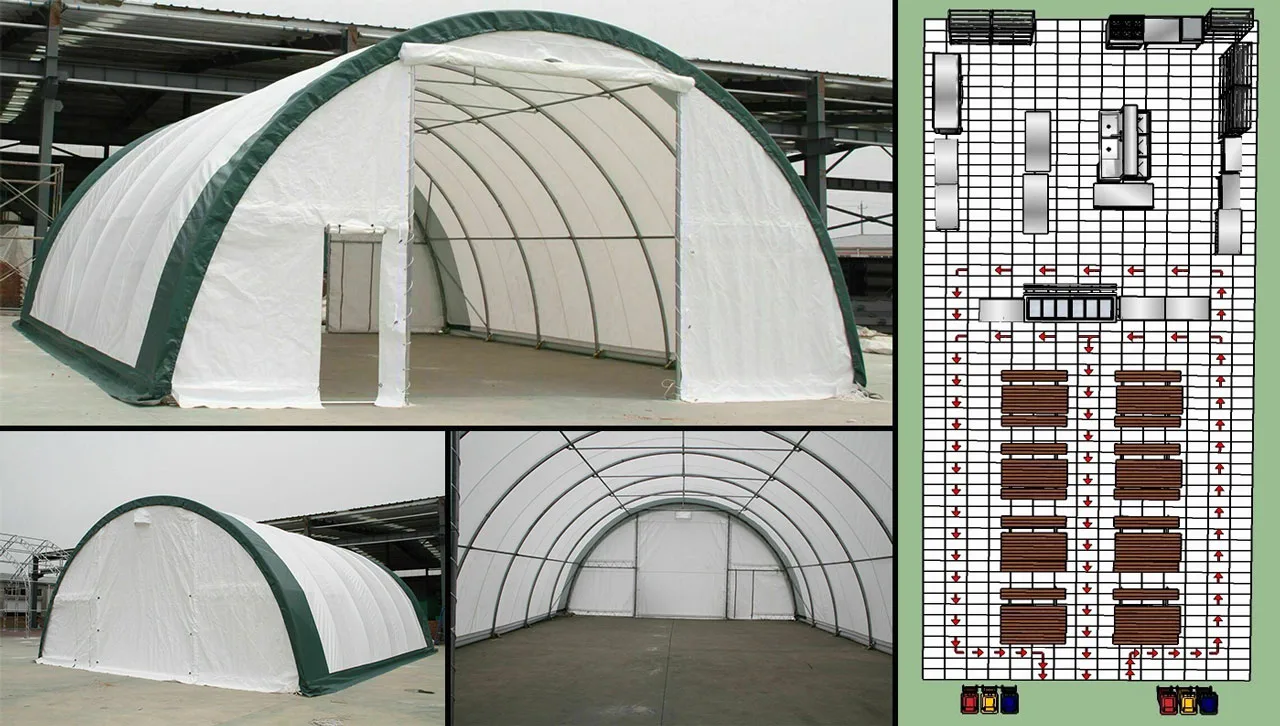
Food bars will be located in our transition kitchen, shown below. The image on the right shows our plan for where equipment will be set up, and the traffic flow during meals.
WHY OPEN SOURCE A FOOD BAR
This food bar strategy is part of our plan to make it easier for others to create a healthy, sustainable, and delicious food program into their projects in any situation where people are looking to establish a temporary kitchen and prepare food for large groups of people over long periods of time. We’ve chosen food bars alongside prepared meals because they’re relatively affordable, sustainable, adaptable, and easy to execute while providing proper nutrition and a fairly wide variety of foods and flavors.
Once we’ve finished this tutorial and open sourced all the updates, modifications/clarifications, and learnings from our experience implementing food bars as part of our Food Self Sufficiency Transition Plan with volunteer builders as part of our crowdfunding campaign, we’ll further evolve it with our core team through building the complete Earthbag Village (Pod 1) and Duplicable City Center®. Our goals in doing all this is:
- To provide menus and meals that can be of benefit to any group
- To demonstrate and share the healthiest and most delicious choices we’ve come up with so far
- To make the food production aspect of DIY sustainable building easier and more affordable for others
WAYS TO CONTRIBUTE TO EVOLVING THIS SUSTAINABILITY COMPONENT WITH US
SUGGESTIONS | CONSULTING | MEMBERSHIP | OTHER OPTIONS
KEY CONSULTANTS TO THE FOOD SELF-SUFFICIENCY TRANSITION PLAN
Benjamin Sessions: Strategic Sales and Real Estate Development Entrepreneur and Food Connoisseur
Dr. Matt Marturano: Naturopathic Doctor & Holistic Recruiter
Sandra Sellani: Business Author, Speaker, Consultant, and Vegan Chef
Tyson Den-Herder: Educator and Electrical Engineer
Chelsea Mariah Stellmach: Project Manager
FOOD BAR OVERVIEW
To make replication as easy as possible, we’ve provided the following sections related to food bar creation:
GENERAL OVERVIEW
The One Community food infrastructure is designed to meet the needs of vegans, vegetarians, omnivores, and everyone in between. We expect most of the community to enjoy the prepared meals, but food bars will be available to supplement the meal in order to meet all dietary needs and preferences. The items included on the food bars will primarily be foods high in protein, fat, or carbohydrates, along with leftovers from the previous meal as well a selection of fruit, nuts, seasonings, and sauces. Additionally, the food bar is an ideal place to add treats for special occasions, or other expensive items that we may want to include on a limited basis.
The food selection on the food bar “buffets” on a daily basis will be based on rotating seasonal and perishable staple items that can modify or add onto the meal service to better meet a variety of daily dietary needs. The bars will also include items that are coming from our bulk food storage, such as grains like rice. There will be a rotation to vary the grains from day to day, while using the same grain for both lunch & dinner on the same day to cut down preparation time.
For example, when the weekly recipes will be based on the ‘root veggie’ or perishable, we could offer brown rice on the lunch and dinner bar on the same day (made fresh at lunch and reused at dinner). Recipes that are chosen for that day would also include legumes or other proteins. When legumes are on the bar, the same legumes will be used within the same day for both lunch and dinner. The grain that goes on the bar will be selected to fit whatever is the best match for the accompanying lunch/dinner root veggie/legume combo.
SUSTAINABLE EATING DESIGN
The procurement, preparation, and consumption of food will take up a large portion of the group’s financial and temporal resources, and even more so in the beginning. Since there are so many differing opinions and theories about nutrition and diet, it is important to have a set of core principles that govern how decisions will be made with respect to these. Here are the principles our food selection and menu design for food bars and daily primary recipes is based on:
- Nutritionally-complete meal plans “ Minimum of 100% RDA for nutrients
- Nutrition-dense foods ” quality comes first
- Minimizing spoilage/waste ” through food selection & storage
- Food education “ including macronutrient and micronutrient content & needs
- Replicable recipes ” straightforward/easy
- Adaptable recipes “ for changes in group sizes and activity levels
- Taste and presentation “ food that is inherently pleasurable
- Coherence ” food policy seeks the highest good for the individuals/groups it effects
You can find the details of this and the other specific details of our food plan, as suggested by our consultant Dr. Matt Marturano, and which can be adapted to suit the needs of any group, on our Sustainable Food Nutrition Calculations page.
CALCULATIONS ON HOW MUCH FOOD IS NEEDED
We answered his four main questions that affect how much food is necessary and the answers to them will be used in devising the transitional food strategy for One Community. We will be designing menus with the following needs in mind:
- 50 people between approximately 25 – 65 years of age with a mean estimated weight 178 lbs and height of 70 inches, who will be very active (from physical labor since we will simultaneously be in the preliminary construction phase)
Please see the Sustainable Food Nutrition Calculations for detailed information on how much total food will be needed while the pioneer group is in the food transition phase and preliminary construction phase.
FOOD BARS
Based on the above calculations, and accounting for our bulk goods selection, we have a general layout below for the breakfast, lunch, and dinner bars.
All food bars will include the following special equipment:
- Coffee grinder for flax seeds
- Hot water maker
- Room temperature water dispenser
- Vitamix or BlendTec Blender
- Salt and Pepper Grinder
BREAKFAST BAR

The breakfast bar will offer staples such as oatmeal, cereals, milks, and fruits. As needed, recipes will be included for breakfast that feature leftovers from the previous day (ex: left over stir fried veggies made into fritatas, or left over potatoes used for breakfast burritos, hashes, etc).


VIDEOS COMING AS WE IMPLEMENT THIS AS PART OF OUR CROWDFUNDING CAMPAIGN: PREPARING EACH RECIPE, SHOPPING TIPS, TEMPORARY KITCHEN SETUP, AND MORE
SEE OUR HOW TO HELP AND/OR CROWDFUNDING CAMPAIGN PAGE TO HELP CREATE ALL THE TUTORIAL VIDEOS FASTER
BREAKFAST BAR FOODS
This is the suggested daily breakfast arrangement for 50 people:

COLD FOODS
The cold foods are chosen for their versatility. They can complement existing breakfast options or be combined to form balanced meals on their own.
- Oats (10 cups / 2 lb, served hot or cold) – A nutrient-dense carbohydrate base that can be eaten alone or paired with toppings.
- Hard-boiled eggs (1 dozen) – A simple and portable source of protein and healthy fats.
- Whole-grain bread (2 loaves / 2 lb, adjust per preference) – For toast or sandwiches such as peanut butter and jam.
- Peanut butter or other nut/seed butter (32 oz) – A calorie-dense spread that adds protein and healthy fats.
- Jam (1 large container) – A sweet complement to bread or fruit.
- Bananas (3 lb) – A versatile fruit option that can also be used in smoothies.
- Rotating fresh fruit (2 lb, plus more for smoothies) – Adds variety and micronutrients.
- Hummus (vegan protein option) – A savory, plant-based choice that pairs well with bread or vegetables.
HOT FOODS
Hot breakfast items provide warm, hearty options to complement cold foods or stand alone as satisfying meals. These foods emphasize protein and plant-based variety, with flexibility to adapt flavors using sauces and spices.
- Leftovers (from previous meal) – Reduces waste and offers variety.
- Scrambled eggs (2 dozen) – A reliable protein source prepared fresh daily.
- Simple beans (vegan protein option) – Plant-based protein that can be flavored with sauces and spices.
SAUCES AND MISCELLANEOUS TOPPINGS
These additions provide flavor, variety, and nutrition, allowing each person to customize their meal. Sauces make dishes more enjoyable, while seeds, nuts, and seasonings add texture, healthy fats, and key nutrients.
- Spices: cinnamon, nutmeg, cardamom, ginger, dessert spices
- Seeds and nuts (sunflower, pumpkin, rotating options, 3 cups / 1 lb each) – Add crunch, healthy fats, and protein
- Nutritional yeast – A plant-based source of flavor and B-vitamins
- Homemade sauce variety – Includes at least one spicy, one sweet, and one rich option
- Traditional condiments – Ketchup, mayonnaise, mustard, hot sauce, marinara, BBQ
- Additional toppings – Flax seeds, chia seeds, hemp hearts, raisins
LIQUIDS
A variety of beverages ensures that both traditional and plant-based dietary preferences are met, while providing simple, reliable options for hydration and comfort. Juice is intentionally excluded due to its high cost and limited nutritional value compared to whole food options.
- Water
- Coffee
- Whole Milk (2 Gallons)
- Tea selection
LUNCH AND DINNER BAR

The lunch and dinner bars offer a mix of cold and hot options that can be combined into sandwiches, salads, or bowls. Each category provides variety and nutrition while allowing flexibility for different dietary needs. These items will be available throughout the day, so if someone misses a scheduled meal or needs extra nourishment between meals, they can still access the bar until it closes after dinner. After that time, a person can use items from the fridge or pantry to prepare their own food if needed.
Lunch and dinner recipes will be made with a weekly theme ingredient and either a legume or grain of the day. Any amounts of legumes, grains, or veggies not used in the recipes for lunch and dinner will be added to the food bar to ensure the recommended daily quantities are served.
VIDEOS COMING AS WE IMPLEMENT THIS AS PART OF OUR CROWDFUNDING CAMPAIGN: PREPARING EACH RECIPE, SHOPPING TIPS, TEMPORARY KITCHEN SETUP, AND MORE
SEE OUR HOW TO HELP AND/OR CROWDFUNDING CAMPAIGN PAGE TO HELP CREATE ALL THE TUTORIAL VIDEOS FASTER
LUNCH AND DINNER BAR FOODS
This is the suggested daily lunch and dinner arrangement for 50 people:

COLD FOODS
Cold items form the foundation for simple meals and can be paired with spreads, vegetables, and toppings to create balanced dishes.
- Whole wheat bread (1 loaf, adjust as needed) – Serves as a base for toast, sandwiches, or peanut butter and jam.
- Hard-boiled eggs (1 dozen) – A portable source of protein and healthy fats.
- Vegetables (2 lb cruciferous and other, 2 lb mushrooms and nightshades, 4 lb root vegetables, 2 lb leafy greens) – Provide fiber, vitamins, and minerals, and can be eaten raw, added to sandwiches, or tossed into salads.
- Hummus (vegan protein option) – A savory spread that pairs well with bread or vegetables.
HOT FOODS
Hot foods create hearty, satisfying meals and allow for flexibility in portion sizes and dietary preferences.
- Leftovers (from previous meal) – Encourage variety and reduce food waste.
- Grains (4 lb) – Options such as rice, quinoa, or other whole grains add carbohydrates, fiber, and energy.
- Simple beans (vegan protein option) – Can be served plain or seasoned with sauces for additional flavor.
SAUCES AND MISCELLANEOUS TOPPINGS
Sauces, seeds, and seasonings make it easy to customize meals while adding flavor, texture, and nutrients.
- Hummus or bean dip (12 cups, served cold or warmed in a crock pot) – Adds protein and creaminess to vegetables, bread, or grains.
- Nutritional yeast – Provides a cheesy flavor along with B-vitamins.
- Homemade sauce variety – Includes at least one spicy, one sweet, and one rich option.
- Traditional condiments – Ketchup, mayonnaise, mustard, hot sauce, marinara, barbecue sauce.
- Seeds and nuts – Flax seeds, chia seeds, hemp hearts, raisins, and roasted sesame seeds (purchased raw and roasted in-house).
- Alliums (2 lb) – Onions, garlic, and related vegetables that add flavor depth and additional nutrients.
PRODUCTION SCHEDULE OVERVIEW
In order to make the lives of the kitchen staff easier, it is strongly advised that items included on the food bar require minimal preparation and cleanup. Foods like fresh fruits, vegetables, nuts, hardboiled eggs, bread, seasonings, and sauces can be served cold. Leftovers may be reheated and served hot with one or two additional items, such as rice and beans.
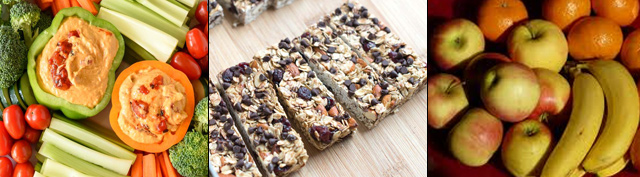
It will be important to also offer healthy snacks to the Community throughout the day. Due to the projected hours of heavy manual labor, a higher caloric intake will be needed than can be satisfied solely through the primary meal setting. With this in mind, healthy snacks will be prepared and offered in cold and dry containers that can be accessed by anyone at anytime. Examples of this would be large dry containers offering food items such as granola, crackers, and mini-pretzels along with chilled water containers that will provide already prepared vegetables, fruits, and hard-boiled eggs.
BI-WEEKLY SHOPPING AND RECIPE LIST
To effectively serve the One Community Team, we will create two primary recipe options: omnivore and vegan. Many meals can flexibly be created from either a vegan or omnivore based meal plan, and all dietary preferences will be addressed. Food bars will be included to meet the dietary needs and preferences of everyone including vegans, lacto vegetarians, ovo vegetarians, lacto-ovo vegetarians, pescatarians, pollotarians, flexitarians, and omnivores. Here are all the One Community links to the recipe pages:
VIDEOS COMING AS WE IMPLEMENT THIS AS PART OF OUR CROWDFUNDING CAMPAIGN: PREPARING EACH RECIPE, SHOPPING TIPS, TEMPORARY KITCHEN SETUP, AND MORE
SEE OUR HOW TO HELP AND/OR CROWDFUNDING CAMPAIGN PAGE TO HELP CREATE ALL THE TUTORIAL VIDEOS FASTER
RECIPES
To address the dietary desires of vegans, omnivores, and everyone in between, a wide variety of both vegan and omnivore recipes have been included in our Recipe Build-Out Tool , and shared below.
RECIPE LISTS
Here are all the One Community links to all the other recipe and menu pages (some of which are in progress):
RECIPE BUILD OUT TOOL
 The Recipe Build-Out Tool is a comprehensive resource designed to streamline meal planning and preparation. It helps communities create sustainable, healthy, and delicious meals for a wide range of dietary preferences. The recipes above are included in our Recipe Build Out Tool, or can be added to the Master Recipe Template to create your own. Click on the link to the Recipe Build Out Tool page and tutorial below.
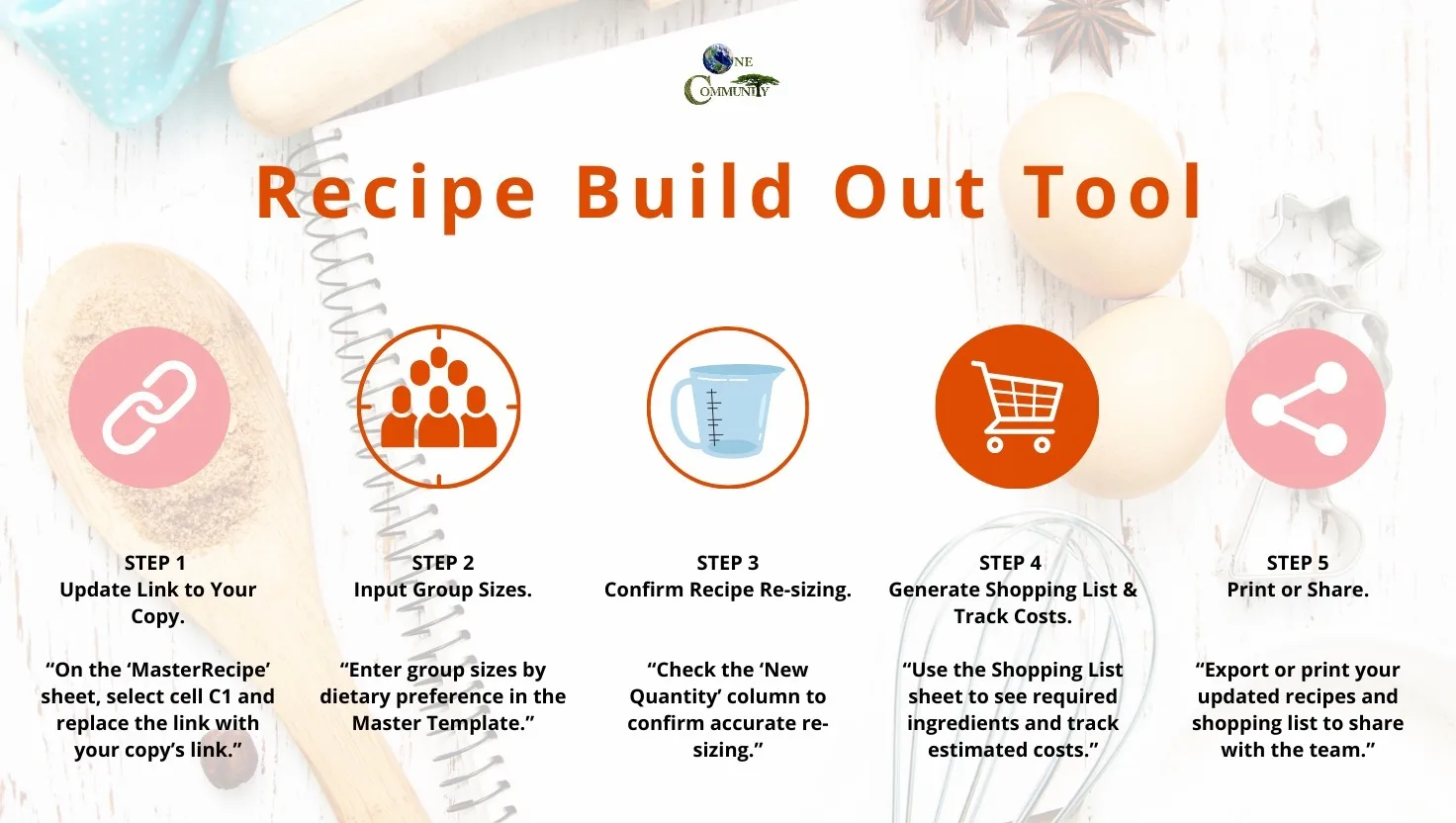
Recipe Build Out Tool summary – Click to visit the complete tutorial
Menus have been created and shared on the Recipe Build Out Tool for the primary “meals” that will be made for each two week period. The food bar recipes are meant to supplement these daily meals and offer staple nutrition as well as alternative basic options for people who may not choose to eat the primary recipe at a particular meal.
EXAMPLE
The “White Bean & Fennel Chili On Brown Rice” recipe already has rice as a grain and garbanzos as a legume in the recipe. In this case, you may look around your pantry and determine that you have an overabundance of another staple and decide to make it as a complementary item or dish. A good pairing for this may be to make something for the chili to go on top of, such as using corn flour to make tortillas, or baking potatoes or yams for the chili to go on. Alternatively, it may meet your group’s needs better to simply make extra plain rice and/or garbanzos to place on the bar so each person can use them at the proportions of their choosing and for those that may not like the spices in the chili recipe.
TWO WEEK SHOPPING LIST
Shopping for meals and food bars will be done on two week cycles for fresh food, and two month cycles for non-perishables. Food bar shopping lists should be updated regularly as items and amounts are adjusted to meet the needs of the community. See the fine-tuning section below for more information about how to adapt the food bar options.
VIDEOS COMING OF: WEEKLY GROCERY LIST CREATING, WEEKLY SHOPPING
SEE OUR HOW TO HELP AND/OR CROWDFUNDING CAMPAIGN PAGE TO HELP CREATE ALL THE TUTORIAL VIDEOS FASTER
FINE-TUNING THE FOOD BAR
The food bar is intended to be flexible and customized to the needs of your group. It is recommended that food options and amounts be fine tuned regularly based on consumption and suggestions. If you are running out of an item you may choose to increase the amount offered, or if another food is not being eaten it should be replaced with a different option. Food bars are designed so they can be adapted for a variety of dietary preferences in almost any situation. Additionally, the food bar is an ideal place to add treats for special occasions, or other expensive items that we may want to include on a limited basis.
VIDEOS COMING OF: WEEKLY GROCERY LIST CREATING, WEEKLY SHOPPING
SEE OUR HOW TO HELP AND/OR CROWDFUNDING CAMPAIGN PAGE TO HELP CREATE ALL THE TUTORIAL VIDEOS FASTER
FOOD BAR COST ANALYSIS
Our menus for preparing meals have been completed for the first two months, and can be viewed along with the shopping lists on our Recipe Build Out Tool. Initial estimate for food bar costs is about $2 per person per day. We estimate a total food cost of less than $10 per person per day for both the primary daily recipes and for the supplementary food bars.
RESOURCES
On the following pages, you can find more information about our open source food program:
- Highest Good Food
- Transition Kitchen Setup
- Food Self Sufficiency Transition Plan
- Sustainable Food Nutrition Calculations
- Food Procurement and Storage
- Recipe Build Out Tool
- Use this page (click here) if you have a resource you’d like to suggest be added here.
SUMMARY
In summary, the food bars are an integral part of One Community’s open source food program and enable us to create easy to make, sustainable, nutritious, and delicious recipes that everyone will love. The items included on the food bars will primarily be staples, such as fruits, vegetables, grains, legumes, and starchy vegetables. The food selection on the food bar “buffets” on a daily basis will be based on rotating seasonal and perishable staple items that will cover much of the daily dietary needs. The bars will also include items that are coming from our bulk food storage, such as grains like rice. There will be a rotation to vary the grains from day to day, while using the same grain for both lunch & dinner in the same day to cut down preparation time.
FREQUENTLY ANSWERED QUESTIONS
Q: How do you intend to deal with the packaging waste for the sauces included in the food bars?
We plan to buy in bulk initially, and eventually create our own recipes for a variety of sauces to minimize packaging waste.
Q: Can the food bars be customized to meet the needs of different communities?
Food bars are intended to be customizable, and adjusted to meet the preferences of your community over time. See the section on for more details.
Q: Is One Community going to be a vegetarian community?
The One Community team consists of vegans, vegetarians, and omnivores. In accordance with our philosophy for The Highest Good of All we are maintaining a non-idealogical approach to food choices. That said, also in accordance with this philosophy, we will only support and consume food items that are ethically and sustainably raised, managed, and produced. The consensus process will be used to decide the evolution of the One Community food plan.
Q: I'm vegetarian/vegan, would I have to participate in any part of the process or raising animals for food and/or eating/cooking them?
No, you would not have to participate in any aspect of One Community's food diversity that didn't agree with your personal beliefs and preferences.
Q: I'm an omnivore or vegan, what if I don't want to eat a vegan or omnivore diet?
The complete food self-sufficiency transition plan is designed to meet the needs of all dietary preferences through:
- Recipes that can be made vegan or omnivore:
- Vegan recipes were chosen that could easily have animal-based proteins added for omnivores
- Omnivore recipes were chosen that could easily be made with 100% vegan ingredients
- Food bars will be provided alongside the prepared meal to make adaptations available, giving community members the opportunity to eat better than 99.9% of the human population. The combination of a prepared meal and food bar will be like having a personal nutritionist and chef, serving the most diverse, nutritious, and fresh food possible
Q: How do you intend to produce spices, mill grain for flour, cooking oil, etc. etc.
To us, "100% food sustainability" means we will demonstrate and open source share a model that doesn't need external food sources. Having achieved this, what we produce internally versus choosing to buy will be decided through the consensus process.
Q: What is One Community's stance on pesticides, herbicides, and fungicides?
If it is not safe to eat, we will not be spraying it on our food. Here's a video we feel is helpful in understanding why:
Q: What if I want something that isn't on the community menu?
The community menu will be agreed upon through the consensus process. If a person wanted something not included on that menu, then they would be welcome to purchase and provide it for themselves.