One Community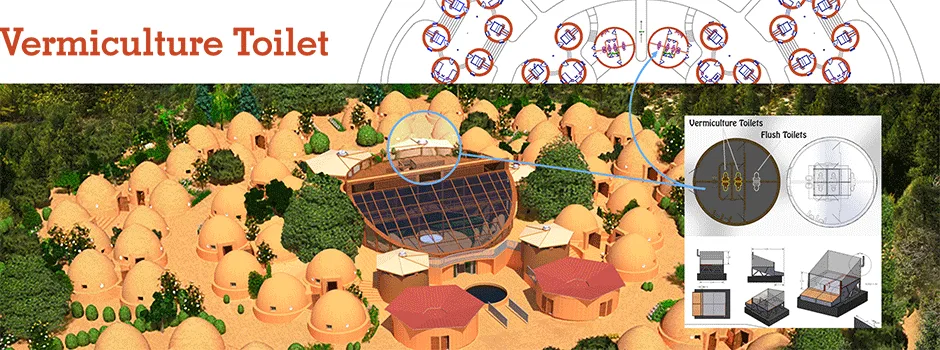
Vermiculture Eco-toilet Design Version One
This page presents the original design for the Vermiculture Eco-toilet Design. These designs were abandoned primarily because of concerns that the density of vermicompost would be so much that it wouldn’t slide down into the collection chamber. The new designs adopted a vertical drawer system that addresses this.
To read about the updated version and latest developments, please visit the Vermiculture Eco-toilet Design page. As part of the open source Earthbag Village (Pod 1), we will be building an open source project-launch blueprinting an ultra-eco vermiculture (worm composting) solid waste processing option. For county compliance, these Vermiculture Toilets also include a traditional toilet and septic option. This page discusses the original version of these designs with the following sections:
- What is a Vermiculture Eco-toilet
- Why Open Source a Vermiculture Eco-toilet
- Consultants for this Component
- Vermiculture Eco-toilet Design Details
- Main Chamber Engineering Details
- Vermiculture Eco-toilet Replication Details
- Resources
- Summary
- FAQ
NOTE: THIS PAGE IS NOT THE MOST CURRENT DESIGN. VISIT THIS PAGE FOR THE MOST CURRENT DESIGN DETAILS.
RELATED PAGES (click icons for complete pages)







CLICK THESE ICONS TO JOIN US THROUGH SOCIAL MEDIA


WHAT IS A VERMICULTURE ECO-TOILET
 “Vermiculture” is the process of using worms to decompose organic food waste or feces. With this process, the waste/feces is turned into a nutrient-rich residue called vermicompost. Vermicompost residue is an excellent fertilizer because it adds organisms that are beneficial to soil and plants because they further help break down organic materials and convert nutrients into a more available food form for plants. Vermiculture also improves soil aeration and increases its water-holding capacity. All of this leads to plants that grow stronger, bigger, and are more drought tolerant and disease resistance than those grown using less natural methods.
Built twice in the North half of the village, the vermiculture toilet designs we have created contain six toilets, two of which are traditional septic toilets and four that are vermiculture solid-waste processors. They are designed with the following goals/criteria:
- Demonstrate indoor worm composting as an option for repurposing human waste
- Include a traditional septic for people that want one and counties that need one
- Demonstrate the Earthbag Village as a duplicable village model capable of producing zero waste
- Make it all DIY replicable, cost effective, dependable, and easy to maintain
The picture below shows the Vermiculture Toilets, their location in relation to the flush toilets, and the central location of these structures within the Earthbag Village and just north of the Tropical Atrium.
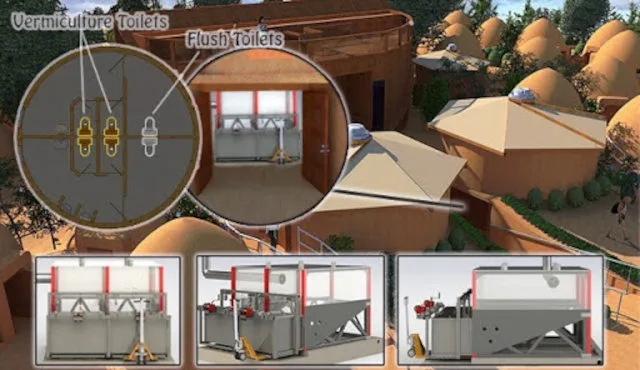
The One Community Earthbag Village Vermiculture Toilets | Concept Render ” View Looking Southwest
WHY OPEN SOURCE A
VERMICULTURE ECO-TOILET
Vermicomposting is a simple, effective, natural and sustainable method of processing food waste and feces. When food is sent down a garbage disposal, or when it is buried in a landfill, nature’s natural and beneficial recycling process is being bypassed. The traditional septic and municipal waste processing for handling feces also requires significant resources and wastes what could be a nutrient-rich (and more beneficial) alternative to synthetic fertilizers. Vermiculture is better for plants, better for the environment, and saves money and resources.
Open source project-launch blueprinting a solution like this supports our goals for positive and permanent global transformation and creating sustainable and self-replicating teacher/demonstration hubs. It is also directly in alignment with our Purpose and Mission, our Global-transformation Pledge, and Highest Good philosophy for open source creation, sharing, and making a difference in the world.
Here is the Work Breakdown for completion of the Vermiculture Toilet designs:

Vermiculture Bathroom | Work Breakdown Structure of Steps for Tutorial Completion – Click to Enlarge
WAYS TO CONTRIBUTE TO EVOLVING THIS SUSTAINABILITY COMPONENT WITH US
SUGGESTIONS | CONSULTING | MEMBERSHIP | OTHER OPTIONS
KEY CONSULTANTS TO THE EARTHBAG VILLAGE VERMICULTURE TOILET DESIGNS
Adil Zulfiquar: Engineer
Adolpho Maia: Mechanical Engineering Student
Ajay Adithiya Kumar Elancheliyan Tamilalagi: Mechanical Engineer
Anil Karathra: Mechanical Engineer
Betty Lenora: Earthbuilding Instructor and Author
Christian Ojeda: Mechatronic Engineer
Dijimba “Joss” Kabuyi Ilunga: Electrical Engineer
Douglas Simms Stenhouse: Architect and Water Color Artist
Erika Yumi Tamashiro: Architecture and Urban Design Student
Fernando Remolina: Industrial Engineer specializing in Project Management
Jorge Antonio Ricardo: Mechanical Engineering Student
Joseph Osayande: Mechanical Engineer
Karthik Pillai: Mechanical Engineer
Lin Xu: Mechanical Engineer
Malhar Y. Solanki: Mechanical Engineer
Manjiri Patil: Mechanical Design Engineer
Matheus Manfredini: Civil Engineering Student specializing in Urban Design
Rahul Kulkarni: Mechanical Engineer
Rishikhesh Chakrapani: Mechanical Engineer
Rizwan Syed: Mechanical Engineer
Victor Herber: Mechanical Engineer
Yagyansh Maheshwari: Mechanical Engineer
VERMICULTURE ECO-TOILET DESIGN DETAILS
 The basic idea of the Vermiculture Toilet is shown below with a receiving structure large enough, and filled with enough worms, to process all the solid human waste (feces) from 40 people. Worms process/eat their way from the bottom to the top as they follow the food source, leaving behind vermicompost. The main chamber is sloped towards the front so the vermicompost slides into removable chambers that can be moved and emptied using an electric pallet jack. Urine separating toilet seats and holes in the bottom of the sloped bottom of the receiving chamber remove liquids. Smells are addressed with venting, fans, and mixing in additional slow-release carbon-rich materials (such as wood chips and shavings) with more bioavailable carbon stores like leaves, grasses, etc. We’ll then use regular soil testing to determine if the resulting vermicompost is safe only for trees and non-food plants or also for food crops as other researchers (see the resources section) have shown is possible.
We discuss these details and more with the following sections:
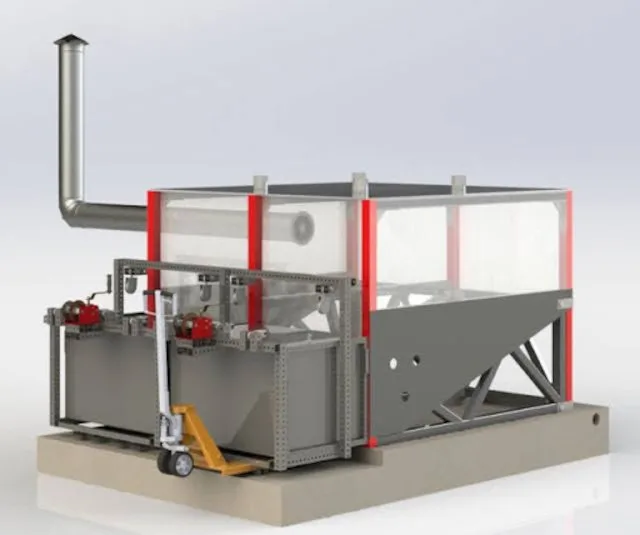
Vermiculture Updated Design (2.0)
DESIGN REQUIREMENTS
The Earthbag Village consists of 72 earthbag hotel-room-styled cabanas measuring 150-200 ft² (14-18.6 m²), plus 4 Communal Eco-shower domes, 2 Net-zero Water-Recycling Bathroom, 2 toilet domes with the Vermiculture Toilets described on this page, and the central Tropical Atrium. Total village capacity is 160 people.
If the vermiculture toilets are used exclusively, there will be 80 people using them. Based on our research, the average person produces approximately 0.556 lb (0.25 kg) of waste daily. So we will have a daily production of –
80 (people) * 0.55 lb (0.25 kg) * 1.1 (safety factor) = 48.5 lb (22 kg) per day
The goal is to process and use this waste in our agriculture system as fertilizer in order to achieve sustainability. There will be 4 vermiculture toilets, shown in yellow, contributing to this. There will also be two flush toilets, they are shown below in gray. In the future, flush toilets are to be eliminated in order to optimize the vermicomposting area, thereby utilizing vermiculture toilets exclusively. The vermiculture system is to be located directly underneath the toilets.

EMPTYING CHAMBER ENGINEERING DETAILS
The Emptying Chamber is the front part of the structure. It is responsible for storing the ready-to-use compost. Its total volume determines the processing rate because a full unit will require it to be emptied before more waste can be added. With this in mind, the design of the Emptying Chamber:
- Is large enough to allow the worms to fully digest the projected ongoing maximum waste volume
- Can be regularly and easily emptied once the worms have fully composted everything in it and to prevent overflow
Our original designs using a removable door are shown below. The steel front piece was made removable and the top would open with a hinge in order to shovel the ready compost to a separate emptying tray. This tray would be transported with an electric pallet jack. The upper frame is there to allow a metal piece to slide in between and hold all the waste in the Processing Chamber (above it) if needed for maintenance.

Vermiculture Design 1 | Emptying Chamber – Click to enlarge in a new tab
MAIN CHAMBER ENGINEERING DETAILS
The Vermiculture system has a steel and stainless steel frame as its main component. Here are the technical design details for this frame with all the component dimensions included. The frame parts are all bolted and/or welded together. We are working on design updates to eliminate all the welding.

Vermiculture Design 1 | Mainframe – Click to enlarge in a new tab
All other parts are fixed to the steel frame with bolts or welding, too. The back is the main/Processing Chamber, and the front is a removable Emptying Chamber. To address corrosion concerns, aluminum is used for the Emptying Chamber walls, and the main/Processing Chamber sloped bottom (with the drainage holes drilled in it). Acrylic is used for the sides, front, and back of the main chamber. Initial Emptying Chamber designs included a wooden top (shown below) that would open. In the latest designs, this has been replaced with an Emptying Chamber that is removable.

Vermiculture Design 1 – Exploded View
The worms will be added to the Emptying Chamber to start processing the incoming waste. Once that chamber gets full, the main/Processing Chamber will begin to be filled. When the worms are finished composting everything in the Emptying Chamber, they will move to the main chamber. This will leave only finished vermicompost behind. The Processing Chamber will then be emptied and the waste inside the main chamber will gravity feed (or be pushed) to fill the empty space created.
The venting system will be responsible for taking the smell out of the structure as well as the chamber.

Vermiculture Design 1 | Measurements – Click to enlarge in a new tab
METAL FRAME ENGINEERING
The vermiculture frame will weigh 1,257 lbs (570 kg) and hold 9 tons (8.2 metric tons) of compost. Utilizing the following equation, the Safety Factor is 2.4 (this would make the structural efficiency 14.65):
Safety Factor = Breakpoint / Normal Workload
The structure can process 818 lb (371 kg) of manure in 82 days. This gives it a 3.7 processing rate. Below we can see the detailed filling process of the structure when being used to maximum capacity. The structure can handle 460 days of filling when used as the only toilet for 40 people. It will take longer to fill if other toilets are available and/or less people are using it.

To test the frame’s ability to withstand maximum loading, the frame response was calculated using EFM routine in SolidWorks. All the members were treated like beams, and all the joints were calculated. What you see below is that it will support 9 tons (8.2 metric tons) that will sit on 5 beams (3 sides, 2 central).

Below, we can see the frame behavior when the structure is full.

The structure will only deform 0.05 in (1.3 mm) in the red areas, so leakage between the pieces attached to the frame will be minimal. Whatever leakage happens will also be caught by the drain below the system.

The lowest safety factor is 2.4 to plastic deformation.
ALUMINUM TRAY ENGINEERING
The aluminum tray bottom is responsible for holding and transmitting all the forces to the metal grid of the frame. It is made of aluminum 3/32 in (¼ cm) thick with 25/32 in (2 cm) holes drilled in it. The holes are there to drain any liquids out of the unit and down into the floor drain below. Draining excess liquids is important for the health of the worms.
The tray dimensions were calculated using the EFM routine in SolidWorks. It was divided into four pieces of equal size to simulate the contact with the grid and to simplify the calculation.

The stress and displacement results were better than expected, and the tray could be wider if we desired it. Here are the testing results:


ACRYLIC LOWER-SIDES ENGINEERING
The acrylic side parts will cover the frame and hold back the waste pressure from within. We chose acrylic because it is easy to buy and assemble, and because they are impermeable.
Initially, the waste could have had as high as 80% water mass. We used this as our worst-case scenario. Considering this, the pressure calculations were made assuming a column of water (P=pgh). The holes in the side are to allow access to the structure with a stick to move the compost in case it gets blocked. They will be covered with rubber stoppers that can be bought in any hardware store. Sides will be bolted to the frame for support and to eliminate leakage. Here’s a graphic showing the holes and stoppers.

Vermiculture Design 1 & 2 | Side Pieces – Click to enlarge in a new tab
Engineering was calculated using the EFM routine in SolidWorks. Because of the roof and ceiling slope, the height is constant along the structure, our pressure distribution will vary in the x and y planes and across these side parts. The pressure equation and its distribution can be seen below:

The stress and displacement results were as expected, and the 1.44 mm of displacement meets our requirements to avoid leaking between the tray and the side pieces. The graphics below show this:


ACRYLIC UPPER-SIDES AND FRONT ENGINEERING
The upper parts of the sides, plus the front and back, are also acrylic sheets. They are all attached to the frame using nuts and bolts. An L beam was added to the center of the structure for additional support.

The stress and displacement results for the upper-side pieces were as expected and can be sees in the graphics below:


Here are the details for the front piece:


Here are the details for the back piece:


VERMICULTURE ECO-TOILET REPLICATION DETAILS
This section will develop to include everything needed for replication and maintenance of the complete Vermiculture Eco-toilet Structure. Our goal is to simplify the process as much as possible by providing complete and easy to follow parts lists, cost analysis details, diagrams, assembly instructions and more. Wherever possible, we’ll also provide all information in the form of web tutorials, PDF and file downloads, as well as video tutorials.
Click the following links to jump directly to the related sections:
PARTS LIST
This section will list all the parts for replication of the complete Vermiculture Toilet unit. We will add these details once we’ve finished the updated design.
COST ANALYSIS
This section will list our initial cost projections for replication of the complete Vermiculture Toilet unit, and then be updated with actual costs once we have purchased and assembled our first unit. We’ll also include here the best materials sources once we’ve identified them.
Here is our cost analysis for Design 1:

Vermiculture Design 1 | Cost Analysis
Here is our initial cost analysis for the Design 2 Emptying Chamber. An updated cost analysis for all of Design 2 is coming and we expect it to be cheaper.

Design 2 Vermiculture Emptying Chamber Cost Analysis – Click to open the Google Spreadsheet with the most current data
DIAGRAMS
Design 2 for this structure is well on its way but we need help finishing it. Click HERE if you’d like to apply to join our all-volunteer team and help us complete these designs.
Below are some of the latest development images to share how the Vermiculture Bathroom has evolved. This image (also above) shows a general overview of the latest structure, where it is located in the North side of the Earthbag Village (Pod 1), and the main-floor layout that has remained consistent though the development process.
The One Community Earthbag Village Vermiculture Toilets | Concept Render ” View Looking Southwest
Here are additional views to help understand how the Main Chamber is accessed and where its placement is within the complete bathroom structure.

The One Community Earthbag Village Vermiculture Toilets | Concept Renders ” Section Views
For design 2, we are working to eliminate the need for welding by using square sign posts as our primary construction material. They cost around $40-50 each when purchased individually but those costs can be cut down significantly when ordering in bulk.

Square Sign Posts – Click Image for Bulk Ordering Options
Bolting everything together will allow us to more easily make changes and/or replace high-usage parts like the Emptying Chamber floor shown in green below. In a worst-case scenario of wanting to replace the entire design, we could also totally disassemble it and repurpose almost all of the parts.

Design 2 for the Vermiculture Assembly will Replace Welding with Nuts and Bolts
Here is how the Emptying Chamber has evolved. The original design had a chamber that needed to be opened and shoveled out. The new design is completely removable and easily movable using an electric-powered pallet jack. This has allowed us to make it larger and will significantly reduce time and labor. Pins are inserted on the bottom to secure the Emptying Chamber to the pallet jack for safe transport and emptying.

New Design for Removing and Emptying the Vermiculture Emptying Chamber
Here is an example of how the emptying chamber has evolved so it can be tipped for emptying it more easily. The details for securing the part that tips to the frame that is secured to the pallet jack for transport still need to be designed.

Vermiculture Emptying Chamber Crank and Pulley System for Easier Emptying
Here is the system for securing the emptying chambers tightly against the Main Chamber. After moving the chamber into position using the electric pallet jack, a ratchet strap applied where the green line is will allow a single person to do the final securing of the Emptying Chamber to the Main Chamber. This is important to reduce leakage and keep it in position during filling.

Securing the Vermiculture Emptying Chamber with a Ratchet Strap
If you’d like to apply to join our all-volunteer team and help us complete these designs, please learn about our volunteer requirements and fill out a volunteer application by clicking here.
RESOURCES
- One Community Resource: Most Sustainable Toilets Research
- Great open source vermiculture site: www.vermicompostingtoilets.net
- Happy D Ranch – Vermiculture Supply
- Commercial Scale Vermicomposting and Earthworm Husbandry
- Manual of On-Farm Vermicomposting
- Five Ways to Harvest Worm Castings
- Free PDF manual comprehensively covering vermiculture and vermicomposting
- Detailed studies on the effectiveness of vermicomposting of human waste
- A company that sells worm farm septic systems that even add greywater
- Here’s a site talking about how vermicomposting toilets don’t traumatize worms
- Open source urine separating toilet seat designs plans we’ll be implementing
- Flush vermiculture toilet working example | more info | completed: followup info
- Humanurehandbook.com featuring the Loveable Loo toilet anyone can set up
- Treehugger.com article: “The Hot Poop on Alternative Toilets”
- Article: “Which Worms Are Best For Composting?”
- Here’s a solar, evaporative, waterless human waste system: The E-Loo
SUMMARY
We went through several designs and even reverse-engineered a successful design before we came up with this one. Our design is inexpensive when compared to similar large-scale designs, easy to build, modifiable, and meets all of our requirements for the Earthbag Village.
FREQUENTLY ANSWERED QUESTIONS
Please see this section on the page about the updated version: Vermiculture Eco-toilet.
WAYS TO CONTRIBUTE TO THE EARTHBAG VILLAGE TOILET DESIGN
SUGGESTIONS | CONSULTING | MEMBERSHIP | OTHER OPTIONS