One Community
Highest Good Society
Highest Good society® is a social construct for cooperation, collaboration, and positive global change. The foundations of this are both social and emotional and this page links to the open source components most important to establishing this. The sections of this page are:
- What is a Highest Good Society
- Why a Highest Good Society
- Ways to contribute
- The Highest Good Society Open Source Portal (Collaborative resource and information hub)
- Highest Good Society Details
- Highest Good Society Rollout Details
- Summary
- FAQ
HIGHEST GOOD SOCIETY® SEARCH ENGINE
WHAT IS A HIGHEST GOOD SOCIETY®
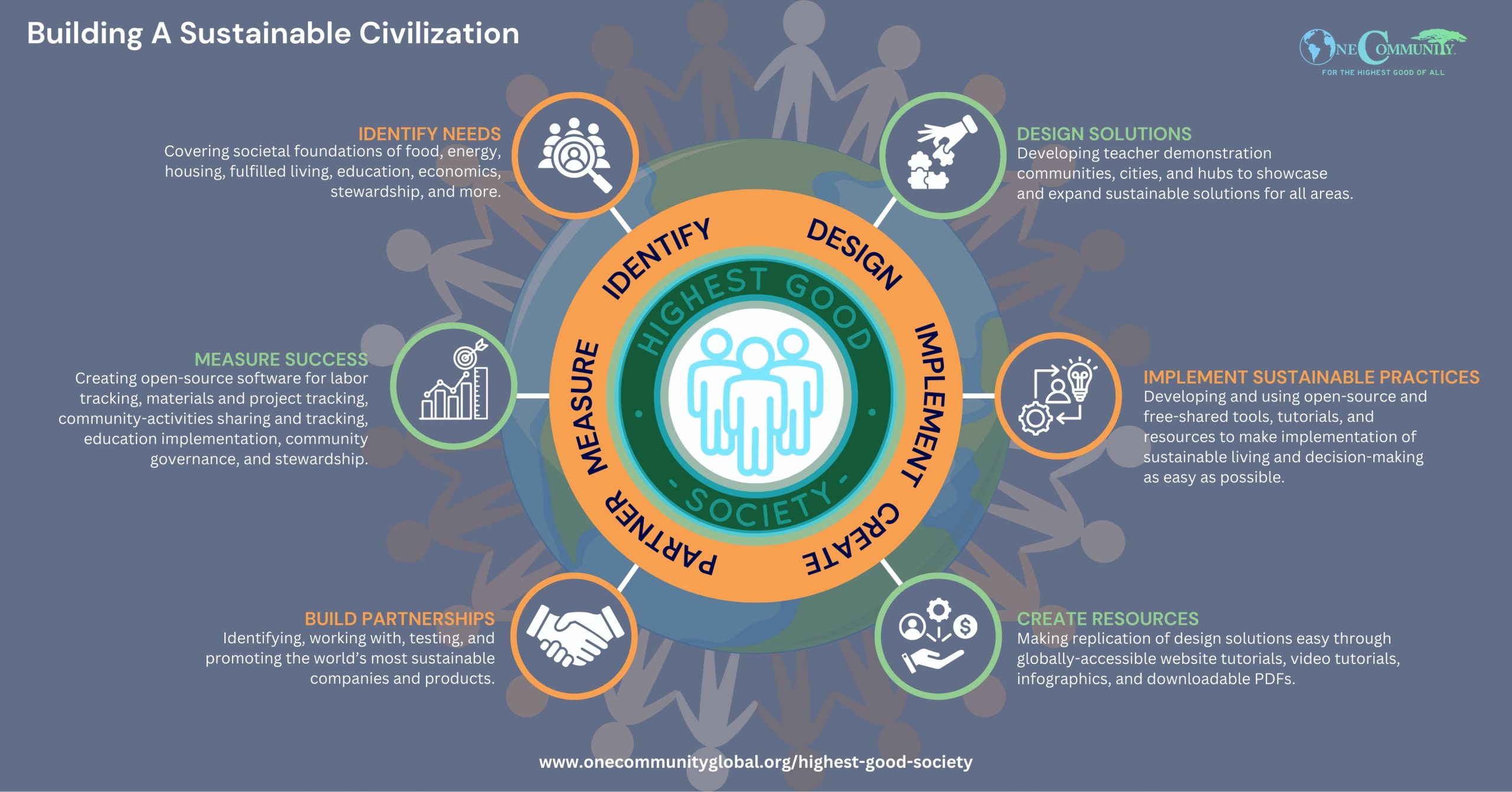
 One Community’s definition of Highest Good society is the combination of all of the elements we consider foundational to supporting people living for The Highest Good of All. It is a social architecture built on three things: helping each other and others, fulfilled living and emotional sustainability, and making a difference in the world by setting an example. Its purpose is forward global movement of self-propagating teacher/demonstration communities, villages, and cities (we’re starting with the Earthbag Village and Duplicable City Center) by specifically catering to the 6-foundational emotional needs with duplicable components that address the foundations of education, social injustice and inequality, crime, economics and poverty, discrimination, emotional health, and happiness.
Click to Enlarge

Highest Good Society Overview – Click to Enlarge in a New Window
WHY A HIGHEST GOOD SOCIETY®
We think philanthropy and humanitarianism for purely altruistic reasons isn’t working sufficiently. Our approach to addressing this is creating a social model that provides specific benefits most people want while simultaneously and comprehensively addressing the most pressing problems humanity is currently struggling with. By coupling solutions to these problems with what most people will consider a significantly better way of living, we create a model that pinpoints the very roots of our socio-economic challenges while teaching others how to address these challenges too. In this way, Highest Good society provides the global value and individual value necessary to build the wide-spread mainstream support (including financial involvement) capable of positive and permanent transformation on a global scale.
WAYS TO CONTRIBUTE TO EVOLVING THIS SUSTAINABILITY COMPONENT WITH US
SUGGESTIONS | CONSULTING | MEMBERSHIP | OTHER OPTIONS
CLICK THESE ICONS TO JOIN US THROUGH SOCIAL MEDIA


HIGHEST GOOD SOCIETY® OPEN SOURCE PORTAL
 Highest Good society is a comprehensive approach to living and creating for The Highest Good of All. Open source and free-sharing the components of Highest Good society is purposed to provide what is necessary for people to create a more fulfilling, enriching, and fun way of living that helps them while they help others. We see this as essential for spreading self-sufficient and self-propagating teacher/demonstration communities, villages, and cities to be built around the world. The initial Highest Good society areas One Community is focused on open source sharing include:



HIGHEST GOOD SOCIETY® DETAILS
 Highest Good society is at its core a model for showing people how to live happier, more abundant, and more positively impactful lives through cooperation and collaboration. One Community is open source project launch-blueprinting all elements of the Highest Good society model for individual implementation while demonstrating how combining them together will:
- Lower individual and group costs
- Reduce waste in all areas of living
- Provide more recreating and free-time
- Provide a learning and growth environment for all ages
- Provide more access to recreation and relaxation activities
- Provide more access to technology and other tangible resources
- Specifically fulfills all six of people’s foundational emotional needs
Maintaining the success and function of all of these elements will be made possible through a community contribution model. Specifically, 35 weekly hours for each person is dedicated to everything that keeps One Community functioning and fulfilling our global change methodology and 5 hours for each person is contributed to support hosting social contribution to an architecture of enriching personal growth, recreation, and interaction. Participation in hosting and attending these events is optional and people can instead choose to contribute their 5 “social hosting hours” as regular community contribution if that is their preference.
CLICK HERE FOR THE COMMUNITY CONTRIBUTION TIME ALLOCATION OUTLINE
Click to Enlarge

STRUCTURING SOCIAL CONTRIBUTION
Because Highest Good society is about living and sharing happier, more abundant, and more positively impactful lives through cooperation and collaboration, the element of Highest Good society that is a social architecture of enriching personal growth, recreation, and socialization is structured around participation. For a hosted event to qualify as social contribution, it will be available to the entire community (and the public once we are hosting) with at least 5% of the community (or visitors) expressing interest and committed to participate.
If less than 5% of participation for 2 events in any one period of monitoring is achieved, the activity ceases to be an option and is replaced by something different. Events times are organized by the host with the structure of the model requiring participation for continued event existence, keeping both the host and the participants accountable for the maintenance of activities.
Hosted activities that count as social contribution include: classes of any kind, exercise, meditation, spiritual or any other open gathering, reading groups, game groups, music and entertainment of any kind, and anything else open to the participation of the entire community with 5% or more people consistently involved.
Participation in all aspects of the social model is voluntary. The ideas for new activities, changes to activities, and the social structure as a whole are discussed and evolved through the consensus process. Activities are posted so everyone knows what is available and sign-in sheets are used to monitor attendance. Changes are made by the host and any activity that has been removed from the schedule due to non-participation can be re-added with a one-time commitment and participation of at least 10% of the community, then ongoing participation of at least 5%.
If a social activity is cancelled due to non-attendance, the host either gathers support and hosts a new activity or uses the available hours to help where it is needed in the community. The same applies if a person chooses not to contribute to hosting classes for the social contribution structure – unused hours are filled with other community contribution aspects of the individual’s choosing.

HIGHEST GOOD SOCIETY® ROLLOUT DETAILS
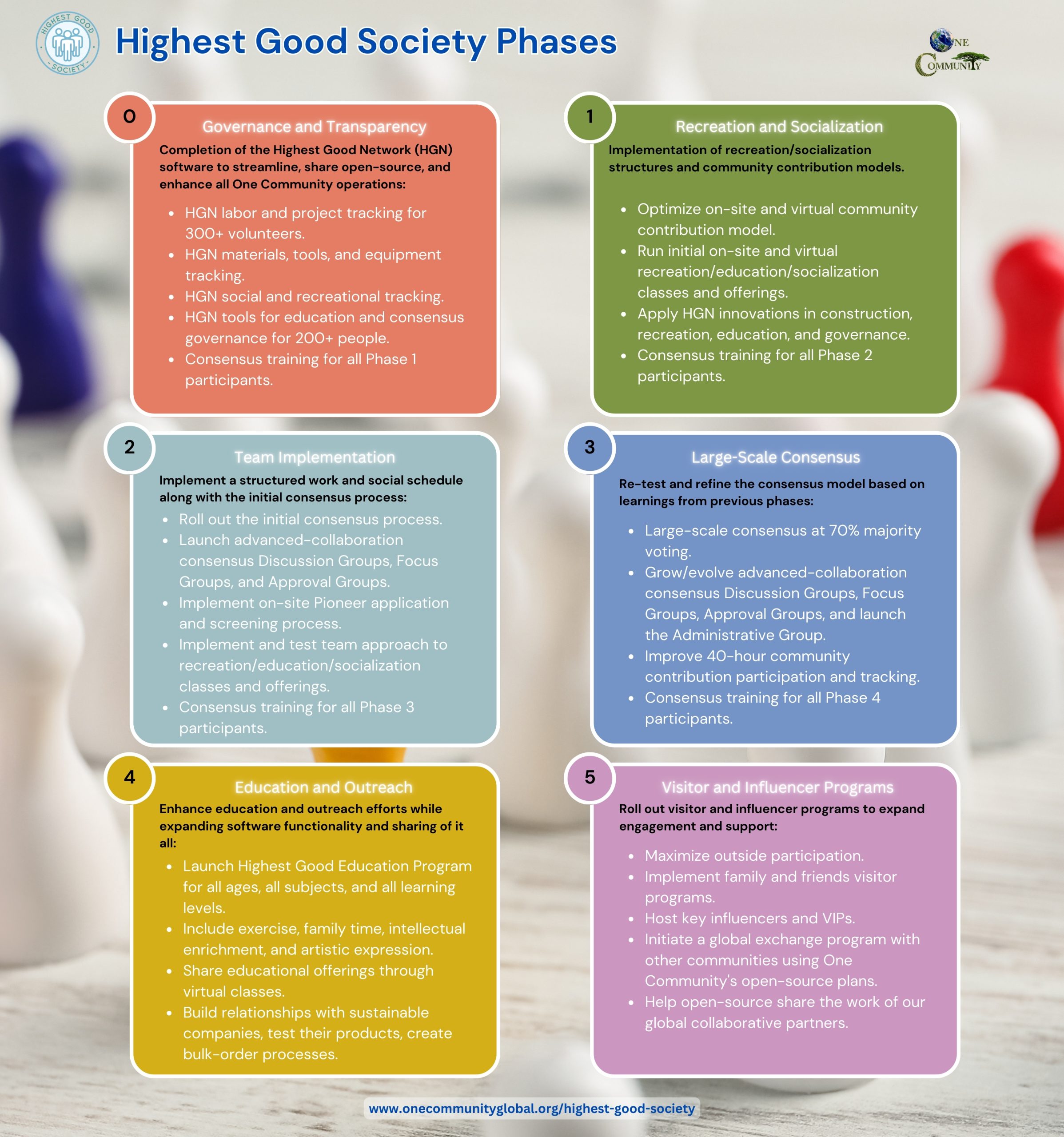
Building the social architecture of a community is different from building its infrastructure. There is nothing to order and no delivery to wait for. What takes time is people learning to work together, and a group of ten does that differently than a group of two hundred. What follows is the specific plan for rolling out One Community’s Highest Good society model, starting with the initial survey team of 3-10 people through our first 400.
As part of our open source goals, this rollout is described in detail to help those interested in replication. Additional details will be added as we complete them and can add our experience. We discuss the complete Highest Good society implementation plan with the following sections:
- Step 1: Initial Survey Team: Society for 3-10 People
- Step 2: Landing Party: Society for 10-20 People
- Step 3: Society for 20-50 People
- Step 4: Society for 50-100 People
- Step 5: The First Five Years: Society for 100-400 People
As part of planning this rollout along with all the other rollout areas, we have estimated how long it will take. The full Highest Good society rollout is estimated at about 36 months of implementation and refinement. Timing for each step is shown in relative months, where Month 1 is the first month on the property, so the plan stays accurate no matter when we land. Every estimate comes from a published One Community process or a working estimate, and each one is listed on the Sources tab of the spreadsheet. Click the donut below to see how the full rollout splits across the five steps.
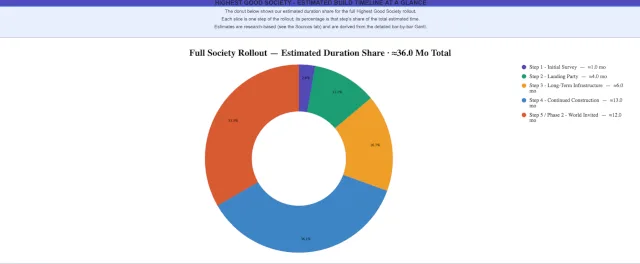
Full Highest Good Society Rollout Estimated Duration Share – Click for spreadsheet that includes sources
All estimates and their sources are listed on the Sources tab of the same spreadsheet.
The chart below shows the entire plan in one view. Each colored bar is one action item and its width is the estimated duration. For example, the long bar running through the middle of Step 3 is the large-scale consensus re-test, the single item that most affects how quickly the community can grow. For readable details, click the image and use the step-by-step charts in each section to expand the specifics.
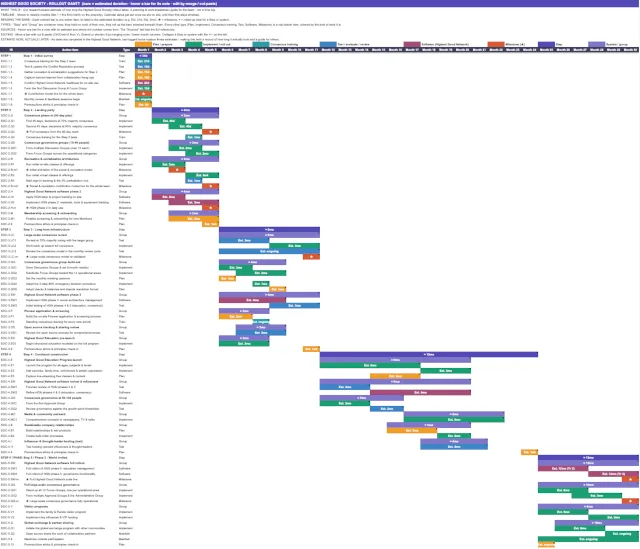
Full Highest Good Society Rollout Gantt – Click for spreadsheet that includes sources
STEP 1: INITIAL SURVEY TEAM: SOCIETY FOR 3-10 PEOPLE
The Initial Survey Team moving onto the property is small enough that everyone can sit in one room and decide things together. The social work in this step is about putting the practices in place before the team grows past that point. This onsite team will test and update the conflict resolution process, form the first Discussion Group and Focus Group, and put the community contribution model into use from the very first month. A remote team will coordinate the off-site training of the incoming Step 2 group in consensus.
3-10 PEOPLE SOCIETY-IMPLEMENTATION ACTION ITEMS
The action items for this stage of the Highest Good society rollout are as follows:
- Complete consensus training for the incoming Step 2 team
- Test and update the conflict resolution process
- Gather recreation and socialization suggestions for Step 2
- Capture lessons learned from collaboration hang-ups
- Confirm the Highest Good Network software is ready for on-site use
- Form the first Discussion Group and Focus Group
- Begin the in-person monthly review and feedback sessions
- Check in with Permaculture Design ethics and principles
3-10 PEOPLE TIMELINE SPECIFICS
Step 1 is about one month long, and nothing in it waits on anything else. Every item runs inside that first month, which is only possible because the group is small enough to decide things without any formal structure in place. The item worth noticing is the community contribution model, which is live from month one. Everyone is contributing their hours before the team has finished arriving. Click the image below and you will see every item in the step sitting inside the same single month column.

Step 1 Rollout Timeline – Click for spreadsheet that includes sources
The donut below shows the same step as a share of work rather than a timeline.
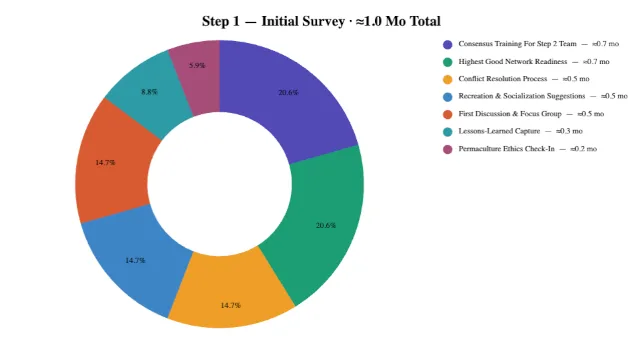
Step 1 Estimated Duration Share – Click for spreadsheet that includes sources
STEP 2: LANDING PARTY: SOCIETY FOR 10-20 PEOPLE
The Landing Party is the first group large enough that decisions can no longer just be talked through by everyone at once. This step phases consensus in over the first 90 days, organizes multiple Discussion and Focus Groups for the first time, brings the social and recreation model to life, and puts the Highest Good Network software to work tracking labor, projects, materials, and equipment.
10-20 PEOPLE SOCIETY-IMPLEMENTATION ACTION ITEMS
The action items for this stage of the Highest Good society rollout are as follows:
- Run the 90-day consensus phase-in, moving from 70% to 85% majority and then to full consensus
- Complete consensus training for the incoming Step 3 team
- Form multiple Discussion Groups, each capped at 12 people
- Form Focus Groups across the operational categories
- Run the initial on-site and virtual classes and offerings
- Start sign-in tracking and apply the 5% participation rule
- Apply Highest Good Network labor and project tracking on site
- Implement Highest Good Network phase 2 for materials, tools, and equipment tracking
- Finalize screening and onboarding for new Members
- Check in with Permaculture Design ethics and principles
10-20 PEOPLE TIMELINE SPECIFICS
Step 2 is estimated at about four months, and the 90-day consensus phase-in sets the pace for everything else in it. Decisions run at 70% majority for the first 45 days, move to 85% for the second 45 days, and reach full consensus at the 90-day mark. None of that is a lead time in the usual sense. It is the time a group needs to build enough trust in the consensus process to give every person a veto. The social and recreation model, the membership screening, and the software work all run alongside it rather than after it.
Click the image below and follow the two 45-day bars at the top of the step to see how the rest of the work lines up against them.
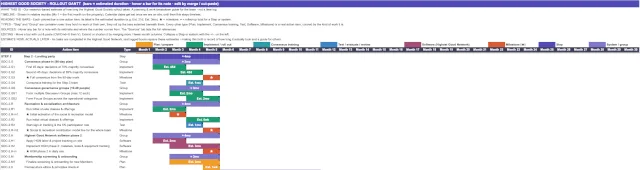
Step 2 Rollout Timeline – Click for spreadsheet that includes sources
The donut below shows how those four months divide across the consensus, social, software, and membership work.
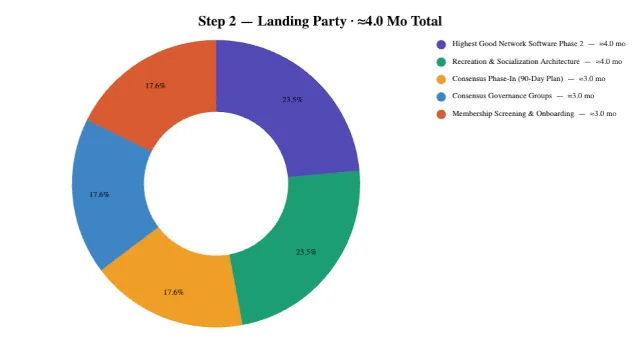
Step 2 Estimated Duration Share – Click for spreadsheet that includes sources
STEP 3: SOCIETY FOR 20-50 PEOPLE
The rest of the Pioneer Team moves onto the property, more than doubling the size of the community. This is where the consensus model gets deliberately stress-tested at the larger size rather than assumed to carry over. Alongside that, the governance groups build out toward the twelve operational areas of large-scale consensus, the open sourcing process gets a full review, and an informal version of the Highest Good education component begins for the children arriving with the team.
20-50 PEOPLE SOCIETY-IMPLEMENTATION ACTION ITEMS
The action items for this stage of the Highest Good society rollout are as follows:
- Re-test decision making at 70% majority voting with the larger group, then work back up toward full consensus
- Review the consensus model as part of the monthly review cycle
- Grow the Discussion Groups and set the 6-month rotation
- Subdivide the Focus Groups toward the twelve operational areas
- Set the monthly meeting cadence for each group type
- Adopt the two-step 80% emergency decision procedure
- Adopt the checks and balances and dispute resolution format
- Implement Highest Good Network phase 3 for social architecture management
- Begin initial testing of Highest Good Network phases 4 and 5
- Build the on-site Pioneer application and screening process
- Run standing consensus training for every new arrival
- Review the open source process for comprehensiveness
- Begin structured education modeled on the full Highest Good education program
- Check in with Permaculture Design ethics and principles
20-50 PEOPLE TIMELINE SPECIFICS
Step 3 is estimated at about six months, and one item accounts for the whole span. Having proven the consensus model at the smaller size, the group deliberately restarts at 70% majority with the larger team and works back up to full consensus. That is not a repeat of the Step 2 phase-in. It is a second pass at a size where the earlier result cannot simply be assumed to hold. If any single estimate on this page is worth watching, it is this one, because it depends on people rather than on equipment arriving.
Click the image below and follow the long bar running from month six through month eleven to see how everything else in the step fits underneath it.
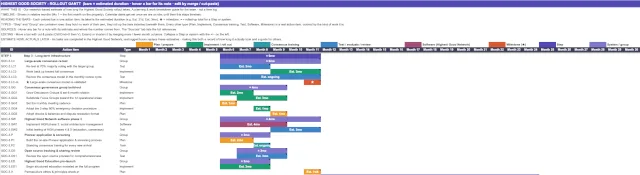
Step 3 Rollout Timeline – Click for spreadsheet that includes sources
The donut below shows the same step by share of work, which makes it obvious how much the consensus re-test dominates.
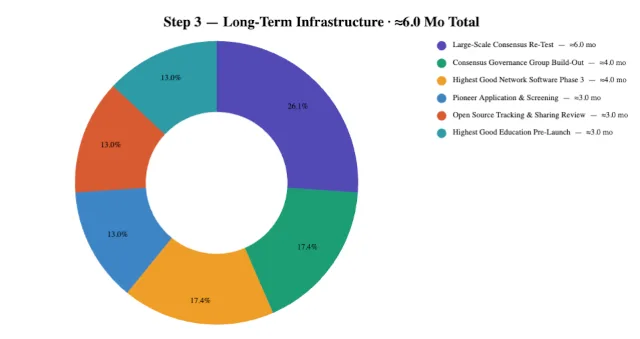
Step 3 Estimated Duration Share – Click for spreadsheet that includes sources
STEP 4: SOCIETY FOR 50-100 PEOPLE
Construction is in full swing and the community is now large enough to need its first Approval Group. The Highest Good Education program launches properly for all ages, subjects, and learning levels. The Highest Good Network software gets a forensic review of the phases already in daily use. One Community also begins comprehensive outreach to newspapers, television, and radio, using the open source work completed so far as the story.
50-100 PEOPLE SOCIETY-IMPLEMENTATION ACTION ITEMS
The action items for this stage of the Highest Good society rollout are as follows:
- Launch the Highest Good education program for all ages, subjects, and learning levels
- Add exercise, family time, enrichment, and artistic expression to the program
- Explore live-streaming free classes and content
- Complete a forensic review of Highest Good Network phases 2 and 3
- Refine Highest Good Network phases 4 and 5
- Form the first Approval Group
- Review governance against the growth-point thresholds
- Run comprehensive outreach to newspapers, TV, and radio
- Build relationships with sustainable companies and test their products
- Create bulk-order processes
- Test hosting relevant influencers and thought leaders
- Check in with Permaculture Design ethics and principles
50-100 PEOPLE TIMELINE SPECIFICS
Step 4 is the longest step at about thirteen months, and unusually for this page, no single item drives it. The Highest Good education program launch and the Highest Good Network software review each run about nine months, the media outreach runs about six, and they overlap rather than queue up behind each other. What makes this step long is breadth rather than any one dependency. Click the image below, then use the minus signs on the left of the spreadsheet to collapse the groups, which lets you compare the education launch against the software work at a glance.
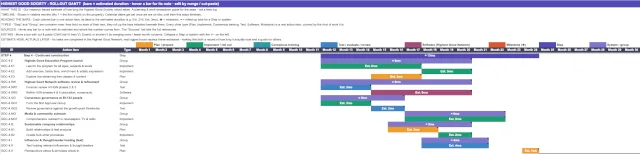
Step 4 Rollout Timeline – Click for spreadsheet that includes sources
The donut below shows how those thirteen months split across education, software, governance, and outreach.
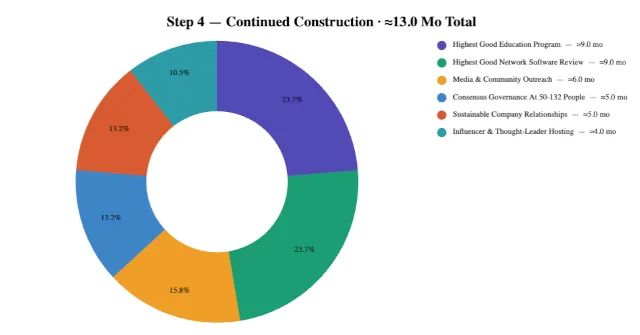
Step 4 Estimated Duration Share – Click for spreadsheet that includes sources
STEP 5: THE FIRST FIVE YEARS – SOCIETY FOR 100-400 PEOPLE
This step opens the community to the world. All twelve Focus Groups are implemented, multiple Approval Groups form alongside the single 12-member Administrative Group, and the full Highest Good Network suite will be live. The visitor programs open to family, friends, and invited guests, and the global exchange program begins with other communities using One Community’s open source work.
100-400 PEOPLE SOCIETY-IMPLEMENTATION ACTION ITEMS
The action items for this stage of the Highest Good society rollout are as follows:
- Complete the full rollout of Highest Good Network phase 4 for education management
- Complete the full rollout of Highest Good Network phase 5 for governance functionality
- Implement all twelve Focus Groups, one per operational area
- Form multiple Approval Groups and the Administrative Group
- Implement the family and friends visitor program
- Implement key influencer and VIP hosting
- Initiate the global exchange program with other communities
- Open source share the work of collaborative partners
- Maximize outside participation
- Check in with Permaculture Design ethics and principles
100-400 PEOPLE TIMELINE SPECIFICS
Step 5 runs for years rather than months. The full Highest Good Network rollout and full large-scale consensus governance are the two anchors, with the visitor programs and the global exchange running alongside them. One thing to know before reading this chart: the grid stops at month thirty, so the bars in this step are cut short by the edge of the chart while their labels are not. Read the labels rather than the bar ends. Click the image below and check the year notes on the software bars, which show the real spans running into years two and three.
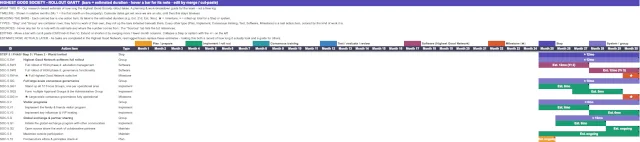
Step 5 Rollout Timeline – Click for spreadsheet that includes sources
The donut below shows how the ongoing work in this step divides up.
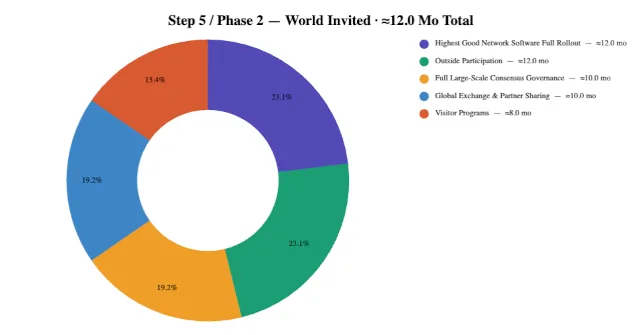
Step 5 Estimated Duration Share – Click for spreadsheet that includes sources
Everything above is an estimate. As the work actually happens, the hours logged in the Highest Good Network software will replace these numbers, which makes this both a record of how long it really took and a guide for anyone building the same thing somewhere else.
SUMMARY
Highest Good society is a model for cooperative and collaborative living for The Highest Good of All. It addresses the very roots of our species’ socio-economic challenges while teaching others how to address these challenges too. By coupling solutions to global problems with what most people will consider a significantly better way of living, we create the necessary global value and individual value needed to build the wide-spread mainstream support (including financial involvement) capable of positive and permanent transformation on a global scale.
FREQUENTLY ANSWERED QUESTIONS
Q: I thought you were 100% open source, why is “Highest Good Society” a registered trademark?
To understand this, please read our Copyrights, Trademarks, Patents and Using them to Support Open Source and Free-sharing page.
Q: Is this a religious or spiritual philosophy?
No. It is a non-ideological approach to cooperative and collaborative living. One Community’s spiritual philosophy is also non-denominational and non-ideological. (click here to read about it)
Q: Do you consider this concept of Highest Good society as the best or only way to live?
No, our philosophy for The Highest Good of All is non-ideological and this applies to Highest Good society also. We are offering this structure and its components as an option for those who’d like to increase cooperation and collaboration in their lives in a way that benefits others too. The Highest Good society model is foundational to our organization and our global transformation approach because we believe the specific individual benefits Highest Good society provides will encourage application and implementation into the self-replicating teacher/demonstration community, village, and city model. How others choose to use any and all components of One Community, however, is the choice of those individuals and groups.
Q: I want to join One Community but I don’t agree with some of the outlined concepts of your Highest Good society approach. What does this mean for me?
We understand that preferred living models and structures will differ greatly between different people and values systems. For this reason, we strive for transparency in all policies and/or procedures that we believe may affect a person’s decision to join One Community so that only people who truly feel One Community is a good fit for them will choose to join us.
Consider joining us as a Satellite Member (click here for the Invitation Form), consultant or partner (click here for the Consultant’s/Partner’s Page), and/or just follow our progress. We expect other communities will follow (we’re open source, you could start one!) with different views on these issues and we will happily be promoting their success also if they are part of the open source and free-sharing network of teacher/demonstration communities, villages, and cities that we are helping to create. Here are the best ways to follow our progress:
Also, the point of One Community is to build living blueprints open source so everyone can then use them for duplication. If you feel like you’d like to see a different version of One Community, we invite you to embrace the task of working with us and using everything we’ve already created to form another iteration of this idea, with a new set of rules, and attract to this idea the people who share your values and thus like your rule sets. In so doing, providing another for The Highest Good of All option with potentially a totally different approach.
Q: Does the “5% of the community (or visitors)” mean social architecture minimum participation needs will fluctuate with the number of visitors?
No. The 5% is based on the number of permanent residents only. If visitor participation plus One Community member combined equals 5% of the permanent population, then the activity will count as social contribution.
Q: What sets One Community apart from similar projects?
One Community's open source project-launch blueprinting strategy and the fact that we are open sourcing and addressing ALL elements of society simultaneously are a combination unique to our organization. Together, these will help others duplicate what we do and create self-propagating teacher/demonstration communities, villages, and cities capable of positively impacting every single person on this planet within one generation.
Q: What sets One Community's open source goals apart from similar projects?
To our knowledge, no other project exists that is providing the comprehensive nature and detail of everything we are open source project-launch blueprinting.
Q: What is the specific One Community short-term goal?
- Become a world leader in global-solution information content within 6 months of moving onto the property as detailed in our open source project-launch blueprinting page.
- Expand within 5 years to a community of 200 full-time residents producing ongoing tools, resources, and tutorials while hosting thousands of annual visitors as outlined in our long-term vision page.
- Define the global-solution industry itself as an open source industry, expanding mainstream awareness, appeal, and desire for comprehensive sustainability by demonstrating and sharing a more attractive and fulfilling way of living that people can have if they desire to create it also.
- Teach as many people as possible to duplicate and/or evolve our global transformation model.
Q: What is the ultimate One Community long-term goal?
To transform our world into a sustainable and happier one through teacher/demonstration communities, villages, and cities to be built all over the world. We will work with these hubs as our open source partners and fellow leaders of the open source, Highest Good of All, and sustainable planet movement leading to a New Golden Age of cooperation, collaboration, innovation, creativity, sustainable living, and increased happiness for the entire human organism.
Q: How are you funding One Community?
We are still seeking funding. Please see our Funding Related Details Page.
Q: Where will One Community be located and why?
Click HERE for property details that include why we have chosen the location we have.
Q: How far is One Community in the creation process?
Visit our progress page for a regularly updated list of our accomplishments and progress. Visit our blog for our on-going mini-updates and weekly summaries of accomplishments and progress.
Q: Why not just build a small-scale prototype home or community that includes a minimum-scale revenue-generating demonstration/operation? Wouldn't this get things going faster?
This small-scale operation already exists as Airbnb. What we see as missing is a complete model for self-sufficiency that is open source and reasonably replicable. Even complete models for self-sufficiency already exist in the form of the many eco-villages out there. What none of those offer though is any sort of understanding and/or path for how average people can replicate them. We also think there isn't enough of a compelling reason for most people to bother with changing how they live now to engage such a path/project, so our project is purposed to provide and demonstrate that too.
From a total global-change perspective though, we think it is even more important to create a permanent example:
- Dedicated to open source
- Capable of providing for the complete needs of hundreds of people.
- Providing the support needed so residents can work together on open source creation full-time.
- Revenue generation and space for expansion to grow to over a 1000+ full-time resident-volunteers.
- Able to support the establishment of other open source teacher/demonstration/R&D hubs around the world.
This is why the intended property, village models, social architecture and economic focuses are all big. To support faster and broader implementation, we are also developing everything so it is modular and implementable as individual components. This will allow for anyone who doesn't desire the full teacher/demonstration hub approach to have options too, but our primary goal is to demonstrate the complete teacher/demonstration hub as easy enough, affordable enough, and attractive enough for average people with average means to want to replicate it and/or use what we provide to build their own version.
Q: If you are giving everything away through open source, how do you intend to make money?
Our model is designed to prosper specifically because we are giving everything away through open source project-launch blueprinting. We accomplish this through eco-tourism marketed with the open source infrastructure we have already created and other supported revenue streams outlined on our revenue streams page. All of this further promotes our model of spreading sustainability and actively promoting and distributing even more open source blueprints for duplication by as many people as possible.
Q: How will this help people in Third World countries and other areas that need resources most?
Using the four-phase strategy above, we wish to demonstrate building a teacher/demonstration community, village, and/or city as profitable for large investors and/or a way for small groups of people to pool what resources they have and get out of debt. We see this spreading and bringing resources to the areas that need them most because building these villages in these areas will be more affordable and easier to do with less building restrictions.
Q: How do you stop the model from being totally capitalized without the positive intent of the original model?
We are not focused on putting limitations on the use of everything we are creating because of our open source commitment. We will, however, directly support any organization contributing specifically to open source project-launch blueprinting and operating for The Highest Good of All.
Q: Where would I find a more detailed description of how this works?
Please visit our About Us page, Methodology page, and Site Map for more comprehensive descriptions and links to complete details for every aspect of One Community.
Q: What about safety?
We consider a community of 500 people with shared goals and vision more safe than current living models. We think even a group of 50 people working together can handle any reasonable challenge.
Click Image for One Community’s Purpose, Values, and Mission Page